Get Full Government Meeting Transcripts, Videos, & Alerts Forever!
Get email alerts on the Transportation System Plan North Sweet Home topic
No spam. Unsubscribe anytime.
Sweet Home council hears North Sweet Home area plan and transportation system plan update; funding shortfall highlighted
Summary
Consultant Garth Appenitis presented draft land‑use alternatives and a long list of transportation projects for the North Sweet Home area and citywide Transportation System Plan, while councilors focused questions on funding options, a problematic Pleasant Valley–Main Street intersection and a private railroad trestle.
Garth Appenitis, a transportation engineer with DKS Associates, briefed the Sweet Home City Council at a joint work session on the citywide Transportation System Plan update and the North Sweet Home area plan (NSHA), describing draft land‑use alternatives and a prioritized list of transportation projects.
The presentation, given during a recorded work session, laid out three land‑use alternatives for the NSHA, emphasized the need for a new east–west collector to improve internal connectivity, and identified dozens of multimodal projects across the city. Appenitis told the council that the city’s currently available, recurring revenues would produce a financially constrained project list of about $3,000,000 over a 20‑year planning horizon while total identified needs could reach “somewhere in the $75 million to $150 million” range depending on growth and prioritization.
Why this matters: the Transportation System Plan (TSP) serves as the city’s long‑range transportation element of the comprehensive plan. Projects listed in the TSP are typically required or expected for many state, regional and federal grants; without plan inclusion, Appenitis said, projects are less likely to be eligible for funding.
Most important details
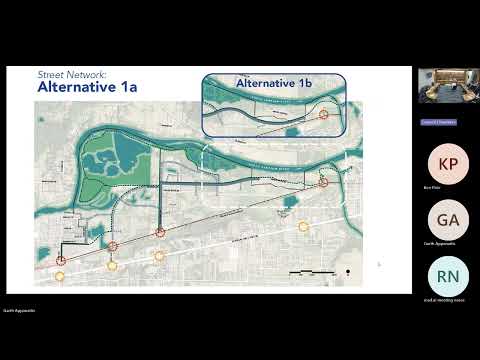
Appenitis described three NSHA alternatives that mix employment, residential and commercial/hospitality uses; one alternative depicts a commercial node near what he referred to as “20 Fourth Avenue,” with employment uses focused to the east and residential to the north. He said the area plan and the TSP overlap and must be coordinated because new development in the North Sweet Home area will affect citywide traffic and utility needs.
From a transportation perspective the consultant emphasized an East–West collector so users need not travel south to Main Street and cross the railroad twice: “One of the really key integral parts of the transportation system for North Sweet Home area is to provide East West connectivity and a new East West collector,” Appenitis said. He also flagged multiple rail crossings that are aging and identified Pleasant Valley at Main Street as the location that currently “does not meet the mobility standards.”
Funding realities and options
Appenitis summarized likely long‑term revenue streams: the state gas tax (he estimated roughly three‑quarters of a million dollars over 20 years for Sweet Home), the city’s transportation system development charge (SDC) — budgeted at about $128,000 per year and extrapolated to roughly $2.4 million over 20 years under current growth assumptions, but potentially up to roughly $10 million if North Sweet Home developed more intensely — and grants. He called a conservative financially constrained capital estimate of about $3,000,000 over 20 years based on existing revenue.
He outlined additional revenue tools other Oregon cities use: a voter‑approved local gas tax (examples cited at about 1¢–10¢ per gallon, with 3¢ common in some places), a monthly street utility or maintenance fee (often $5–$10 per household per month), local bonds and urban renewal. Appenitis noted voter approval is required for a local gas tax and that a street utility fee is typically implemented by the council and often appears as a line item on utility bills.
Council discussion and related constraints
Councilors and staff pressed on priorities and implementation. Several councilors favored the more flexible alternative (referred to during the meeting as option 3) that included mixed uses and a corridor focused on “20 Fourth Avenue.” Appenitis and councilors repeatedly stressed flexibility and phased utility/transportation extensions because northern portions of the NSHA will be expensive to serve and are unlikely to develop first.
On the Pleasant Valley/Main Street intersection, Appenitis said more study and coordination with the Oregon Department of Transportation (ODOT) would be needed, including an intersection control evaluation and review by the region’s Mobility Advisory Committee (MAC). He noted ODOT oversees the highway corridor and freight route designations and that final decisions on treatments (signal, roundabout, etc.) come later in that ODOT process.
Railroad crossing and trestle
City staff and the city attorney explained that a trestle on the state highway is within the railroad’s right‑of‑way and that ODOT lacks authority to require removal; the railroad has inspected and secured the structure and is working with insurance to repair it. The attorney said past sidewalk work stopped at the trestle because ODOT would not build sidewalk under the private trestle for safety reasons.
Next steps
Appenitis asked councilors for timely feedback on the NSHA alternatives and network priorities. Staff said drafts will be submitted to the state review program (Transportation and Growth Management grant administration through ODOT and the Department of Land Conservation and Development), returned to the Planning Commission for recommendation, then back to council for adoption. Council leadership asked that comments be directed to Angela (city staff) who will coordinate with Garth and project staff; staff indicated a target to complete work and return with drafts by March–April for formal adoption steps.
No formal motions or votes were taken during the work session; the meeting concluded with staff asking councilors to submit feedback to Angela so consultants can prepare the preferred concept for public review and the adoption process.