Get Full Government Meeting Transcripts, Videos, & Alerts Forever!
Get email alerts on the Ev Charging Infrastructure topic
No spam. Unsubscribe anytime.
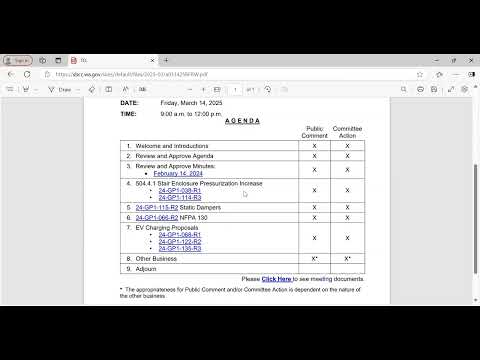
BRFW committee delays EV-charging rule choices, asks for forecasting and cost analysis
Summary
The committee tabled three competing petitions to change state EV-charging requirements (proposals 068, 122 and 135) and asked staff and stakeholders to submit written proposals, forecasting and cost-benefit analysis so the committee can bring a consolidated recommendation to the full council.
The Building Code Council BRFW Committee on March 14 tabled three competing petitions that would alter the state’s EV-charging requirements in the International Building Code and asked for additional written analysis, forecasting and stakeholder input before making a recommendation to the full council.
The three petitions under review address the IBC parking/EV table (section 429) but take different approaches. Proposal 068 seeks to reduce certain EV thresholds (Dustin noted one change from 25% to 15% in the table), while proposals 122 and 135 would increase one or more categories of required EV infrastructure, including EV-capable parking spaces. The committee described 068 as a reduction intended to lower near-term costs for builders; proponents of the increases said they were intended to anticipate higher EV adoption in the future.
Patrick Hanks of the Building Industry Association of Washington urged caution about raising minimums while housing supply is constrained, saying the state-level average EV adoption is still low: “EV adoption was only at 4.44% of the entire passenger vehicle fleet.” He said a lower minimum would reduce upfront costs for multifamily construction and help housing feasibility.
Other participants offered different perspectives. Quinn Ty, a resident and former HOA board member, said higher numbers for EV-capable stalls would have helped his condominium association accommodate later owner demand and said, “If I had to choose, the third option would be my favorite.” Jason (electrical enforcement subject-matter expert) clarified inspection and technical distinctions, noting that “EVSE stands for electrical vehicle supply equipment” and describing the practical difference between a receptacle outlet (which an inspector may count as EV-ready) and a hard-wired charging station with power management capacity.
Several committee members and public participants said the meeting exposed cross-cutting issues that the petitions alone do not resolve: the RCW language directing the council to “exceed” statutory minimums, the absence of a statewide forecasting tool from WSDOT, the technical limits imposed by utility transformers and distribution capacity, and how to interpret the three categories in the IBC table (EV charging station, EV-ready parking space, and EV-capable parking space).
Given those open questions, the committee moved to table the three petitions and asked staff to consolidate written input and any proposed amendment language. The motion, which called for staff to publish submitted materials in advance and for proponents and commenters to provide numeric substantiation (cost estimates, anticipated adoption/forecasting, and utility-capacity checks), passed by voice vote.
Ending: The petitions remain active in the rulemaking queue, but the BRFW Committee requested written proposals and analysis from proponents and stakeholders and will revisit a consolidated recommendation at its next meeting. Stakeholders were asked to submit materials to the SBCC email box so staff can post them for committee review at least one week before the next meeting.