Get Full Government Meeting Transcripts, Videos, & Alerts Forever!
Get email alerts on the Residential Energy Code Bases topic
No spam. Unsubscribe anytime.
Committee approves Washington residential integrated energy draft, removes 2024 IECC as parallel option
Summary
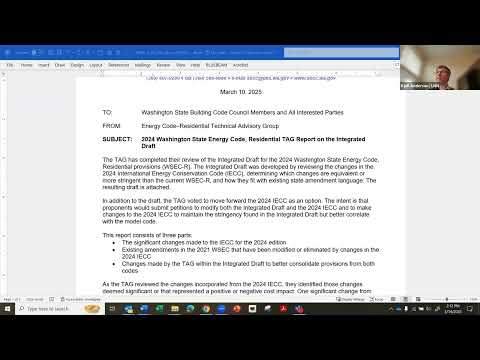
The Mechanical Ventilation, Plumbing and Energy Code Committee voted to advance the Washington State residential integrated energy code draft to the council while removing the 2024 IECC as a parallel option for accepting code-change proposals; the 2024 IECC will remain listed as a reference only.
On March 14, 2025, the Mechanical Ventilation, Plumbing and Energy Code Committee voted to advance the Washington State residential integrated energy code draft to the council while striking consideration of the 2024 International Energy Conservation Code (IECC) as a parallel option for receiving code-change proposals. Committee members said the 2024 IECC will remain listed in the report as a reference but not be treated as a base document to accept proposals against.
Committee members said the decision matters because accepting two full base documents would significantly increase the volunteer and staff workload and could split code-proposal proponents between the two bases, potentially leaving many proposals without hearings. Several committee members argued the integrated draft is the appropriate single basis for proposals to avoid duplicating effort. Other committee members and some tag participants had argued earlier at the tag level that the 2024 IECC should be included as an option because certain tax-credit and financing programs require compliance with the model code.
The discussion began with a presentation of the integrated draft and the tag report, and committee members debated whether to accept both the integrated draft and the 2024 IECC as bases for submitting proposals. Proponents of including the 2024 IECC, including members who served on the residential tag, said including it could produce code proposals that align with model-code incentives. Opponents said the tag did not fully debate the motion at length, that moving forward with two bases would double the time volunteers must spend, and that staff resources are already strained.
Nick (committee member) moved to advance the Washington State Energy Code residential integrated draft to the council but to remove consideration of the 2024 IECC as a parallel option; the motion specified keeping the 2024 IECC only as a reference. Katie Sheehan seconded the motion. The committee conducted a roll-call of willing members; recorded votes in the transcript include Todd Bayruther (Aye), Kjell Anderson (Yes), Ben O'Meara (Yes) and Katie Sheehan (Yes). The motion carried.
Committee members noted the tag vote that produced the report had earlier passed at the tag level with a larger membership and that some tag participants later expressed they had not fully understood the motion when they voted. Several members urged that council and tag volunteers be given a clear process for handling proposals and that staff workload implications be taken into account as the council opens the period to accept proposals.
Next steps: the committee forwarded its recommendation to the council. Committee members said the council could decide next steps at its meeting, including whether to open one or multiple proposal windows. The integrated draft will be posted for consideration according to the council's usual CR-102 procedures and timeline.