Get Full Government Meeting Transcripts, Videos, & Alerts Forever!
Get email alerts on the Semiconductors topic
No spam. Unsubscribe anytime.
Business Oregon details $240 million semiconductor program, warns some funds may revert if federal matches fail
Summary
Business Oregon told the Ways and Means joint committee that $240 million in state funding to attract semiconductor projects has produced 15 awards and 11 signed contracts but depends on federal awards for some projects; roughly $30 million in non-contracted funds could revert to the general fund.
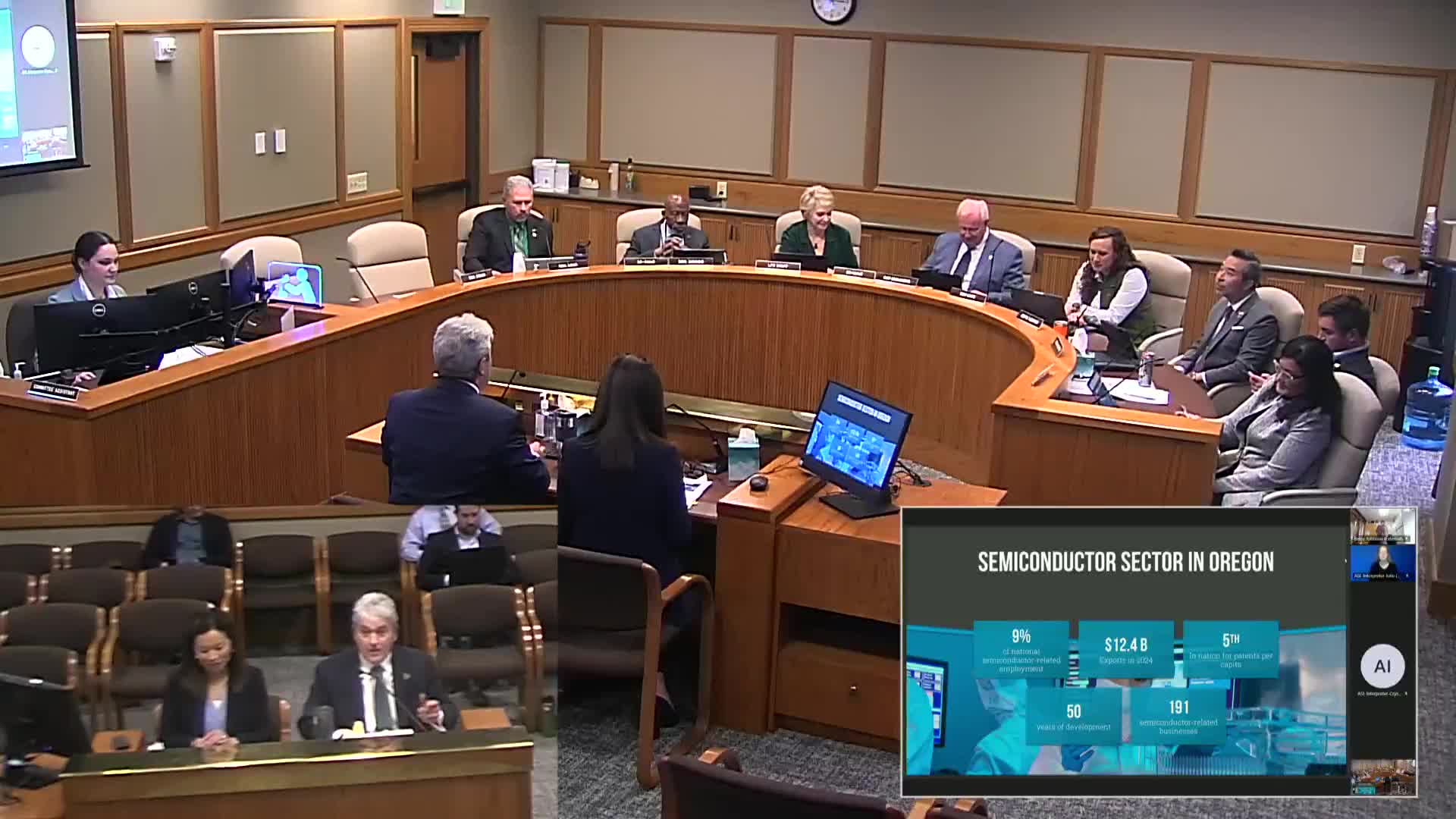
Business Oregon told the Joint Committee on Ways and Means — Transportation and Economic Development on March 17 that the state’s $240 million semiconductor cash program has produced 15 awards and 11 signed contracts but remains contingent on federal awards for several projects.
Deputy Director Chris Cummings told committee members that the $240 million cited in HB 5024 is general‑fund money the agency used to award semiconductor incentive contracts. He said 11 contracts are signed and 15 awards have been announced. Cummings said some awards are contingent on projects’ receiving federal CHIPS Act funding; if federal awards are denied, the state statute would make those companies ineligible for the state money.
That contingency matters for the budget. Senator Tim Khotra asked whether the $240 million is bonded revenue or general fund; Cummings said it is general fund. He later told the committee his office expects roughly $30 million of the $240 million to remain uncontracted and therefore available to revert to the general fund if not used. “Right now we haven’t awarded $240,000,000… after that and some transfers… we expect that there’ll probably be around $30,000,000 left in non‑contracted funds to revert back,” Cummings said.
Cummings and Director Sipon Jing also discussed the state’s follow‑up programs for semiconductor projects, including a tax credit stream worth up to $255 million through 2029 and an industrial lands loan fund created because of a shortage of large industrial parcels suitable for semiconductor fabs. Business Oregon said it awarded eight loans in the first industrial lands round and anticipates three to five additional awards in a second round for municipalities upgrading industrial land for semiconductor or supply‑chain uses.
On jobs and investment, Cummings said contracted companies report their own figures and Business Oregon verifies the data with the Employment Department. He presented an estimate of $4 billion in anticipated capital investment tied to awarded projects and said the most recent company reporting cycle recorded 433 jobs across six reporting companies; the aggregate expectation for those six companies was about 3,800 jobs. Cummings emphasized these are point‑in‑time, self‑reported figures that will change as companies report new data.
Committee members pressed the agency on accountability and the metrics used in award agreements. Cummings said each contract is negotiated separately and may use different performance measures — for example, jobs created, income tax withholdings, or increases in tax ratables. Representative Nguyen asked for Oregon‑specific R&D expenditure breakdowns for firms such as Intel; Cummings said the agency would provide more localized figures.
The deputy director also noted competition from other states and that many projects involve vertically integrated supply chains with both domestic and international inputs, making simple “onshore/offshore” descriptions incomplete.
As HB 5024 moves through the budget process, committee members asked whether the state should assume federal CHIPS matching funds will arrive. Cummings cautioned that without federal awards some conditional state commitments could be withdrawn, affecting the contracted totals and any planned reversion to the general fund.
If additional information is requested, Business Oregon said it will provide updated lists of contracts, the metrics used in each agreement, and more detailed, Oregon‑specific R&D and employment data.
Ending: Business Oregon closed its semiconductor briefing by offering to supply further documentation on each contract’s metrics and on which awards are contingent on federal CHIPS Act funding. The agency emphasized that reported employment and investment figures are point‑in‑time and verified through later reporting with the Employment Department.