Get Full Government Meeting Transcripts, Videos, & Alerts Forever!
Get email alerts on the Voting Residency topic
No spam. Unsubscribe anytime.
Montana bill clarifies 'temporary' residency language; witnesses disagree over student voting impact
Summary
Representative Jane Gillette introduced House Bill 413 to clarify what Montana law means by "temporary" residence, saying the change would not alter existing eligibility rules but would define temporary work, training and education programs as non-residency.
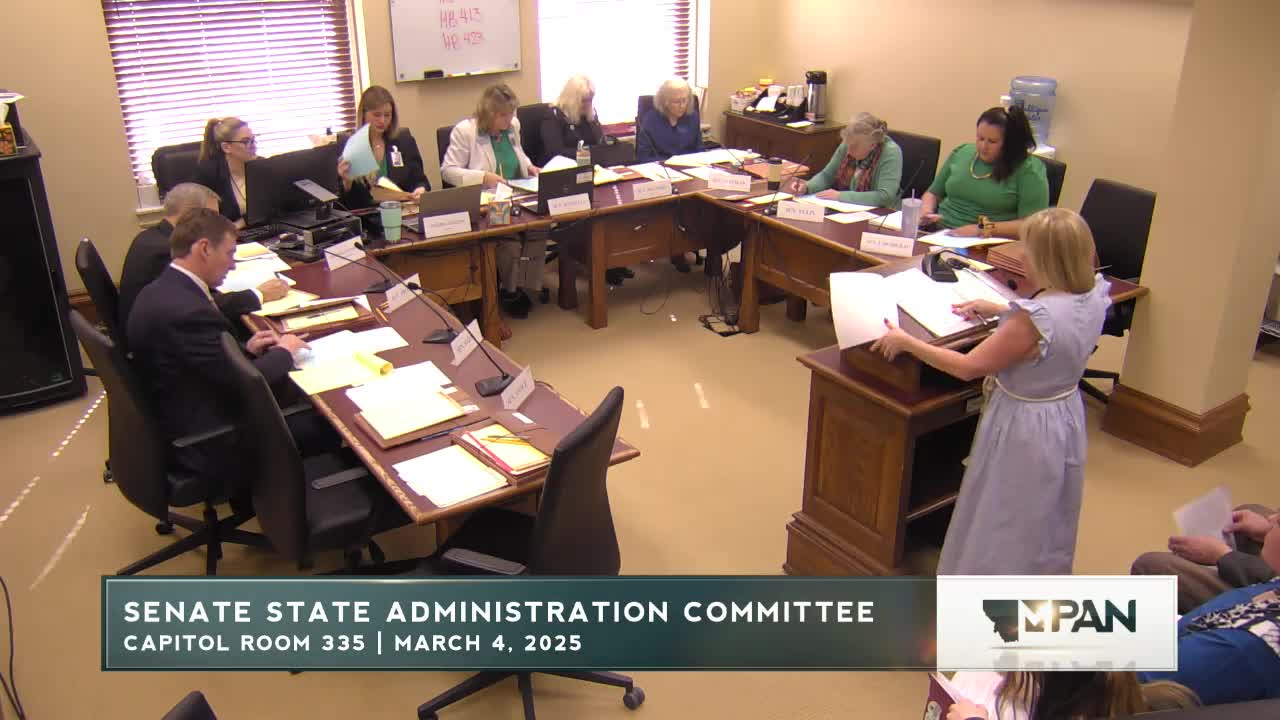
Representative Jane Gillette introduced House Bill 413 to the Senate State Administration Committee, saying the measure clarifies an existing law that prevents people who are in a county only for temporary purposes "without the intention of making that county the individual's home" from gaining residence there.
The bill, Gillette said, does not change who can vote but clarifies what the code means by "temporary," listing temporary work, temporary training and temporary education programs as examples. "House bill 4 1 3 just clarifies, an existing section of law," Gillette told the committee.
Why it matters: supporters said the bill addresses confusion between short-term physical presence and legal domicile — a long-running issue in Montana code — and could help election administrators and the public understand eligibility rules. Opponents, including student organizations and tribal representatives, said the bill is vague about enforcement and could disenfranchise students, people with unstable housing and tribal members whose living patterns do not fit the bill's examples.
Attorney Tom Stusick, a proponent testifying from Bozeman, argued the change is a necessary clarification of legal terms. Quoting Black's Law Dictionary, Stusick said, "Residence means living in a particular locality, but domicile means living in that locality with the intention to make it your fixed and permanent home." He told the committee the distinction has produced confusion across tax, motor vehicle and election law and cited Dunn v. Blumstein as a key precedent about a state's interest in ensuring a voter "has in fact become a member of the community."
Other proponents, including Mary Beveridge and county election official Lisa Bennett, told the committee the clarification would help local election administrators and align state practice with federal registration requirements. Austin James, speaking later in the hearing on a different bill, likewise emphasized operational clarity for clerks.
Opponents included tribal representatives and multiple student organizations. Patrick Yawaki, speaking for the Blackfeet Scribe and tribal communities, said the bill would place new burdens on Montana tribal electors who often face unstable housing and employment. "House Bill 4 13 sets out more restrictions against Montana voters," Yawaki said.
Isabelle Watson, representing the Associated Students of Montana State University, told senators the bill "denies voting rights to anyone relocating to Montana for temporary purposes, including education, unless they prove intent to make the state their permanent home." Watson and other campus organizations argued the intent standard is difficult to apply and could keep students from voting on local matters—housing, transit and minimum wage—that affect them.
Committee members questioned sponsors and witnesses about enforcement and the practical effect on students, snowbirds and others who split time among states. Gillette said the bill does not create a new enforcement mechanism; it is intended to clarify the existing law for the public, not to direct clerks to pursue prosecutions. "This bill does not have an enforcement component to it," she said.
No committee vote was recorded during the hearing. The committee closed the hearing on HB413 after extended testimony and discussion.
The hearing drew lengthy testimony from legal experts, student organizations, tribal representatives and election administrators, and senators asked staff to consider possible follow-up language to address questions raised about specific populations and the bill's practical application.