Get Full Government Meeting Transcripts, Videos, & Alerts Forever!
Get email alerts on the Disability Language Reform topic
No spam. Unsubscribe anytime.
Montana bill would replace 'hearing impaired' with modern terms to refer to deaf and hard-of-hearing people
Summary
A House bill to update statutory language would standardize references to deaf and hard-of-hearing individuals across Montana law; proponents said the change affirms dignity and will not alter benefits or services.
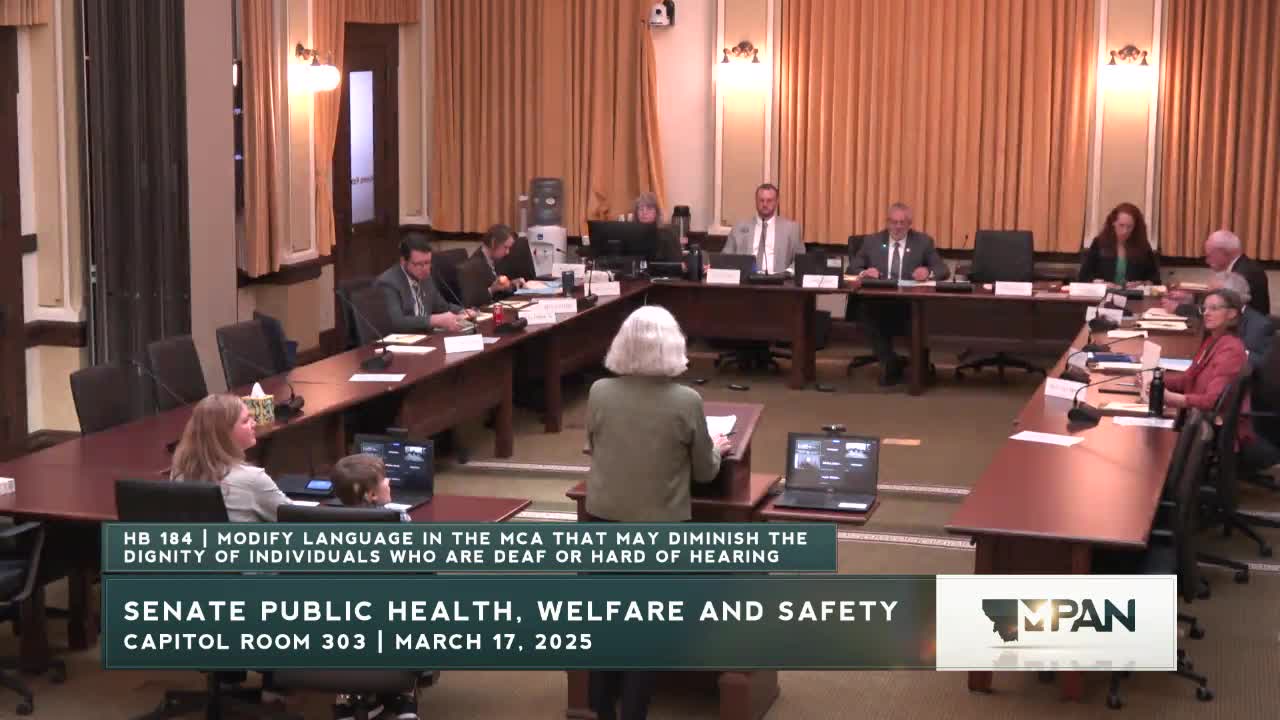
Representative Keogh, sponsor of House Bill 184, told the Senate Health and Public Health Committee on March 17 that the bill would modernize statutory language used to describe people who are deaf or hard of hearing and would not change eligibility for services.
The measure would replace the phrase "hearing impaired" with terms such as "deaf" or "hard of hearing" and add a defined phrase — cited in the bill as "various auditory ranges" — to provide consistent statutory language. "House Bill 184 is also a step toward updating and affirming the dignity of deaf and hard of hearing individuals by replacing terminology that diminishes their identity," Representative Keogh said in opening remarks.
Proponents including deaf Montanans, family members and disability advocates testified in support. Jennifer Hensley, speaking for Ability Montana, said the organization supports updating legal language and asked the committee to "please do that." Eliza Kragh, who identified herself as a deaf individual, told the committee, "Being deaf is not a deficit. It's a different part of who we are, our culture, our language."
Keogh told the committee the bill is intended as a standardization measure and would not alter benefits or services. "No benefits or any services will be impacted by this bill or changed or altered in any way," Keogh said, noting the bill text incorporates clarifying language on page 22 to make that clear. The sponsor said the legislation identifies 13 statutory sections for revision and that some changes convert the phrase "hearing impaired" to "hard of hearing" while other sections use the broader defined term.
Committee members asked about related needs — notably interpreter and educator shortages in Montana schools. Senator Yakovich, who said he wears hearing aids, asked whether public schools in Montana make accommodations; testimony from advocates and parents said the availability of educational interpreters is limited and that some children attend the residential School for the Deaf and Blind in Great Falls while many attend public schools. Eliza Kragh and other witnesses described workforce shortages for educational interpreters and teachers of the deaf and encouraged additional funding and workforce development.
No committee action or vote appears on the record in the hearing transcript; the bill hearing closed after public testimony and the sponsor's closing remarks.
Why it matters: Supporters said the changes remove terminology they described as stigmatizing, align Montana with other states that have updated legal language, and provide consistent, dignity-preserving language across code without changing eligibility for services.
Next steps: The hearing record closed and sponsors indicated the bill will continue its legislative process. The sponsor said related work on interpreter funding may appear in additional legislation.