Get Full Government Meeting Transcripts, Videos, & Alerts Forever!
Get email alerts on the Community Schools topic
No spam. Unsubscribe anytime.
PGCPS committee advances revision of community‑schools policy after detailed staff briefing
Summary
The Policy & Governance Committee voted to recommend revisions to Policy 1.100 (Community Schools) after a long discussion with Dr. Ingrid Horton, director of community schools, about governance, needs assessments, staffing and family engagement.
The Policy and Governance Committee of the Prince George's County Board of Education on March 11 recommended Policy 1.100 (Community Schools) to the policy sponsor for revision after hearing a detailed briefing from Dr. Ingrid Horton, director of community schools for Prince George's County Public Schools.
The vote followed a substantive discussion about steering‑committee structure, the cadence of needs assessments and implementation details for wraparound services. “We do community schools better than anyone in the state of Maryland,” Dr. Horton told the committee, describing the district program and how school‑level needs assessments shape services.
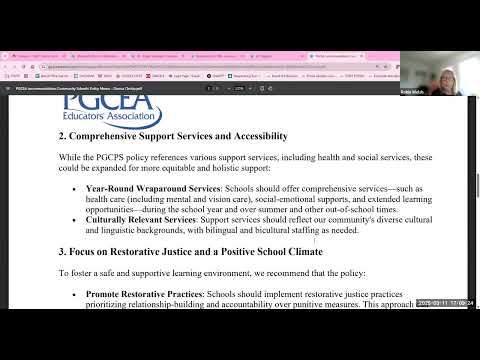
The committee’s review was prompted in part by written comments submitted by the Prince George's County Educators' Association (PGCEA). Ms. Welsh, who presented the PGCEA recommendations to the committee, said the union proposed changes including a formal agenda‑setting group for the steering committee, rotation of steering committee leadership, year‑round wraparound services with bilingual staffing where needed, and stronger family engagement and transparent reporting.
Dr. Horton told the committee that some suggested changes duplicate existing practice or law: she said the district already requires a steering committee, that community school coordinators are 12‑month employees in the district, and that “by law, we as a district conduct a community school needs assessment every 3 years.” She described local flexibility in how schools implement services: “We don't dictate our schools…Community schools is based on how our stakeholders see or what they need.”
Board members sought clarification on multiple items. Board member Briggs asked whether the district‑level three‑year cycle for the formal needs assessment should be shortened to an annual requirement; Horton said state law requires a district needs assessment every three years but encouraged coordinators to review data and adjust implementation in intervening years. Board member Walker asked whether policy language could list examples of trainings (for example, restorative practices and trauma‑informed approaches) while remaining non‑prescriptive; Horton said the district has a restorative justice coordinator on staff and provides training and vendor resources when schools identify a need. Several board members pushed for clearer administrative representation on the district steering committee; Horton said the absence of building‑level administrator buy‑in makes consistent implementation difficult and recommended adding administrator representation.
The steering‑committee role paid by PGCEA — the community school liaison stipend — was discussed at length. Horton said the liaison role is a PGCEA position that supports the community school coordinator outside of regular work hours and that the stipend for that role is paid from the community schools allocation.
After roughly an hour of discussion the committee voted. The roll call showed four members in the affirmative; the committee will recommend Policy 1.100 to the policy sponsor for revision.
Committee members and staff said further technical edits will be developed for subsequent drafts. The committee chair thanked Dr. Horton for attending and noted continued advocacy for community‑school funding across the state.
Ending: The committee vote forwards the policy to the sponsor for revision; committee members said they expect additional edits and an updated draft will return to the committee for further consideration.