Get Full Government Meeting Transcripts, Videos, & Alerts Forever!
Get email alerts on the Business topic
No spam. Unsubscribe anytime.
Committee sends bill requiring banks to explain account closures to House floor after 15-2 vote
Summary
Representative Josh Tanner, sponsor and a lawmaker from District 14, told the House Business Committee on March 13 that Senate Bill 10 27 aims to increase transparency when large banks and merchant processors close or restrict customer accounts.
Representative Josh Tanner, sponsor and a lawmaker from District 14, told the House Business Committee on March 13 that Senate Bill 10 27 aims to increase transparency when large banks and merchant processors close or restrict customer accounts.
"This bill deals with transparency," Representative Josh Tanner said, adding the measure would require covered institutions to give customers an explanation when their accounts are closed and set deadlines for responses.
The bill would apply to banks and merchant processors with at least $100,000,000,000 in assets and would allow the Idaho Attorney General to investigate and enforce the law under the Idaho Consumer Protection Act. It also creates a timetable in which customers may request an explanation and the financial institution must respond; Tanner described a 90-day window for a customer to seek an explanation and a 14-day response period for the institution.
The proposal drew public testimony from residents and lawyers who said account closures have harmed individuals and nonprofits. Tony Ulrich, State Chairman of the Constitution Party of Idaho, described receiving a notice of account closure with no explanation: "I found a check for our account balance and a notice on it that just said account closure. No explanation, nothing whatsoever." Ulrich said that lack of explanation disrupted the party’s operations and that the bill would give customers a right to know why an account was closed.
Matt Sharp, senior counsel with Alliance Defending Freedom, told the committee he sees a pattern he described as "modern day redlining" in which banks and payment processors decline to serve certain businesses or nonprofits because of their political or religious views or industry. "These banks and payment processors are discriminating against businesses and consumers because of their religious beliefs and political views or because they're in the firearm or energy industry," Sharp said, and urged committee members to pass the bill to provide transparency and remedies for consumers.
Industry and regulatory witnesses urged changes to the bill. A testifier identified in the record as Stacy Satterley said financial institutions close a very small percentage of accounts each year to comply with federal anti-money-laundering and related statutes and that those federal rules sometimes prevent banks from disclosing specific details. "If this law is enacted as it's written today, the result will be or could be lawsuits pouring in to banks for every account closed or every loan that's denied," Satterley said. She recommended removing the private right of action for out-of-state plaintiffs, aligning Idaho's complaint process with laws in Tennessee and Florida, and lengthening the bank response window to 30 days.
Committee members pressed both sides on the interaction with federal law. Representative Wheeler asked whether federal regulations would conflict with a state requirement to disclose reasons for account closures; witnesses and the sponsor said the bill text includes a caveat that requires disclosure only "unless otherwise prohibited by law." Representative Birch said he shared concerns about creating opportunities for politically motivated enforcement or litigation, and he opposed the motion to send the bill to the floor.
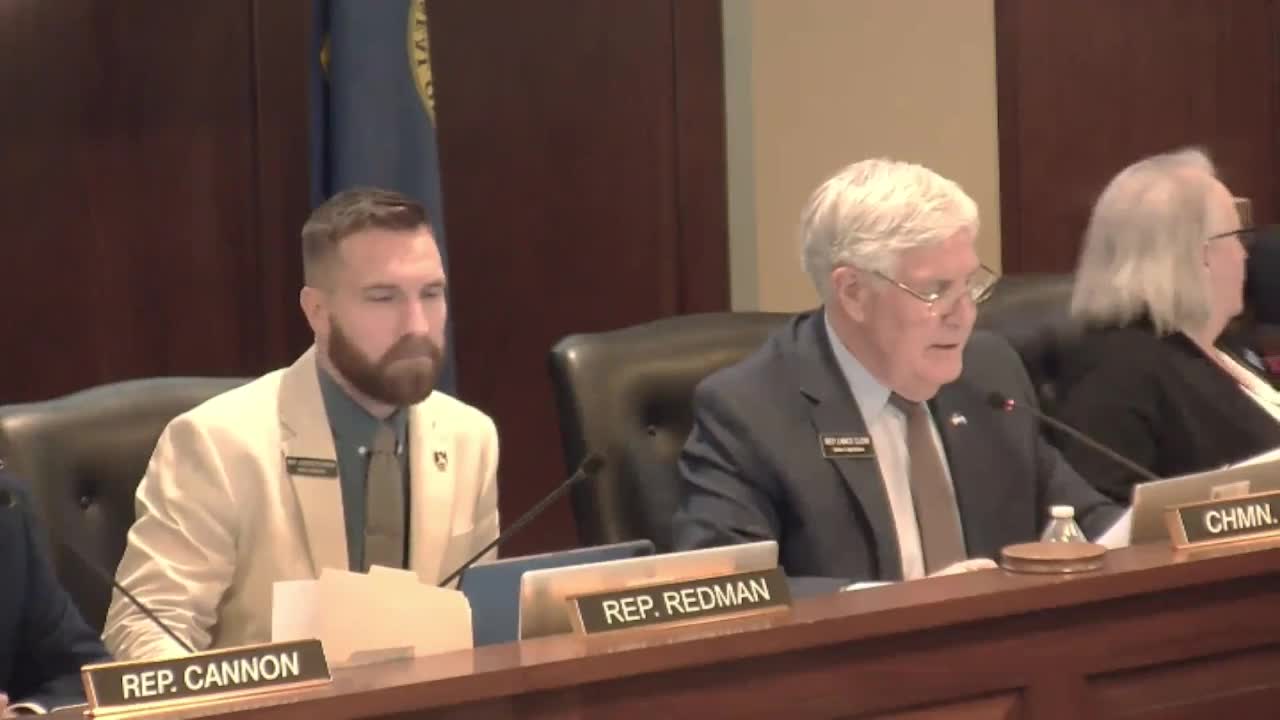
After debate, the committee approved a motion to send Senate Bill 10 27 to the House floor with a due-pass recommendation. The motion was made by Vice Chairman Redmond and passed on a roll call vote; the clerk recorded the committee vote tally as 15 in favor and 2 opposed. Representative Birch announced he would not support the motion. The committee record shows the bill passed the Senate earlier by a 32-2 vote, according to the sponsor.
What happens next: with the committee vote, Senate Bill 10 27 is scheduled to proceed to the full House for consideration. The committee did not adopt the industry-requested amendments during the hearing; witnesses asked the committee to consider those changes in amending order. The Attorney General would be granted enforcement authority under the bill text shown to the committee.
Votes at a glance: The committee motion to send Senate Bill 10 27 to the floor with a due-pass recommendation passed 15-2 on March 13, 2025. The committee recorded a roll-call series of "yes" votes and two "no" votes; the formal tally recorded by the committee was 15 yes, 2 no.