Get Full Government Meeting Transcripts, Videos, & Alerts Forever!
Get email alerts on the Alcohol Regulation topic
No spam. Unsubscribe anytime.
Panel weighs narrow permit exemption after Sazerac acquisition of Southern Champion
Summary
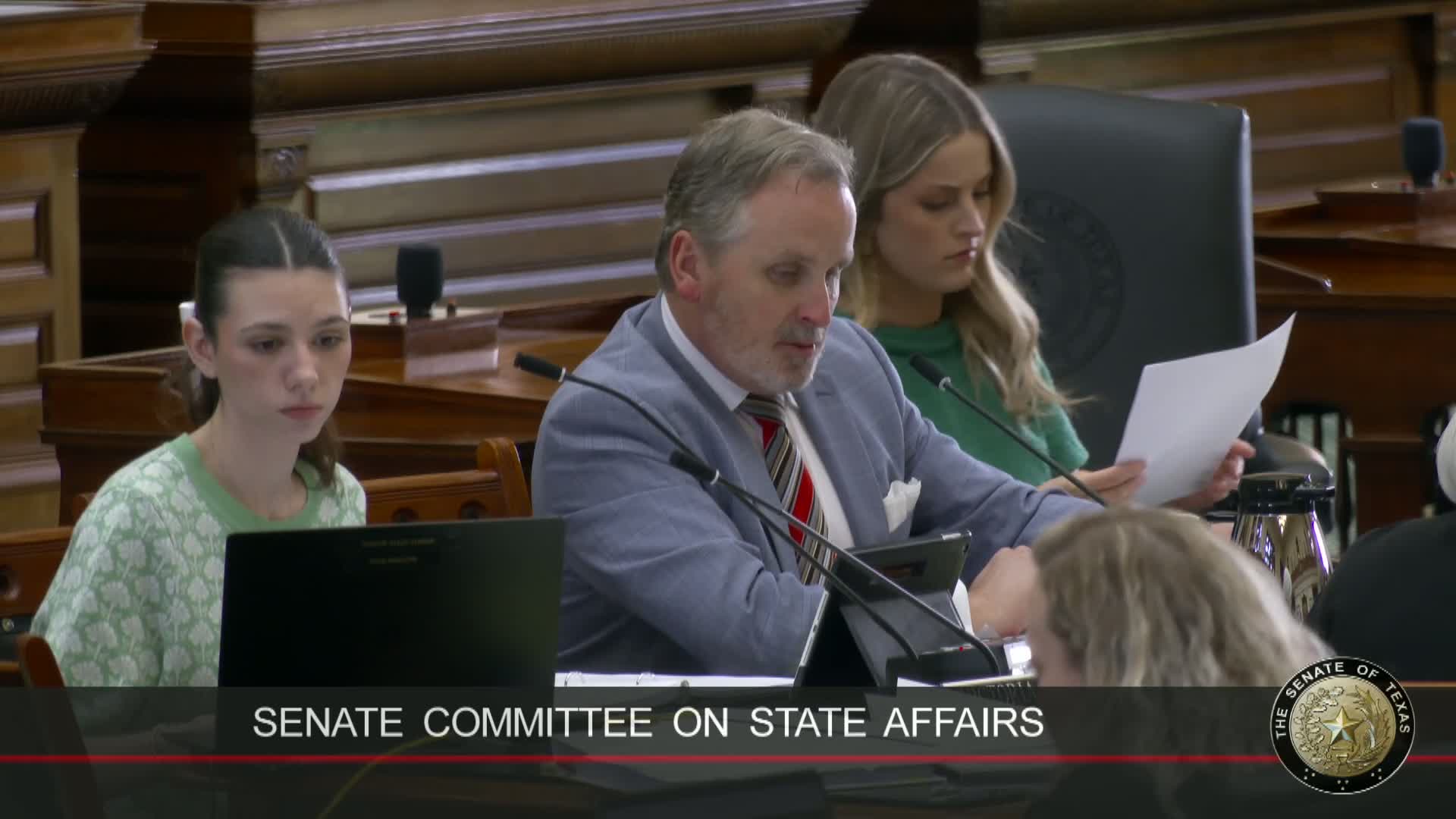
The Senate Committee on State Affairs heard competing testimony on Senate Bill 13-78, a local bill that would provide a narrowly bracketed exemption allowing Southern Champion — recently acquired by Sazerac — to hold both a Texas winery (G) permit and a nonresident seller’s (S) permit without forcing operations to change.
The Senate Committee on State Affairs heard competing testimony on Senate Bill 13-78, a local bill that would provide a narrowly bracketed exemption allowing Southern Champion — recently acquired by Sazerac — to hold both a Texas winery (G) permit and a nonresident seller’s (S) permit without forcing a change that could disrupt operations in Carrollton.
Senator Charles Parker, the bill’s author, said the exemption is limited to a single, specific acquisition and is intended to prevent “over a thousand Texans” from losing jobs in Carrollton. Parker said the bill includes a provision in section 37.07 to prohibit Sazerac from selling wine to itself and that the measure is “narrowly bracketed to apply only to this 1 specific acquisition, preventing unintended consequences for other existing and future companies in the industry.”
Matthew Cherry, senior counsel for the Texas Alcoholic Beverage Commission, appeared as a resource witness and told the committee that “in the way that it’s currently drafted, those specific subsections that create those prequalifications for this exception, there’s no other permits or locations that would apply to.” Cherry’s statement was offered to reassure members that the draft exemption would not automatically expand to other permits or locations.
Mason Moreland, president of Texas Vine Country, testified in opposition to SB 13-78 as filed. Moreland said the bill “rewards violation of our law, giving special privileges and special valuation to” the purchaser and argued the measure would not extend the same relief to Texas wineries and farmers facing similar issues. He raised a drafting concern that the bill does not limit the permitted amount of direct-to-consumer wine sales for the affected G permits; earlier in testimony he described a provision that would allow “up to 70,000 gallons of wine sales direct to consumer in Texas” and later told the committee the relevant permits could be treated as allowing “35,000 gallons of direct to consumer wine a year each for those G permits.”
Moreland described his business as a vertically integrated wine operation that farms “over 1,000 acres” and said Texas Vine Country’s assets total about $50,000,000; he said the bill as filed would confer a unique commercial advantage on the company being accommodated and urged a broader statutory review rather than a single-company exemption. Moreland said he supports the policy goal if applied broadly but opposed the narrow, company-specific approach.
Senators asked questions about whether the exemption would affect the three-tier distribution system and whether the bill’s language unintentionally expands direct-to-consumer privileges. Parker and Cherry both stated the draft is narrowly targeted; Moreland urged comprehensive statutory changes instead of a single exception. The committee closed public testimony on SB 13-78 and left the bill pending.