Get Full Government Meeting Transcripts, Videos, & Alerts Forever!
Get email alerts on the Immigration 287g topic
No spam. Unsubscribe anytime.
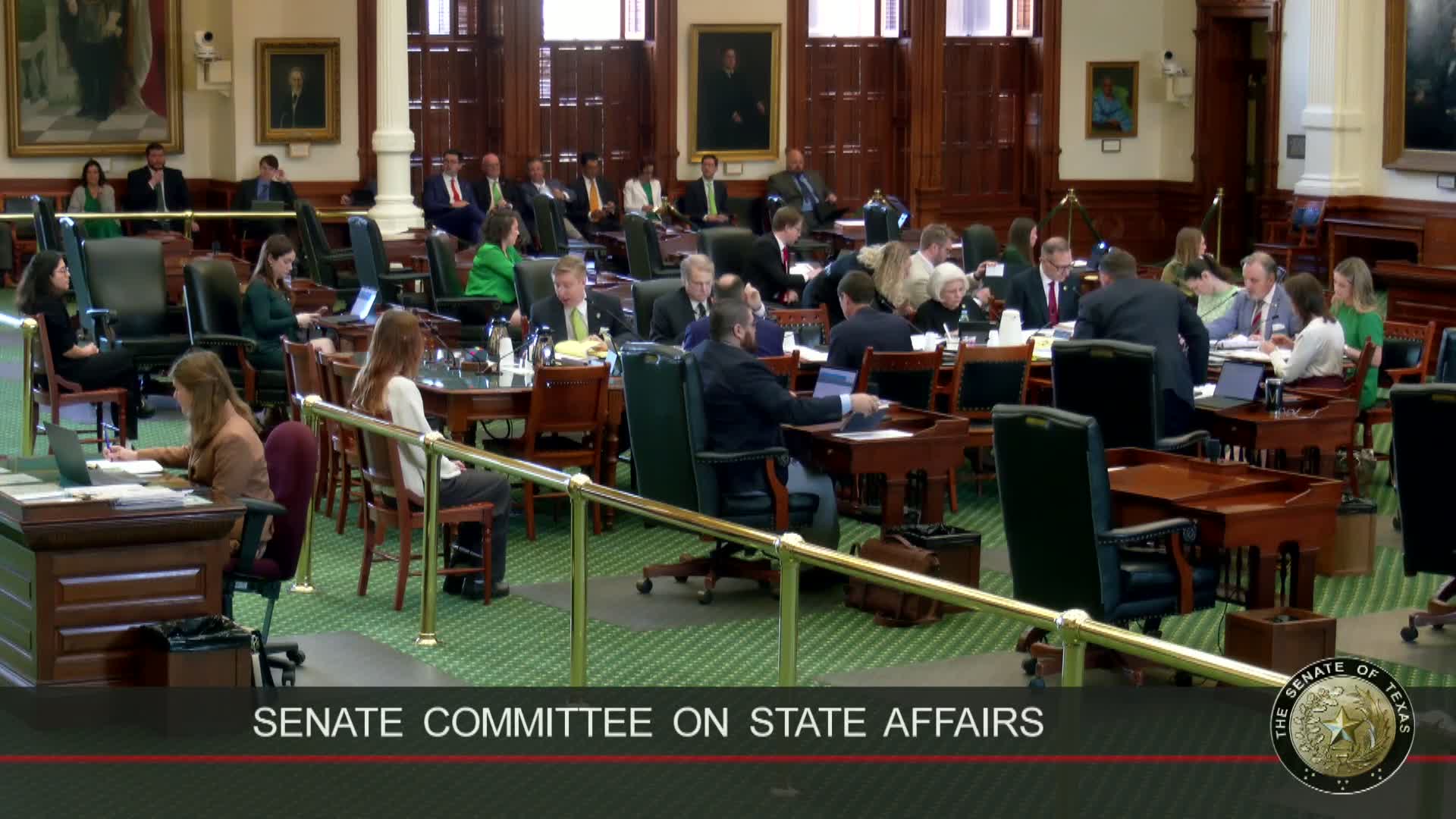
Long hearing on SB 8 leaves committee with concerns about costs, mandates for sheriff ICE agreements
Summary
The Senate Committee on State Affairs held a lengthy hearing on Senate Bill 8, a measure that would require counties of 100,000 or more to enter into 287(g) agreements with ICE; advocates and sheriffs argued over funding, training needs, and community‑policing impacts.
Senate Bill 8, authored by Senator Sarah Schwartner, would require county sheriffs and counties with populations of 100,000 or more to enter into written agreements with the federal government under the immigration and nationality act (commonly called 287(g) agreements) so jail booking officers can check the immigration status of arrestees and, where appropriate, issue detainers for pickup by Immigration and Customs Enforcement (ICE).
Sponsor’s case and committee substitute: Senator Schwartner told the committee the measure mandates participation in counties of 100,000 or more while establishing a grant program for counties under 1,000,000 population to defray costs. Supporters said the state needs consistent cooperation to identify criminal aliens arrested in county jails; the senator linked the bill to a 2025 federal executive order titled Protecting the American People Against Invasion.
Extensive public testimony: The committee heard invited and public witnesses over more than two hours. Multiple sheriffs and the Texas Sheriffs’ Association testified in favor, saying dozens of counties already participate and the program helps remove dangerous criminals. Sheriff Bill Weybourn of Tarrant County described a long‑running local 287(g) program with trained credentialed staff and said it targets aggravated assaults and other violent felonies. Sheriffs who testified asked the Legislature to provide funding and to avoid creating duplicate paperwork; some expressed concern about unfunded mandates for the largest counties.
Civil‑rights groups, legal advocates, health and social‑services witnesses, and local advocates testified in opposition. They warned mandatory 287(g) agreements can undermine community policing, reduce reporting by immigrant victims, and impose high local costs. Witnesses cited investigations and studies that linked local immigration enforcement partnerships to decreased crime‑reporting among Latino communities and argued the measures would divert resources from core policing functions.
Cost and program mechanics: Witnesses and the committee discussed training and staffing needs for the 287(g) program. Sheriffs described training that historically lasted several weeks (some witnesses said it is being shortened and regionalized) and said the program is manpower‑intensive; one sheriff estimated roughly $10,000 per jailer for training and travel costs. The committee heard the state comptroller would administer a grants program for counties under 1,000,000 population; the fiscal note discussed by witnesses put some proposed grant funding at $1.4 million for the biennium, but witnesses said that figure was likely insufficient to cover many county costs. The bill also authorizes the attorney general to pursue legal action against jurisdictions that do not apply for agreements, a provision that raised concerns among some sheriffs about undefined enforcement tools.
Outcome: The committee left SB 8 pending after hearing a substantial and divided record. No committee vote was taken during the hearing.
What to watch: Key outstanding issues the committee flagged include how much state money will be made available to cover training, overtime and backfill when county staff are in training, how the attorney general’s enforcement authority would be defined, and whether reporting and data reporting requirements will be streamlined to avoid duplicative paperwork.