Get Full Government Meeting Transcripts, Videos, & Alerts Forever!
Get email alerts on the School Mental Health Education topic
No spam. Unsubscribe anytime.
Committee takes public testimony, fiscal estimate on HB105 to add mental‑health education to K‑12 health standards
Summary
House Bill 105 would direct the Department of Education to update K‑12 health education to include mental‑health learning objectives; the committee heard supportive testimony and a department fiscal estimate of $216,000 for first‑year convening and guideline work.
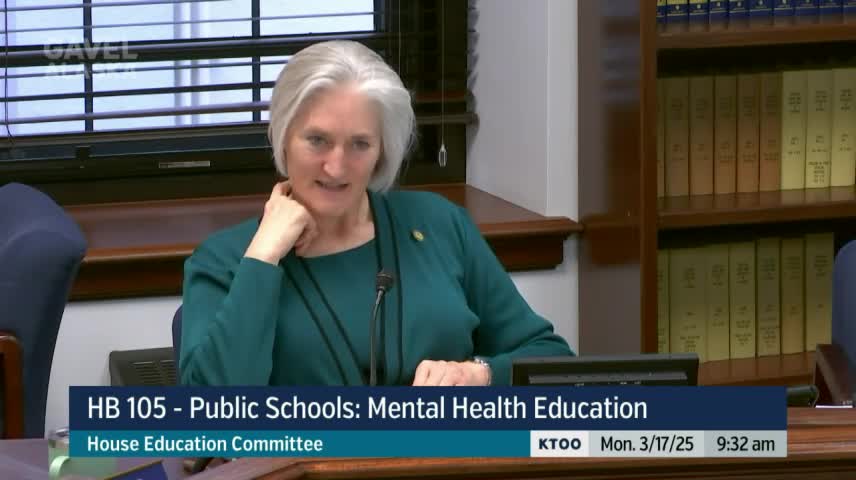
House Bill 105, which would require the Department of Education and Early Development to include mental‑health content in kindergarten through 12th‑grade health education guidelines, drew public testimony and a department fiscal estimate during the March 17 House Education Committee hearing.
Nut graf: Supporters said adding mental‑health education could reduce stigma and help identify students who need services; opponents urged a broader, holistic curriculum and cautioned against an approach focused on psychiatric diagnosis and medication. The department provided a first‑year fiscal estimate and the committee set an amendment deadline as the bill moves forward.
Multiple witnesses testified in support. Caroline Storm (vice chair, Alaska Eating Disorders Alliance, testifying personally) said eating disorders are mental illnesses with high suicide risk and argued early education could enable intervention. Trevor Storrs (president and CEO, Alaska Children’s Trust) testified the bill “supports schools who choose to include mental wellness as part of their health education curriculum” and pointed to Kids Count data showing increases in students reporting persistent sadness and suicide planning. Adrian Richardson (pastor and president of a post‑secondary scholarship/prep program, testifying personally) said integrating mental‑health supports into schools could help identify students and connect families to services.
The committee also heard an alternative perspective from Kathleen Wiedemeyer (Citizens Commission on Human Rights). Wiedemeyer urged a broader, “holistic” curriculum that would include non‑psychiatric providers and information about medical and nutritional causes of distress; she asked the committee to require a more inclusive group of experts in any guideline process.
Kelly Manning, deputy director for the Department of Education’s Division of Innovation and Education Excellence, presented a fiscal estimate tied to the bill’s implementation tasks. The department estimated a first‑year cost of $216,000 to update standards and convene a guideline‑writing committee. Manning’s breakdown included $120,000 in convening expenses, $30,000 for a facilitator, $6,000 for regulation‑change work, and $50,000 for committee member stipends. The department characterized the convening cost as a standard estimate for a work group charged with updating standards and meeting the bill’s reporting requirements in year one.
Representative Galvin, sponsor of HB105, received no committee questions that required the bill to be held for additional immediate action; the committee set an amendment deadline of Thursday, March 30 at 3 p.m.
Ending: HB105 will advance through the committee process with an amendment deadline; the department and sponsor offered follow‑up materials to support drafting and potential amendments.