Get Full Government Meeting Transcripts, Videos, & Alerts Forever!
Get email alerts on the State Budget topic
No spam. Unsubscribe anytime.
Appropriations panel grills Highway Patrol budget after Senate trims fleet funding
Summary
Lawmakers questioned how a $1 million Senate reduction to the Highway Patrol's fleet services will affect per-mile charge rates and contingency funding, while reviewing equipment requests, a $500,000 DOJ grant carryover and the agency's permit-fund balance.
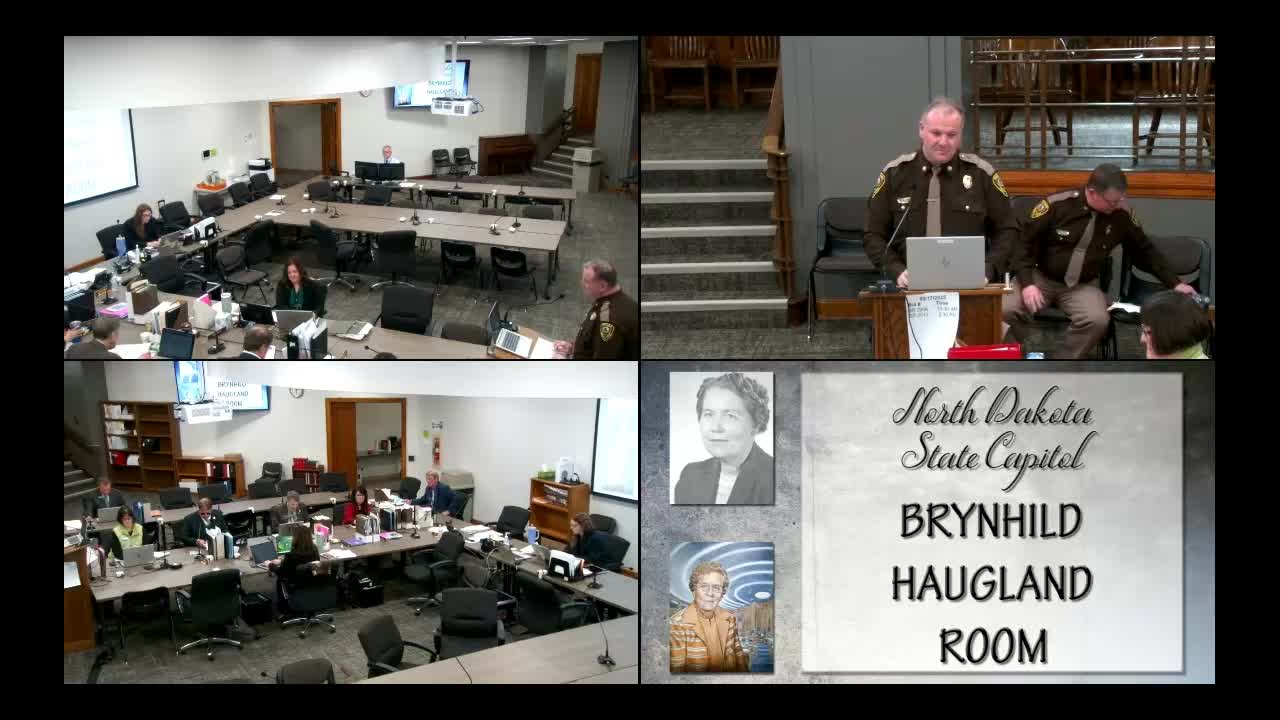
Members of the Appropriations - Government Operations Division pressed Highway Patrol officials on February (date not specified) about a $1 million Senate reduction to fleet services that staff said will lower the patrol's projected allowance for vehicle costs and leave unresolved choices for the committee to address.
The discussion centered on one-time and ongoing fleet funding, inflationary equipment requests and two technology items: a $500,000 federal grant for in-car routers that the patrol asked permission to carry over into the 2025'27 biennium, and $210,000 in ongoing costs to support the router network. Aaron Hummel, chief of staff for the Highway Patrol, told the committee the patrol is seeking $370,000 in ongoing inflationary funding for equipment, uniforms and ammunition.
Why it matters: fleet and permit fees fund routine Highway Patrol operations such as fuel, vehicle repairs and equipment. A shortfall or a larger-than-expected fuel/repair spike can force agencies to seek deficiency appropriations later in the biennium or rely on one-time funds that legislators say they prefer to limit.
Hummel said the patrol's inflation request is smaller than the prior biennium's package. "The inflationary increases that we're asking for, this biennium are specifically for equipment," he said, adding the patrol is asking that amount as ongoing funding. He also described the in-car router project as a combination of a $500,000 U.S. Department of Justice grant received during the interim and $210,000 in ongoing network and NDIT (Information Technology) fees to maintain the replacement cycle and hosting costs.
On fleet services, committee members and patrol staff traced a series of estimates and reductions that yielded differing per-mile figures. Hummel said the patrol's request originally followed Department of Transportation guidance and early cost projections that in some scenarios approached $1.49 per mile. After budgeting and the Senate's $1 million reduction, the patrol's current projection for the upcoming biennium is roughly $1.18 per mile based on an assumed 9,734,000 miles and about 171 sworn troopers. By contrast, the patrol's current billings to agencies are about $0.80 per mile, and the patrol said it had budgeted roughly $0.99 to $1.00 per mile for the biennium.
Committee members repeatedly asked how the $1 million cut was chosen and whether the agency could absorb it without returning for a deficiency. "They just took a million off the top," Hummel said of the Senate action. Several members proposed a compromise to restore part of the reduction. Representative Pyle suggested restoring $500,000 as a middle ground; Representative Meyer supported that idea, noting unused one-time funds would turn back to the general fund if not spent.
The patrol described a history of using one-time funds to manage monthly fluctuations. Hummel said the patrol had about $2,046,000 in one-time fleet funding in the prior biennium and that a large portion likely will be returned because actual rates have been lower than earlier projections. He warned, however, that fuel prices, vehicle repair costs and labor rates remain uncertain and that DOT's rate guidance had historically been conservative.
On permit-fee finances, Hummel told the committee the motor carrier permit fund had a balance of about $7.8 million in February, with an estimated ending balance near $7.7 million for the biennium and projected revenues this biennium of roughly $2.3 million. He said permit sales were down about 15 percent in the first two months of the year compared with the same period previously.
Committee members also reviewed several other budget items the patrol put forward: replacement tasers (about $870,000 requested, roughly 162 units), a handgun replacement request for $200,000 (one-time, split on the usual 86/14 general/special split), body armor (about $184,000, presented as ongoing general/special split), emergency vehicle operations course resurfacing (site and dimensions discussed by Danny Haugen, superintendent), breath-test devices (about $50,000) and shooting-range ventilation (which staff said may be achievable with prior range funding). Hummel said some of those items were supported by special permit funds, SIF funds or general funds as noted in the hearing.
The patrol also requested formal authority to carry over the $500,000 DOJ body-camera/in-car-router grant into the 2025'27 biennium and a $45,000 carryover from a motor carrier electronic transaction special fund for technology work. Hummel asked the committee for that carryover authorization so the patrol could finish the projects.
No formal votes were taken on the floor of the committee during the hearing. Members asked staff to bring an updated long sheet with consolidated numbers and to return with suggested amendments on fleet services so the panel could move the budget forward. Hummel said the agency would provide additional detail to the committee on miles, rate calculations and other line-item breakdowns.
Next steps: committee members said they would consider the competing approaches to fleet funding when the updated long sheet is circulated, and some members said they expected the budget to be finalized after that follow-up meeting.