Get Full Government Meeting Transcripts, Videos, & Alerts Forever!
Get email alerts on the School Transportation topic
No spam. Unsubscribe anytime.
Senate panel hears overhaul of school transportation funding formula after UND study
Summary
House Bill 12 14 would replace the long‑standing transportation block grant with a formula tied to per‑pupil funding and new weights for district area and building count, aiming to better account for geography and service density and to stabilize transportation reimbursement.
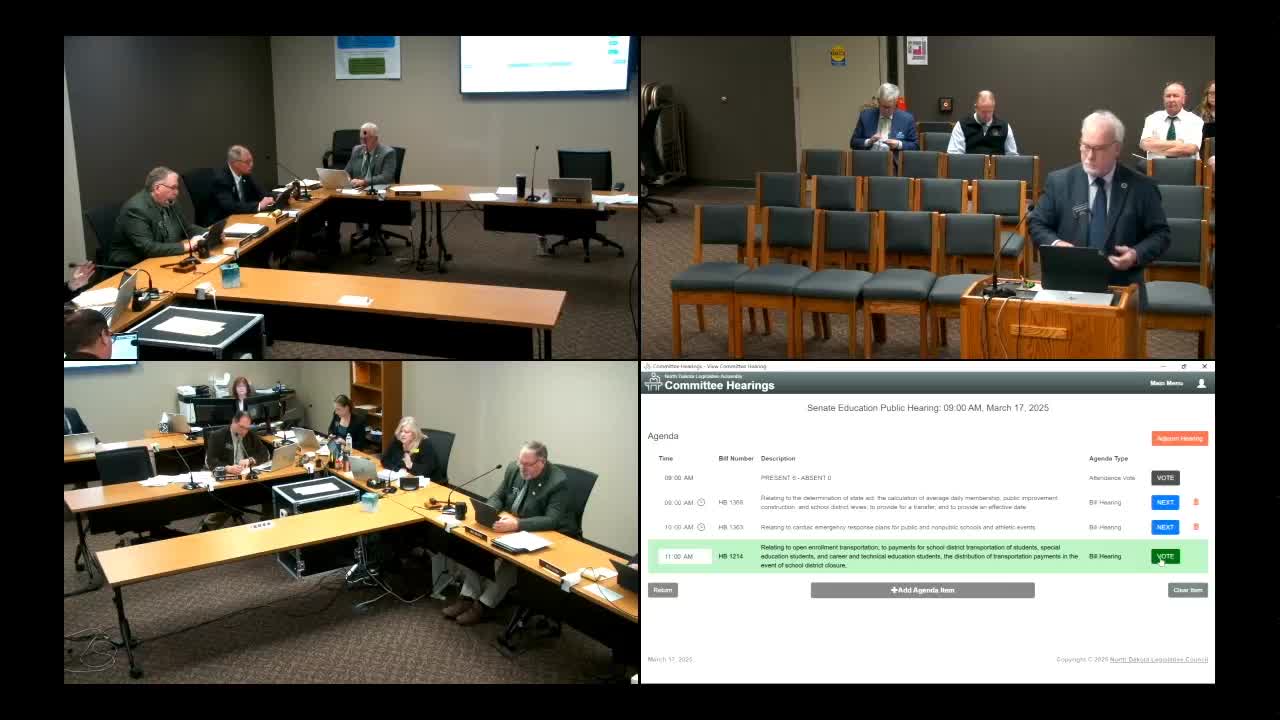
House Bill 12 14, a rewrite of the state school transportation funding mechanism, was presented to the Senate Education Committee with broad support from superintendents and school associations.
Representative David Richter (Williston), the bill sponsor, said the measure stems from a University of North Dakota transportation study and work by the interim education funding task force. The proposal would shift the state’s transportation allocation from a fixed block grant to a formula tied to the per‑pupil payment and adjusted by several new weighting factors that account for large district land area and number of school buildings, as well as reported bus miles and runs.
Steve Holland, superintendent of Mackenzie County School District No. 1 (Watford City), testified that transportation reimbursement under the current block grant has eroded and now covers a much smaller share of districts’ actual transportation costs than it did two decades ago. Holland told the committee some districts spend a double‑digit share of their budgets on transportation and said moving toward a weighted formula would better reflect geographic and density differences among districts.
Under the proposed worksheet shown to the committee, each district’s reported large‑bus miles and large‑bus runs are converted to weighted student units using fixed factors; district square miles and the number of school buildings are additional weights. The weighted student total is converted into a transportation payment that is then tied to the statewide per‑pupil rate. Witnesses emphasized the bill will increase transportation payments for most districts and that required reporting already exists, so no substantial new data burden is anticipated.
Supporters noted the bill is a phase‑1 reform: it does not immediately eliminate all disparities in reimbursement rates, but it creates a statutory vehicle for further refinement (for example, future consideration of road surface or other cost drivers). Department of Public Instruction staff said the department’s existing reports provide the data needed to calculate the new formula and suggested placing the rolling three‑year ADM adjustment as a weighting factor rather than changing ADM definitions directly (to avoid impacts on related calculations).
No final committee vote on House Bill 12 14 is recorded in the transcript; committee members asked for additional time to review the fiscal note and to consider how the change would interact with other budget decisions. Representative Richter noted the bill contains an appropriation in the fiscal note and said the measure will go to the Appropriations Committee if it advances.
Ending: Advocates said the new formula will provide a more equitable and predictable state contribution for school transportation by accounting for geography and district structure; committee members requested more time to examine fiscal impacts and possible drafting tweaks before a formal recommendation.