Get Full Government Meeting Transcripts, Videos, & Alerts Forever!
Get email alerts on the Gambling Greyhound‑racing‑adw topic
No spam. Unsubscribe anytime.
Heated Hearing on Bill That Would Phase Out Greyhound Betting, Tidy Electronic Pull‑tab Rules
Summary
Lawmakers heard hours of testimony on Senate Bill 2384, which would phase out online wagering on greyhound races that ADW operators process through North Dakota, adjust language about electronic pull‑tab stamps, and—after a sponsor amendment—remove a disputed charitable‑gaming provision.
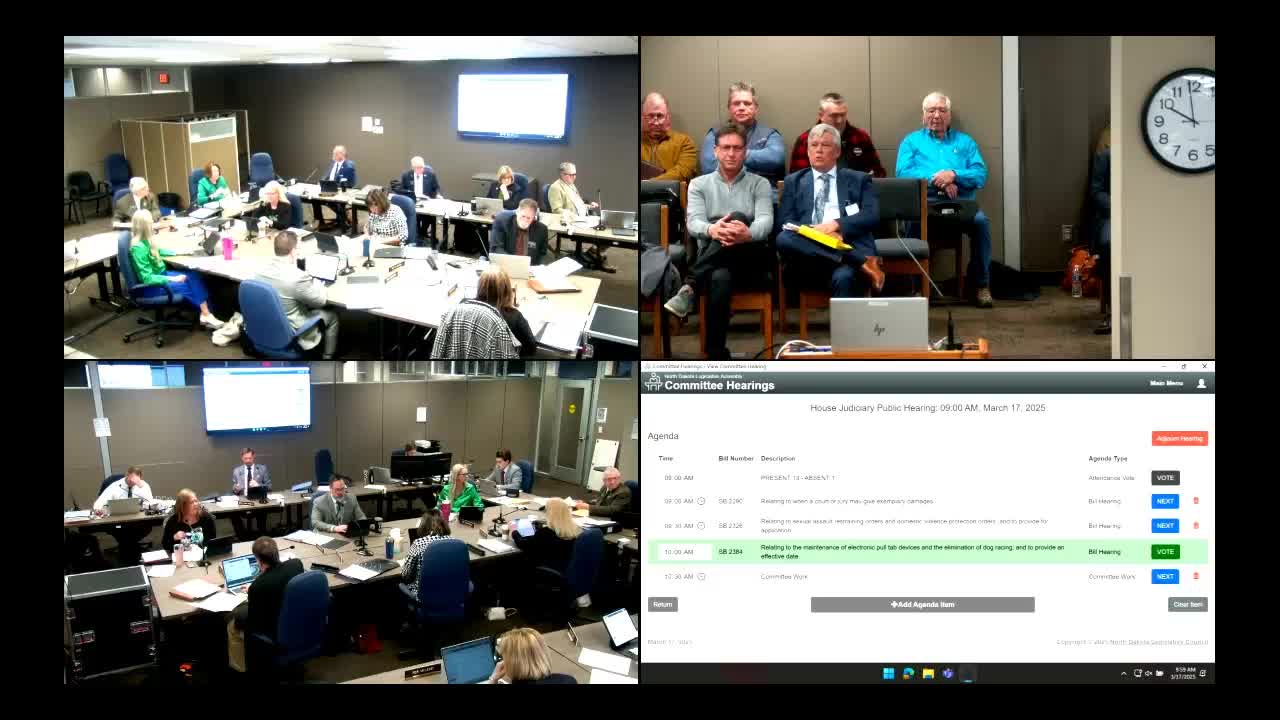
The House Judiciary Committee took lengthy testimony on Senate Bill 2384, a multipart measure that (1) updates statutory language related to maintenance of electronic pull‑tab devices, (2) phases out online wagering on greyhound racing processed through North Dakota‑licensed advanced‑deposit wagering (ADW) companies, and (3) (in its original draft) included a controversial change about manufacturer/distributor access to charities that the sponsor moved to remove in an amendment.
Supporters of the bill included national and state animal‑welfare advocates and groups focused on ending greyhound racing. Carrie Teal, executive director of Greyhound Protection Group/Grey2K USA, argued the bill advances animal welfare, flags industry practices she described as abusive (including live‑lure training documented in other states), and points to enforcement concerns where North Dakota‑based ADW processors allegedly helped offer wagers illegally in other states. Teal told the committee she had sent a cease‑and‑desist letter from the Massachusetts attorney general to committee members alleging that a North Dakota ADW had offered illegal dog‑race wagers to Massachusetts residents; she said the state racing commission had not adequately regulated ADW activity.
Senator Claire Corey, the Senate sponsor who later offered drafting amendments, told the committee the bill also "cleans up language related to physical stamps on electronic machines, which are no longer needed because the machines have serial numbers now," and that her amendments would remove disputed distributor/manufacturer language. Corey said the greyhound portion would be phased out by August 2027 to give business partners time to adapt.
Opponents included the North Dakota Racing Commission and representatives of the live horse‑racing industry and ADW processors. Bruce Johnson, executive director of the North Dakota Racing Commission, warned that ADW revenue is a central source of funding for the state racing program and that ADW companies could withdraw services, which he said would end live racing in the state. He gave committee figures for recent wagering handle and tax receipts and said several ADW operators had told him privately they would leave if the greyhound product were removed. Horsemen and breed organizations echoed that testimony, saying purse, breed and promotion funds and rural economic activity depend on the ADW handle.
Witnesses debated the scale of revenue at issue. Support witnesses said greyhound wagering is a small share of overall ADW handle—Carrie Teal said greyhound betting accounted for about 5% of ADW wagering and generated roughly $240,000 in tax revenue per biennium—while racing officials said ADW tax receipts overall were a larger funding source for purses and promotion and that the departure of multiple ADW firms could eliminate the revenue stream. Industry witnesses discussed an existing statutory cap on ADW tax collections (testimony said there is a $420,000 cap that some had proposed raising to $500,000 to offset loss of greyhound revenue).
Other testimony addressed charitable‑gaming and electronic pull‑tab language. The Attorney General’s charitable gaming division said it supported a narrow drafting change (adding the word "paper" in one line) to reflect current practice for electronic pull‑tab stamps. Several in the charitable‑gaming distribution business opposed the bill’s original subsection on manufacturer‑to‑charity access; Senator Corey’s amendment removed that provision, and several distributors told the committee they supported the amendment while still opposing language they said would have allowed manufacturers direct sales/service access to charities.
Committee members heard international and interstate context: witnesses described bans in many U.S. states and several other countries; others warned that eliminating the greyhound product could push ADW companies to relocate their business and that Oregon is the only other U.S. state that hosts the ADW hub model used by those processors. Parabet, an ADW operator licensed in North Dakota, said it and similar companies have paid millions in state taxes and millions more to charities and employment and that removing a single product would risk moving operating hubs elsewhere.
The committee closed the hearing after more than an hour of testimony from both sides. No committee vote was recorded in the hearing record.