Get Full Government Meeting Transcripts, Videos, & Alerts Forever!
Get email alerts on the Property Tax topic
No spam. Unsubscribe anytime.
Senate panel advances House Bill 1176 to expand primary-residence tax credit and cap local levies
Summary
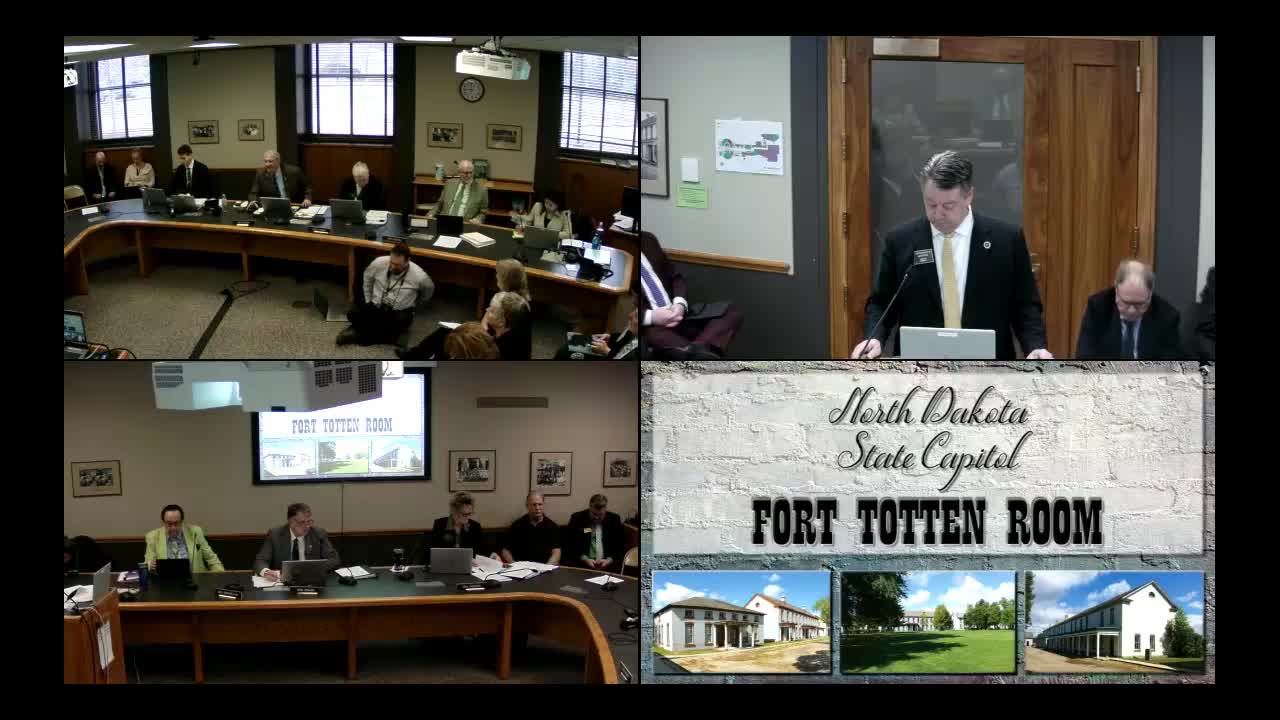
The Senate Finance and Taxation Committee on Monday considered House Bill 1176, legislation that would increase the state's primary-residence property tax credit and impose a 3% cap on annual levy increases for local taxing districts while allowing voter-approved opt-outs.
The Senate Finance and Taxation Committee on Monday considered House Bill 1176, legislation that would increase the state's primary-residence property tax credit and impose a 3% cap on the annual levy increase for local taxing districts while allowing local governments to seek voter approval to exceed the cap for a fixed term.
Representative Mike Nathie, who introduced the bill to the committee, said HB 1176 focuses "just on primary residences only," not agricultural, commercial or second homes. He and other backers described three main components: an expanded primary-residence credit, changes to the Homestead Tax Credit program and a 3% cap on levies that local political subdivisions could exceed only by a voter-approved exemption at a general election.
Supporters and local officials said the bill would deliver targeted relief while attempting to preserve long-term sustainability. "This is the most aggressive, durable, and responsible plan to reduce property taxes," Governor Kelly Armstrong told the committee, urging its passage and noting the bill combines relief from a state credit with reforms intended to control local spending.
What the bill would change
- Primary-residence credit: The bill, as presented to the committee, would raise the primary-residence credit to $14.50 (as written in the bill text presented to the committee). Sponsors said the expansion builds on last session's $500 credit and that the total fiscal cost of the primary-residence component is roughly $473,000,000 (estimate provided in committee testimony). Rep. Nathie said about $74,000,000 of the next-biennium cost is appropriated from the general fund and the remainder is planned to come from legacy fund earnings.
- Levy cap and opt-outs: HB 1176 would set a 3% cap on the annual increase in taxes levied on property owners (a cap on levies, not valuations or budgets). Political subdivisions that do not want to be constrained by the cap could put an opt-out question to voters at a general election; if approved by voters, the exemption would apply for four years under the house-engrossed version the committee reviewed.
- Homestead and renter changes: The bill raises Homestead Tax Credit income thresholds (from $40,000 to $50,000 for the maximum credit and from $70,000 to $80,000 for the reduced credit, as described in testimony) and raises the renters' refund from $400 to $600 for qualifying renters. The committee heard that the House included an appropriation of about $5,450,000 to help fund the homestead changes; additional funding for these programs also appears in the Tax Department's budget bill.
Testimony and concerns
The committee heard roughly three hours of testimony from elected officials, state and local staff, municipalities, county leaders, associations and advocacy groups. Supporters included representatives of the governor's office, members of the House who worked on the measure, the North Dakota League of Cities, the National Federation of Independent Business and AARP North Dakota, who emphasized relief for older and low-income homeowners.
Local government and county officials cautioned that a fixed 3% cap could create fiscal strain, particularly for rapidly growing counties and cities that face rising personnel, infrastructure and equipment costs. Cass County's finance director told the panel the county faces a multi-million-dollar deficit under the bill's base-year methodology and that about two-thirds of the county's general fund is public-safety costs that rise faster than general inflation. City and county witnesses urged either a CPI-based cap or a CPI-plus-growth approach (for example, CPI+2% with a ceiling and floor) and suggested exemptions, thresholds, or special treatment for very small jurisdictions, townships and service districts.
Ambulance services testified in opposition, saying some rural ambulance districts rely on the ability to increase levies to sustain operations as volunteer staffs shift to paid staffs and equipment costs rise; they asked for carve-outs or the ability to use special elections to exceed the cap because ambulance district boundaries often do not align with standard election precincts.
Several local officials requested technical fixes and asked the Legislature to clarify how the bill would handle new-growth valuation, classification changes (for example, agricultural land that becomes residential) and the timing of state credit payments to counties. County auditors asked the committee to consider an earlier certification and payment date than the May 31 date in the bill so counties receive funds in time for the construction season and budget implementation.
Formal action and next steps
Senator Rummel moved a "do pass" recommendation and referral to the Appropriations Committee. The committee adopted the motion on a recorded voice roll call that the clerk read: Chairman Weber, Vice Chair Rommel, Senator Marsali, Senator Patton, Senator Powers and Senator Wallen were recorded as voting yes; no no-votes were recorded. The motion passed and the bill was referred to Appropriations for further consideration.
Why it matters
Sponsors and supporters framed HB 1176 as a focused, politically achievable approach that would deliver noticeable relief to homeowners while using legacy fund earnings to reduce the burden on the general fund. Opponents and many local officials said the bill's 3% cap needs flexibility to avoid service cuts or deferred maintenance, particularly in jurisdictions facing large valuation growth, rapid population increases or special local costs.
The Appropriations Committee will next review the fiscal mechanics of the bill and any amendments. If amended and advanced, the bill would return to the full Senate for further debate and a final vote.
(Reporting based on testimony at the Senate Finance and Taxation Committee hearing on House Bill 1176.)