Get Full Government Meeting Transcripts, Videos, & Alerts Forever!
Get email alerts on the Education Funding topic
No spam. Unsubscribe anytime.
Senate committee hears bill to raise per‑pupil funding, change ADM formula and shift construction dollars
Summary
Lawmakers heard House Bill 13 69, which would increase the state per‑pupil payment, change average daily membership (ADM) calculation to a greater‑of rule or 3‑year rolling average, remove a 12% levy cap and transfer $75 million from the foundation aid stabilization fund to the school construction revolving loan fund.
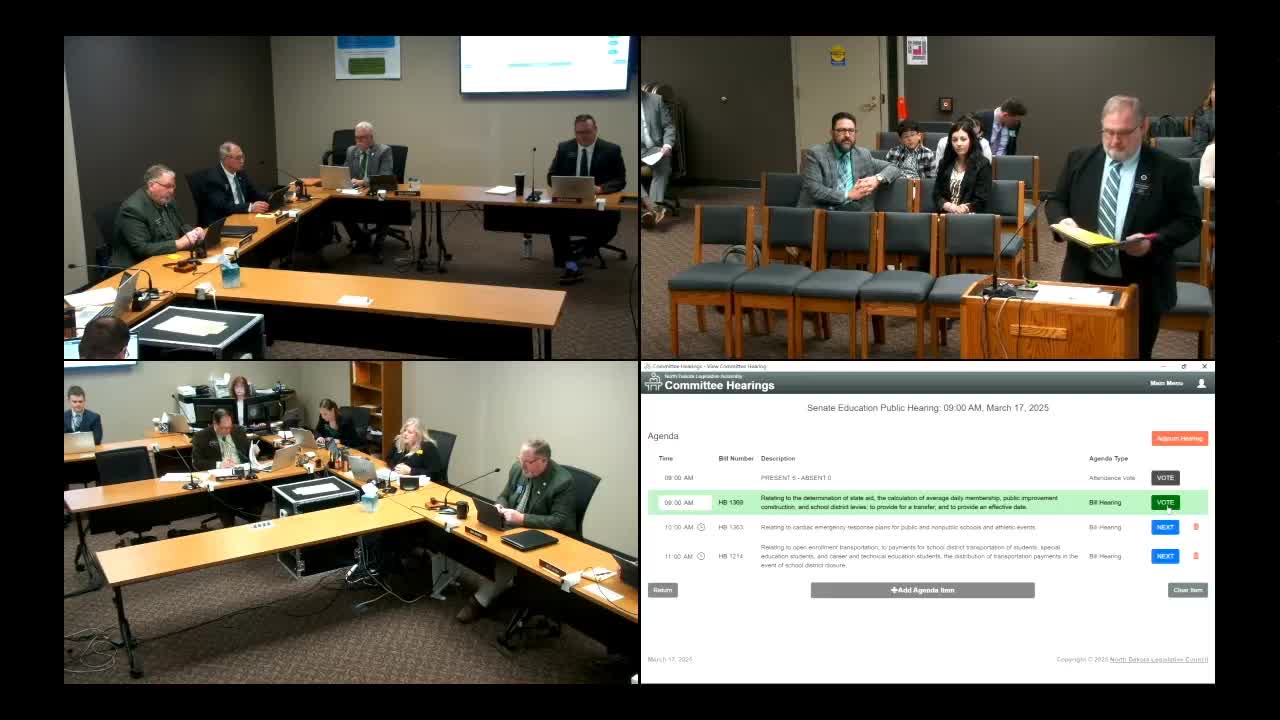
House Bill 13 69, the superintendent’s funding bill, was presented to the Senate Education Committee with proposals to increase per‑pupil payments, alter enrollment accounting and move $75 million into school construction loans.
Representative Jeff Heiner, the bill sponsor, told the committee the measure “is basically the superintendent’s bill and the per student payment,” and said Section 1 would increase the per‑pupil payment by 2 percent for the 2025–26 biennium and another 2 percent for the 2026–27 biennium. Heiner said the change “would amount to a total cost of 91,968,000” and stated the bill would set new per‑student dollar levels for the coming biennia (as presented in testimony).
The bill would also change how average daily membership (ADM) is calculated so districts receive the greater of the previous year’s ADM or a three‑year rolling average. Testimony to the committee focused heavily on that change and on adjustments to weighting for English language learners and special education.
Mike Crumwoody, representing the American Institute of Architects and the American Council of Engineering Companies, described a technical amendment to the bill’s construction and bonding language. He noted the underlying statute includes three separate dollar thresholds related to architecture, engineering and bonding and recommended aligning them to avoid procurement confusion. Crumwoody urged moving bonding language into the correct section and raising a $250,000 threshold in the bonding section to match the other thresholds.
Several school leaders and education organizations testified in support and urged larger increases and changes to student weightings: Jeff Osnat, superintendent of Bismarck Public Schools, asked the committee to consider raises comparable to those proposed for state employees and to review English learner weightings. Nick Archuleta, president of North Dakota United, and representatives from the North Dakota Council of Educational Leaders and school boards urged increases larger than 2 percent and supported raising EL and special education weightings. Superintendents from small rural districts described how a three‑year ADM average would soften sudden funding cliffs when small cohorts graduate.
Adam Tesher, school finance officer for the Department of Public Instruction, walked the committee through the department’s worksheet showing how ADM, weighting factors and local revenue produce each district’s formula payment. Tesher suggested, as a drafting alternative, making the rolling ADM adjustment a weight rather than changing the base ADM definition, to avoid unintended effects on other calculations such as on‑time funding.
No formal committee vote on House Bill 13 69 was recorded in the hearing transcript. Committee members asked technical questions; several speakers urged larger per‑pupil increases and higher EL/special education weights. The bill remains under discussion and could be revised in committee drafting before any vote.
Ending: Sponsors and witnesses said the intent is to stabilize funding for districts that face sudden enrollment drops and to align construction‑related procurement thresholds; the committee did not take final action during the hearing and directed staff to continue working on technical drafting and fiscal estimates.