Get Full Government Meeting Transcripts, Videos, & Alerts Forever!
Get email alerts on the Domestic‑violence Protection‑orders topic
No spam. Unsubscribe anytime.
Sponsor Seeks Statutory Fix to Keep Protection‑order Hearings Closed and Comply with VAWA
Summary
Senate Bill 2326 would amend North Dakota statute to close hearings and records for certain assault restraining orders and domestic violence protection orders, aligning state practice with federal Violence Against Women Act (VAWA) obligations and closing a public‑records pathway identified by court‑record search tools.
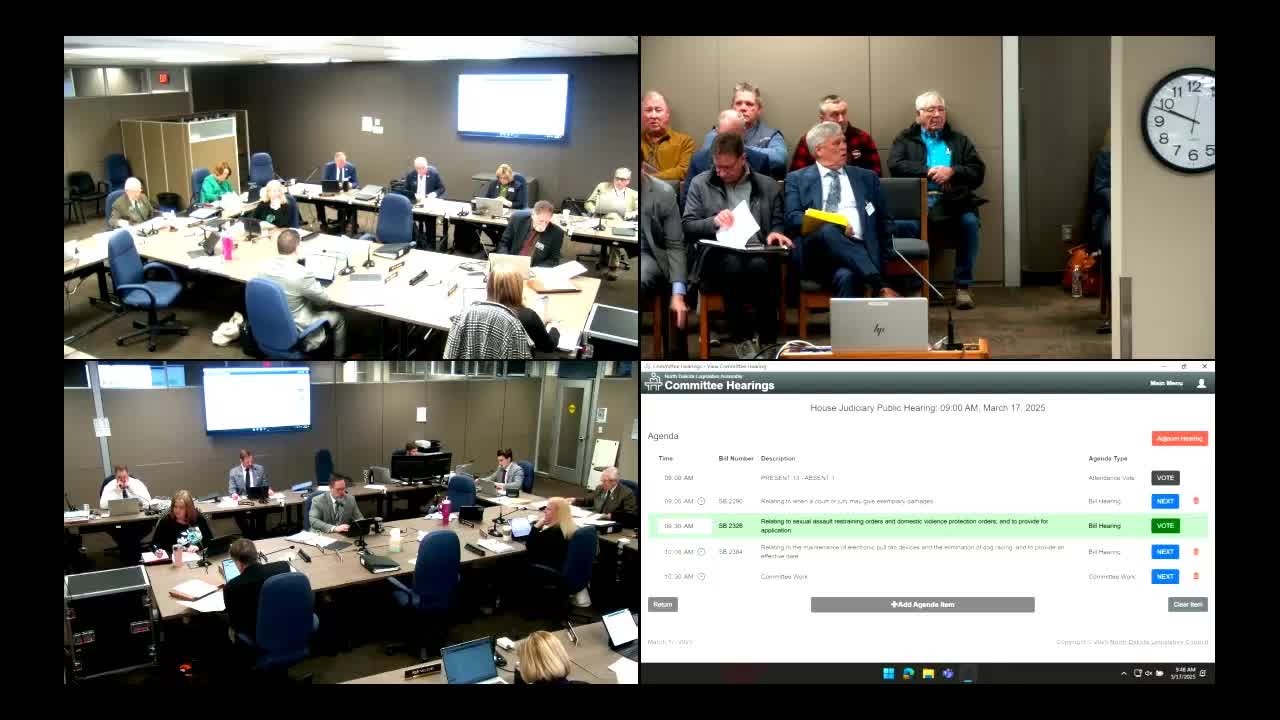
Senators and witnesses told the House Judiciary Committee that Senate Bill 2326 would codify current court practice by closing hearings and restricting online public access to petitions for certain protection orders.
Senator Josh Bochee (District 44), the bill sponsor, said the measure adds language in two sections of the Century Code to close hearings for criminal‑ and civil‑based protection orders and to prevent publication of petition filings on the state’s online court search site. "The Violence Against Women Act states that 'a state... shall not make available publicly on the Internet any information regarding the registration, filing a petition for, or issuance of a protection order ... if such publication would be likely to publicly reveal the identity or location of the party protected under such an order,'" Bochee told the committee and asked lawmakers to align state law with that federal requirement.
Bochee said the revision responds to a report from a juvenile‑justice worker who discovered that filings for protection orders could be viewed via the courts’ public search tool. He said courts already commonly close these hearings in practice, and the bill would remove doubt and ensure compliance with federal law. He also proposed a technical amendment to replace the word "victim" with "protected party" in several places to match VAWA terminology and better reflect situations where more than one person (for example, a parent and children) is protected by an order.
No opponents appeared at the hearing, and committee members had no questions for the sponsor. The committee closed the hearing after the sponsor’s presentation and supporting testimony.