Get Full Government Meeting Transcripts, Videos, & Alerts Forever!
Get email alerts on the Aviation Infrastructure topic
No spam. Unsubscribe anytime.
Appropriations panel holds Aeronautics budget bill amid questions over $120 million SIF request
Summary
The Government Operations section of the North Dakota House Appropriations Committee paused action on Senate Bill 2,006, the Aeronautics Commission budget bill, after members raised questions about a proposed $120 million one-time Strategic Improvement Fund appropriation and the reliability of a $20 million Prairie Dog allocation.
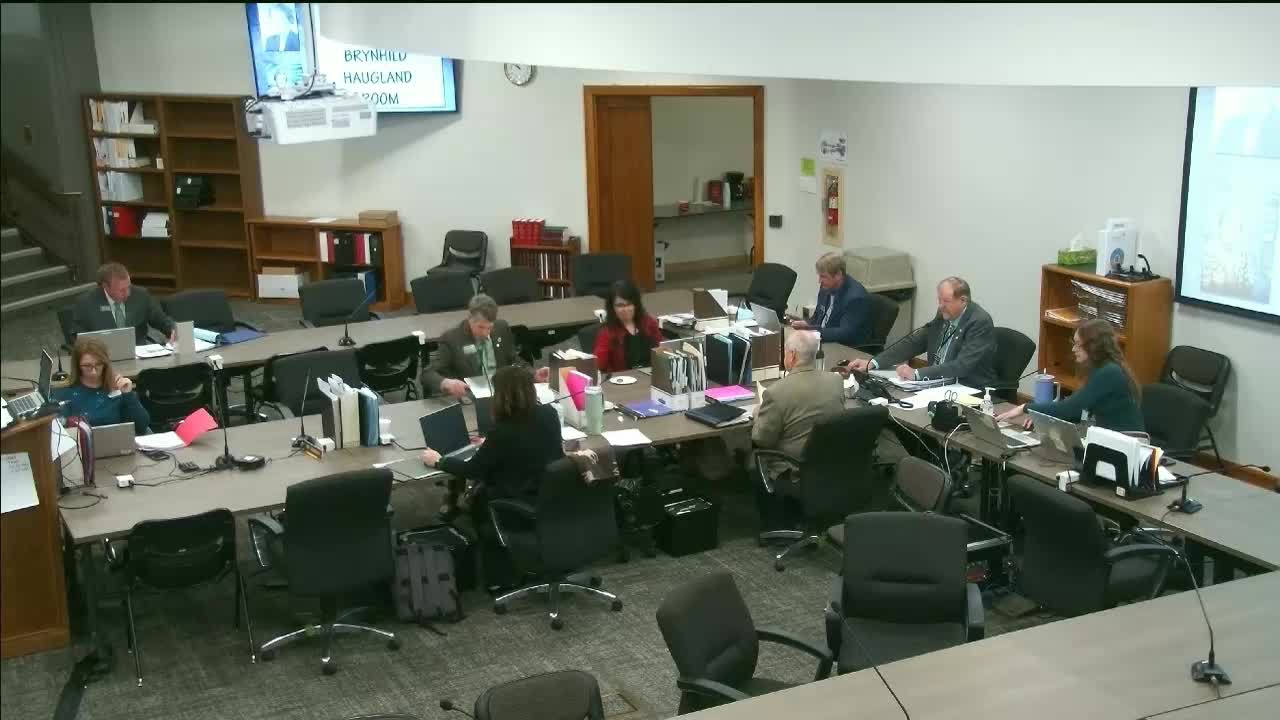
The Government Operations section of the North Dakota House Appropriations Committee paused action on Senate Bill 2,006, the budget bill for the North Dakota Aeronautics Commission, after members pressed the commission on whether state funding identified in the bill is guaranteed and how the timing of those funds would affect projects at Fargo, Grand Forks and Dickinson.
Committee members said the bill would authorize a one-time appropriation of $120,000,000 from the Strategic Improvement Investment Fund (SIF) for three generational projects at Fargo, Grand Forks and Dickinson and would also identify $20,000,000 from the airport infrastructure ("Prairie Dog") fund in the next biennium. Kyle Wanner, director for the North Dakota Aeronautics Commission, told the committee the $120 million is the commission's recommended amount and that the $20 million Prairie Dog allocation is uncertain because the revenue forecast may not produce those funds.
Why it matters: Committee members said state certainty about the funding stream matters because airports need state and local matches to leverage federal grants. Without guaranteed state funds, the commission and local airports may be unable to accept federal awards or proceed with multi‑year bids and construction phases.
Most important details
- The bill, as described to the committee, would: authorize a one-time $120,000,000 appropriation from SIF for three generational projects (Fargo, Grand Forks, Dickinson) and identify $20,000,000 from the airport infrastructure/Prairie Dog fund for use in the next biennium.
- Kyle Wanner, director for the North Dakota Aeronautics Commission, told the committee, "The current bill allocates a one-time allocation from the Strategic Improvement Investment Fund of $120,000,000 specifically for 3 generational projects at Fargo, Grand Forks and Dickinson." He added, "If the $120,000,000 was reduced or eliminated, that would have profound impacts on the airport system in the state beyond the 3 generational projects as well." (first reference: Kyle Wanner, director for the North Dakota Aeronautics Commission)
- Wanner also said the $20,000,000 Prairie Dog allocation "may not come" in the next biennium under the current revenue forecast, and that Prairie Dog funding historically arrives at the end of the biennium and is often carried forward.
- Committee members asked whether portions of projects could be financed through loans or bonding instead of up-front SIF cash. Wanner said Fargo already has a $40,000,000 loan from Bank of North Dakota and that Bank of North Dakota currently has about $14,000,000 available for new allocations, making very large loans unlikely. Representative Bosch asked, "Is there any flexibility where we could use the infrastructure revolving loan fund for some of this rather than just all upfront money?" (first reference: Representative Bosch)
- Members raised options including bonding, Bank of North Dakota loans, or splitting SIF across bienniums. Wanner said the requested $120,000,000 could be spent through 2029 and that he expects some spending to occur across multiple biennia.
Context and backstory
Wanner reviewed prior state airport investments dating to 2013, including a $60,000,000 allocation, a later $45,000,000 allocation of which only $3,000,000 was received during a downturn, a reallocation in a subsequent session, and a 2019 one-time $20,000,000 allocation for runway projects including Dickinson and Watford City. He also noted a recent federal development: Congress increased a national airport grant program from about $3.35 billion to $4.0 billion, which could raise the state's chances of receiving federal discretionary funds if the state and local matches are ready.
Points of concern raised by the committee
- Reliability of Prairie Dog funds: Members emphasized that the $20,000,000 identified from the Prairie Dog/airport infrastructure fund is uncertain in the current revenue forecast.
- Scope and prioritization if SIF is reduced: Several members asked whether one of the three generational projects should be removed if the $120 million were cut, or whether the Aeronautics Commission should decide which projects to prioritize.
- Local matches and debt capacity: Committee members asked how much local airports can borrow and whether the infrastructure revolving loan fund or Bank of North Dakota lending capacity could cover local shares; Wanner said there is some capacity for smaller loans but not large $10–$20 million loans in the current BND program.
- Timing and cash flow: Airports reportedly need assurance that state dollars are available before they accept federal grants or open bids; Wanner said some federal funds are already programmed for these projects, but state assurances matter for leveraging additional federal money.
Committee action and next steps
Committee members agreed to hold the bill and gather more information before moving it out of the Government Operations section. They asked the Aeronautics Commission to work with the three airports on cash‑flow projections (which phases need funds in which biennium), to consult with Bank of North Dakota about lending capacity, and to discuss bonding options with leadership. Representative Pyle and others volunteered to gather local numbers for their airports. The committee did not take a formal vote on the bill during the session.
Ending
The committee paused action to allow additional conversations with leadership, local airport authorities and the Aeronautics Commission. Members said they want clearer options for a state funding source (SIF, bonding, loans or a mix) before deciding whether to advance the bill.