Get Full Government Meeting Transcripts, Videos, & Alerts Forever!
Get email alerts on the Workforce Development topic
No spam. Unsubscribe anytime.
Commerce seeks restored funding for workforce and global talent programs in SB 2018 hearing
Summary
Department of Commerce officials told the House Appropriations — Education and Environment Division committee they need restored FTEs and program funding to sustain workforce programs including the Regional Workforce Impact Program, talent‑attraction efforts and the Global Talent Office; the Senate trimmed several requests.
Chairman Nathy opened a hearing on Senate Bill 2018 and the North Dakota Department of Commerce presented its budget request and program updates, asking the committee to restore positions and one‑time funding the Senate cut.
At the hearing Commissioner Chris Shilkin of the North Dakota Department of Commerce summarized the agency’s mission and budget request, saying commerce “exists to attract and retain wealth and talent for the state of North Dakota.” He asked the committee to reinstate the governor’s executive budget recommendations and highlighted requested FTEs including a procurement officer and a workforce program manager that the Senate removed.
Commerce officials reported a total base budget near $87,000,000 for the department, with roughly $33,400,000 in general funds, about $44,000,000 in federal funds and $9,500,000 in special funds. Commissioner Shilkin also described two proposed transfers the department included in the executive recommendation: a $50,000,000 request for the North Dakota Development Fund and $10,000,000 for the Legacy Investment for Technology (Lehi) program.
Katie Ralston Howe, workforce director for the Department of Commerce, walked the committee through workforce programs funded or requested in the executive budget. She said the agency seeks reinstatement of several items the Senate reduced and described performance concerns if salary and position requests are not approved, urging support for the governor’s total‑rewards proposal of 3 percent performance increases in both years of the next biennium.
Regional Workforce Impact Program (RWIP)
Howe described the Regional Workforce Impact Program, launched in April 2022 with $15,000,000 in ARPA funds and sustained at $12,500,000 for the 2023–25 biennium. She reported the division has awarded $26,500,000 to 113 projects, leveraging more than $16,000,000 in local match. Howe said childcare projects supported by RWIP are “supporting 60 facilities, adding more than 2,500 child‑care slots and more than 200 new child‑care workers,” and that the program has awarded 48 projects this biennium covering career exploration, talent attraction and childcare. The department requested $10,000,000 for RWIP in the upcoming biennium; the Senate reduced that request to $5,000,000, which the department said “presents significant challenges for the structure and implementation of this program.”
Talent attraction: Find the Good Life and ROOT
Howe described Find the Good Life, a talent‑attraction initiative the department runs with tourism and marketing. The program maintains a candidate marketplace and a community champion network to connect job seekers to employers and communities. Howe said the division currently has more than 5,000 job seekers in its pipeline (2,900 as of the day of testimony) and that the office has confirmed 80 movers plus 42 family members — 122 people the department tracks who have relocated to North Dakota through agency‑assisted efforts. Howe said the agency seeks $5,000,000 to sustain talent attraction activities shared between workforce and marketing; she added the Senate moved the Senate’s $5,000,000 allocation to marketing only and removed programmatic funding the workforce division uses to track and connect job seekers.
Global Talent Office (Office of Legal Immigration name change)
Howe reviewed the Global Talent Office (the department’s proposed name change from the Office of Legal Immigration) and the office’s work after passage of Senate Bill 2142. She told the committee the office “has quickly become a national leader” in helping employers navigate federal immigration processes and that it does not provide legal advice, certifications, or immigration enforcement functions. Howe described pathways used so far — E‑3 visas, secondary migration and Optional Practical Training (OPT) — and said nine employers have successfully recruited 15 employees since December, with 26 employers actively engaged in recruiting international workers.
Howe asked for $2,000,000 for the Global Talent Office for the next biennium (proposed split: $250,000 operating, $1,750,000 grants). She said the Senate cut that request to $1,000,000 and that Senate staff moved $500,000 to operating and $500,000 to grants. Department staff explained the office already has two FTEs (about $485,000 for two FTEs included in base funding following Senate Bill 2142) and one‑time operating dollars were added in the prior biennium.
Operation Intern, technical skills training, AmeriCorps
Howe described Operation Intern, the department’s wage‑matching program for internships and apprenticeships; she said the 2024 application window closed in one business day and that the department maintains a waitlist. She described changes intended to increase access for new businesses and noted Senate adjustments that affected ongoing budget calculations.
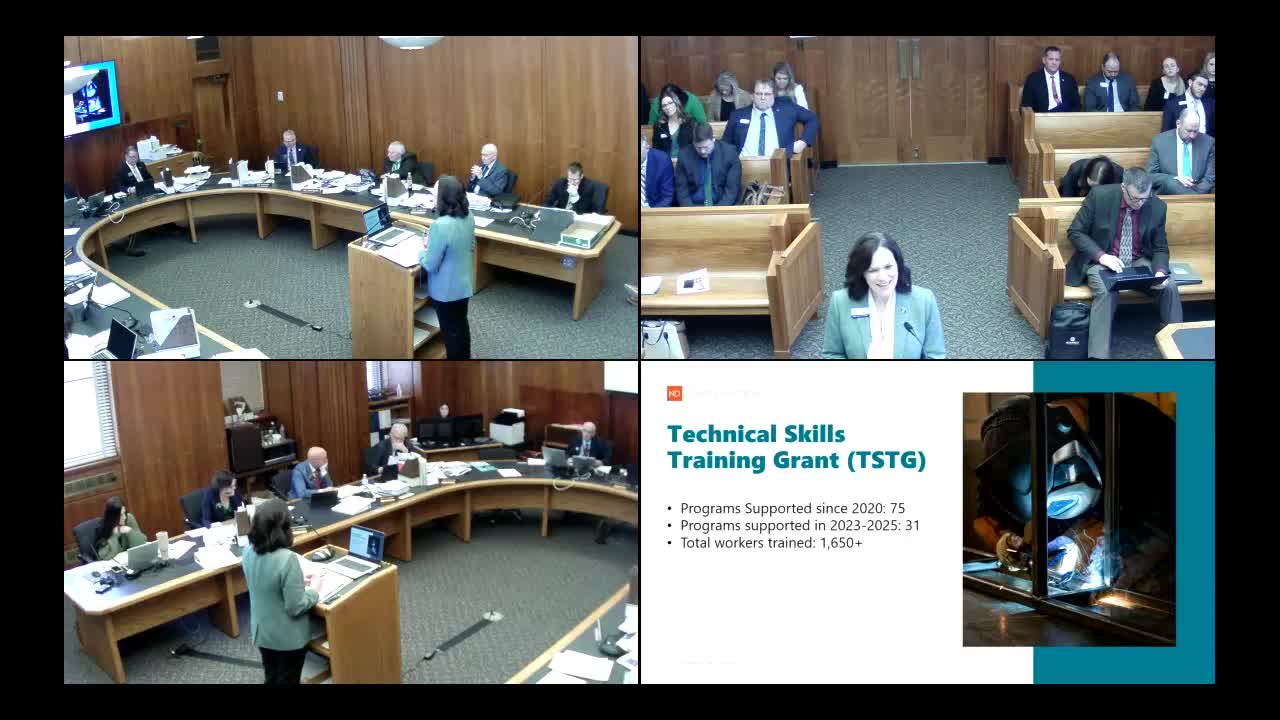
The department also highlighted the Technical Skills Training Grant (three tracks supporting accelerated non‑degree training, employer upskilling and workforce automation), reporting $1,400,000 obligated to 36 programs this biennium and a total of 75 programs supported since inception with capacity for more than 1,750 trainees. The department sought $2,000,000 for that grant for the next biennium.
Howe briefed the committee on AmeriCorps funding the department uses as the state match for federal AmeriCorps grants and said the federal program is “under evaluation.” She requested $552,000 for AmeriCorps match in the next biennium.
Senate changes and FTE requests
Commissioner Shilkin and workforce staff described two requested FTEs the Senate removed: a procurement officer (one FTE) and a workforce program manager; Shilkin said internal procurement responsibilities now consume 20 to 25 percent of staff time and that the agency needs a dedicated procurement officer. Committee members asked for clarifications about which line items are base funding, one‑time and grants; Allison Widmer, director of administrative services, clarified the Senate’s $1,000,000 modification to the Global Talent Office split the million into $500,000 operating and $500,000 in grants.
Why it matters
Commerce officials told the committee the discussed programs support rural employers, long‑term care facilities, childcare capacity, and technician training across energy, healthcare, manufacturing and other sectors. Officials emphasized that talent attraction and integration take time and that sustaining programmatic funding matters to preserve the state’s ability to connect job seekers to communities and employers.
The department concluded by asking the committee to reinstate the governor’s budget recommendations amended by the Senate and indicated staff would be available for follow‑up questions as the hearing continues into the afternoon.
Ending
The committee recessed and indicated the hearing will resume after floor activity; Commerce staff said they would remain available for questions throughout the day.