Get Full Government Meeting Transcripts, Videos, & Alerts Forever!
Get email alerts on the Public Health State Aid topic
No spam. Unsubscribe anytime.
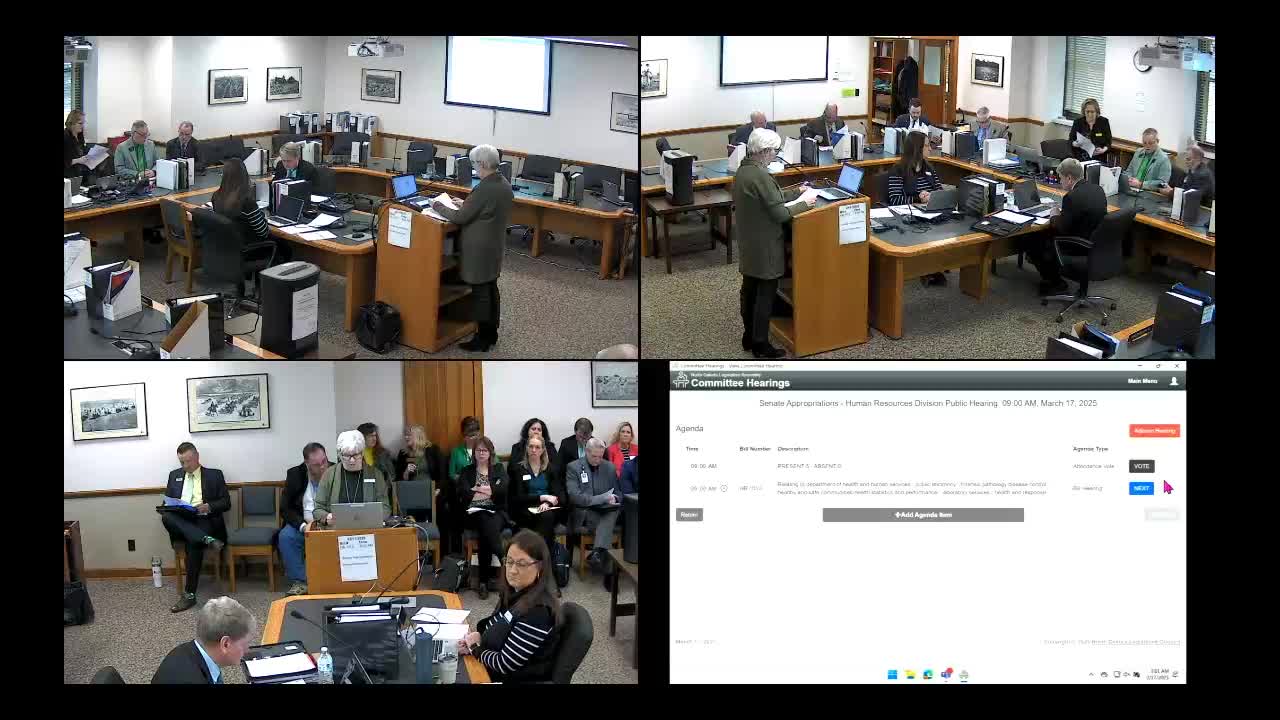
Local public health directors ask Senate panel to restore $2 million in state aid
Summary
Directors from multiple North Dakota local public health units told the Senate Appropriations Human Resources Division that flexible state aid helps cover gaps in federal grants, emergency response and everyday services and urged increasing biennial state aid from $8 million to $10 million (House proposal 10.12).
Multiple local public health administrators told the Senate Appropriations Human Resources Division on March 17 that flexible state aid is critical to responding to local needs and emergencies and urged the committee to restore a $2 million increase that the House omitted from the governor's budget.
Sherry Adams, Southwestern District Health Unit administrator, told the panel, "State aid is our most flexible funding that we have." She said local units use it for a wide range of needs from communicable disease response to suicide-prevention screening and environmental health work that licensing fees do not cover.
Why it matters: local health units said state aid lets them pivot when federal grants end or are delayed. Adams said, "For our health unit, our federal grants are 40% of our budget. Our state aid is only 6% of our budget," and warned that recent federal grant expirations and national disease trends could leave gaps that only state or local flexible funds could fill.
Panel testimony and examples: administrators from Western Plains, Bismarck Burleigh, First District and smaller rural units described ways they use state aid. Erin Arata, administrator at Western Plains Public Health, said state aid "made up 13% of Western Plains annual collections" in 2024 and described using that flexibility for emergency flood response and school vision screening that detected a vision problem in her first-grade daughter. Renee Mach, Bismarck Burleigh Public Health director, told the committee state aid provides an "equitable cost share" among local, federal and state funding sources and supports home-health maintenance, disease prevention, chronic disease work and health-promotion programs.
Rural and low‑wealth counties emphasized the distributional stakes. Barbara Friedland of Roullette County Public Health said her unit is limited by statute to a 5‑mill levy and receives about $57,000 a year in state aid (about 3% of its budget); she said some pass-through federal grants and base immunization and emergency preparedness allotments are only a few thousand dollars each and do not cover local needs.
Concerns raised: speakers asked the committee to account for uncertain federal funding streams (many COVID-era grants and other CDC-supported programs were said to be expiring this biennium) and for possible limits on county mill levies that could constrain local matching revenue. Adams also warned of disease threats: "We are really concerned about a potential measles outbreak in North Dakota…we're not sure we're going to get federal funding if measles would happen in North Dakota." Several speakers described maintaining reserves because federal pass-throughs can arrive late; Adams said her unit holds a reserve to cover about six months of operations.
What they asked: multiple witnesses explicitly supported the House proposal on House Bill 10.12 to increase the biennial state aid pool for local public health from $8,000,000 to $10,000,000 and asked the committee to reinstate or preserve that funding.
Outlook: committee members asked for additional data (total budgets and staffing numbers across the 28 local health units, mill-levy tables and clearer statewide cost breakdowns) that witnesses offered to supply. No formal committee action or vote occurred during the testimony.
Ending: the committee continued hearings; witnesses said they will provide requested breakdowns of budgets, mill levy rates and staffing to help the legislature evaluate the request.