Get Full Government Meeting Transcripts, Videos, & Alerts Forever!
Get email alerts on the Civil‑justice Exemplary‑damages topic
No spam. Unsubscribe anytime.
Panel Hears Testimony on Bill to Redefine "Malice" and Remove DUI Carve‑Out for Exemplary Damages
Summary
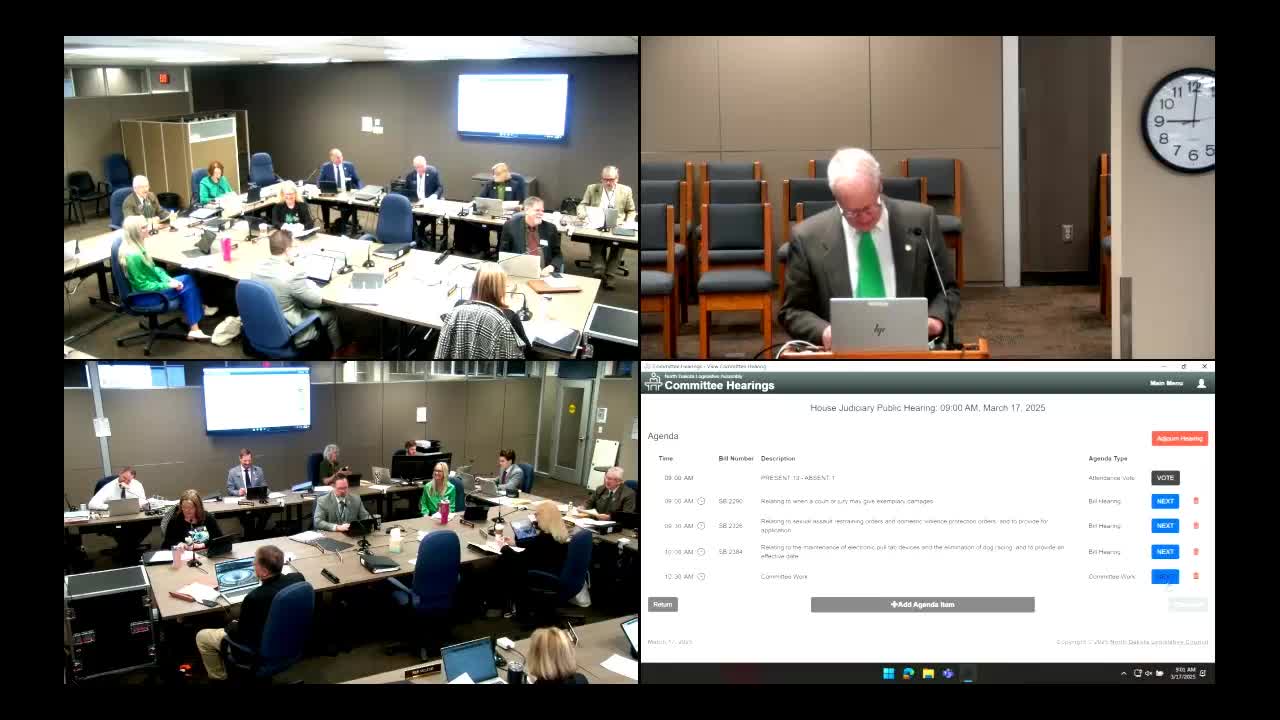
The House Judiciary Committee heard competing testimony on Senate Bill 2290, which would insert a jury‑style definition of malice into statute and remove a five‑year DUI exception that can block exemplary damages claims.
The House Judiciary Committee heard testimony on Senate Bill 2290, which would (1) replace the current statutory phrase "actual malice" with a jury‑style definition of malice and (2) remove a statutory carve‑out that limits exemplary (punitive) damages in some DUI cases.
Supporters told the committee the bill brings statutory language in line with the jury instructions currently used by North Dakota courts and would allow juries to consider exemplary damages in DUI crashes regardless of prior DUI history. "Exemplary damages, also known as punitive damages, are financial compensation awarded to a plaintiff not just to compensate them for their actual loss, but to punish the defendant for particularly harmful or egregious behavior and to deter others," said Jackie Hall, executive director of the North Dakota Association for Justice. Hall said the current statute and the jury instructions differ in their standards, causing confusion.
The bill’s second change would remove a statutory limitation that, in practice, can prevent exemplary damages in DUI cases unless an offender had another qualifying DUI within five years. Several supporters tied that change to facts in a high‑profile crash described to the committee. Attorney Jeff Wycomb and counsel for crash survivor Sheena (Shana) Munson described a 2015 head‑on crash in which Munson and two classmates were struck by a wrong‑way driver whose blood‑alcohol level was reported at 0.295. Wycomb said juries had awarded punitive damages in trials but that state Supreme Court decisions and statutory language have blocked or reduced recovery in the appeals process.
Opponents focused on the bill’s first section, which they said would lower the threshold for awarding punitive damages beyond intentional, malicious conduct. Dennis Pathroff, speaking for the American Property Casualty Insurance Association, said the change would "redefine and dilute malice to include anything that might be considered unintentional and reckless," and warned it could increase litigation and insurance costs. Kerry Silverman of the American Tort Reform Association likewise urged the committee not to reduce the standard that reserves punitive awards for "the most truly reprehensible conduct."
Committee members asked practical questions about payment and caps. Witnesses noted that standard liability insurance excludes punitive/exemplary damages, so an award would typically be the individual defendant’s obligation unless the defendant had umbrella or other coverage. Witnesses also discussed statutory limits discussed in case law — a committee member referenced the statute and prior court rulings noting that exemplary awards may be limited to multiples of compensatory damages or capped amounts in some cases.
No formal committee action or vote on the bill was recorded in the hearing.