Get Full Government Meeting Transcripts, Videos, & Alerts Forever!
Get email alerts on the Education Math Instruction topic
No spam. Unsubscribe anytime.
Committee hears bill to set statewide math teacher competencies, screening and $1.2M for training
Summary
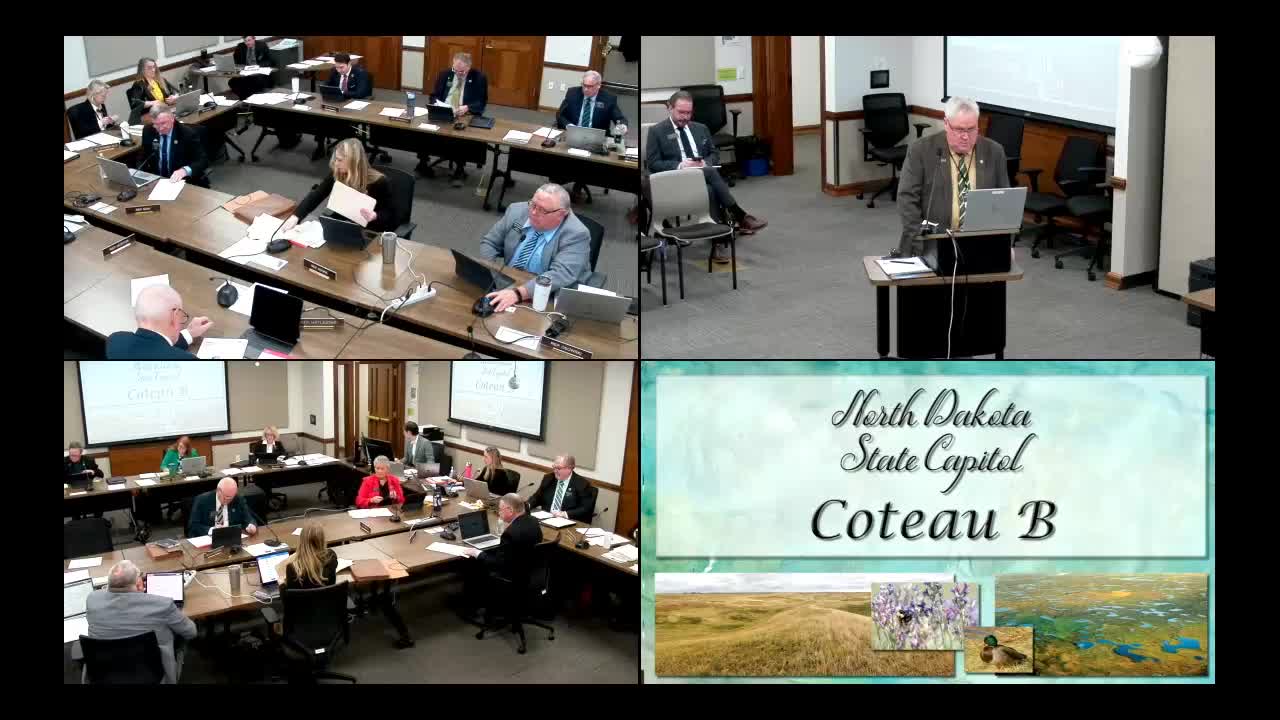
Senators and education officials described Senate Bill 2,213 as a statewide effort to strengthen math instruction during a House Education Committee hearing; the bill would add new mathematics-instruction competencies to teacher licensure, require screening and targeted interventions for students with math deficiencies, set administrative rulemaking and reporting requirements, and provide $1,200,000 for professional development and coaching.
Senators and education officials described Senate Bill 2,213 as a statewide effort to strengthen math instruction during a House Education Committee hearing; the bill would add new mathematics-instruction competencies to teacher licensure, require screening and targeted interventions for students with math deficiencies, set administrative rulemaking and reporting requirements, and provide $1,200,000 for professional development and coaching.
Senator Don Schaible, who introduced the bill, told the committee the measure was modeled on North Dakota’s recent “science of reading” work and is intended to mirror that approach for mathematics. “Senate bill 2,213 attempts to make the same improvements to the implementation of our math instruction,” Schaible said, summarizing the bill’s scope and the areas it would change in licensure and classroom practice.
The bill would add math-competency language to teacher licensing (separate sections addressing grades 6–12 and grades 1–8), define foundational skills and assessment expectations, require screening for students with mathematics deficiencies and parent notification during that screening, and direct the superintendent and the K–12 coordination council to develop rules and work with regional education agencies (REAs) on implementation.
Anne Ellifson, director of academic support at the North Dakota Department of Public Instruction (DPI), framed the bill as a response to state NAEP results and pandemic-related learning loss. Ellifson told the committee that the 2024 NAEP results showed “43 percent in grade 4 and 29 percent in grade 8,” and said the legislation seeks a comprehensive approach across curriculum alignment, professional development, screening and intervention, and instructor competencies.
Ellifson also addressed the bill’s language on dyscalculia, saying it would identify “characteristics of dyscalculia” but would not require schools to make clinical diagnoses. “It would not require a school or a district to diagnose dyscalculia,” she said, noting that diagnosis would typically come from special education teams or outside specialists, while the classroom efforts would focus on identifying characteristics and providing supports.
Committee members raised questions about timeline and capacity. Representative Schreiberbeck asked whether the $1,200,000 provision was already in the DPI budget; committee members were told the amount would be an additional appropriation if the bill passes. Members also asked about coordination with higher-education teacher-preparation programs and whether colleges have been involved; witnesses said higher education has been consulted and that program approval and standards review are already underway.
Several education stakeholders endorsed the bill while urging flexibility for districts already implementing successful math programs. Kevin Howartz, representing the North Dakota Council of Educational Leaders, recommended that the bill allow districts that have demonstrable success with existing professional development to continue their programs rather than forcing a wholesale switch. “Don’t try fixing something that’s working already,” he said, urging that local success be preserved.
Nonprofit New Classrooms urged the committee to add explicit language supporting personalized, competency-based supplemental tools and diagnostics so teachers can identify students’ current skill levels and create individualized pathways spanning multiple grade levels. Alexandra Morris, deputy director at New Classrooms, recommended amending the bill to fund and authorize evidence-based diagnostic tools and supplemental materials linked to professional learning for teachers.
Supporters noted DPI’s prior use of federal ESSER funds for literacy and math pilots and described ongoing REA–DPI work such as the Greater Math pilot and the North Dakota Effective Math Instruction initiative. Testimony emphasized that professional development plus aligned curriculum and high-quality materials are necessary for classroom impact.
No formal action or vote occurred during the hearing; the committee closed testimony and will consider the bill in future committee work. The hearing record shows committee interest in timeline, funding source, coordination with teacher-preparation programs, and safeguards for districts already demonstrating progress.
For now, proponents say the bill aims to replicate the statewide approach used for reading and extend similar standards, screening, and support to mathematics instruction in K–12 classrooms.