Get Full Government Meeting Transcripts, Videos, & Alerts Forever!
Get email alerts on the Parental Rights Healthcare topic
No spam. Unsubscribe anytime.
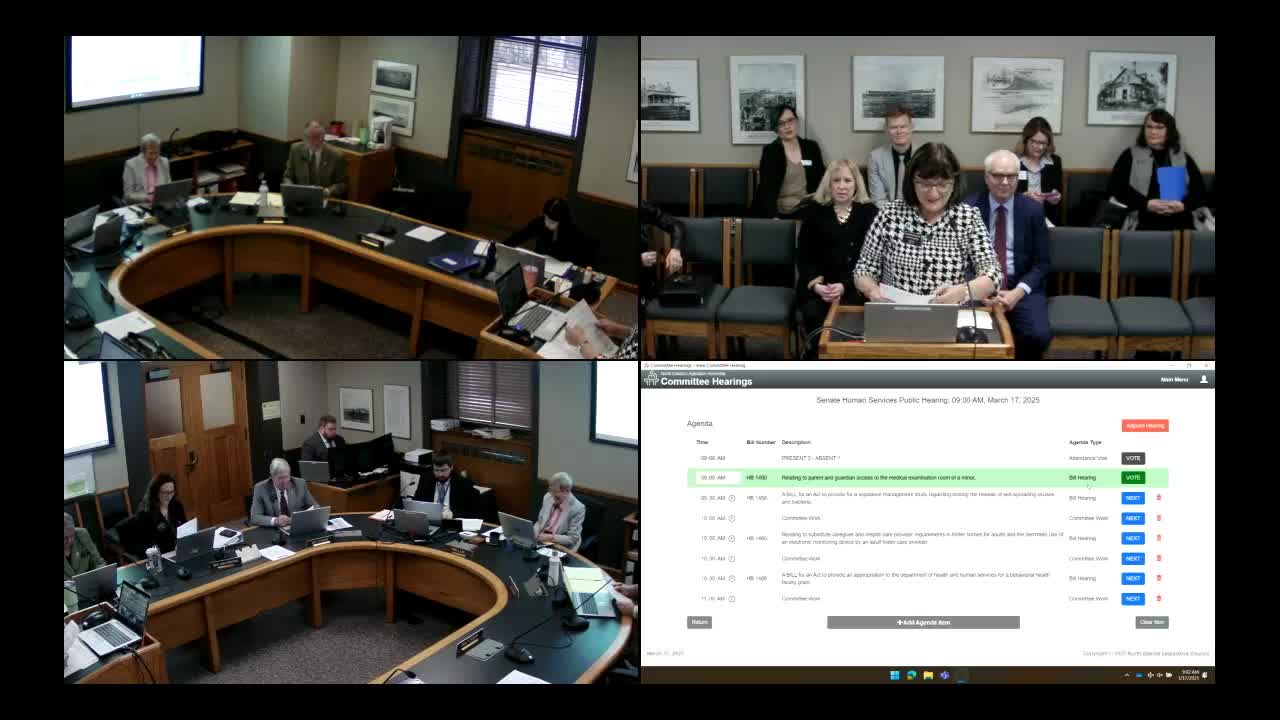
Senate Human Services hears bill to guarantee parent access to minor’s medical exam room
Summary
House Bill 1450, introduced to the Senate Human Services Committee, would add a section to Chapter 14-10 declaring that a parent or guardian "has full access to an examination room in which their child is receiving care," requires notice of parents’ rights, allows a privacy screen and requires written notice before standardized questions not related to the visit are asked of a minor.
House Bill 1450, introduced to the Senate Human Services Committee, would add a section to Chapter 14-10 declaring that a parent or guardian “has full access to an examination room in which their child is receiving care,” requires notice of parents’ rights, allows a privacy screen and requires written notice before standardized questions not related to the visit are asked of a minor.
The bill was introduced by Representative Sue Ann Olson, who told the committee the measure is “a simple but important bill that protects parents' rights in medical exam rooms.” Olson said the bill would require providers to give parents written notice of the categories of questions that may be asked, whether answers will be recorded or shared, and a right to opt out of questions unrelated to the purpose of the visit.
Supporters told lawmakers the proposal would stop parents from being excluded from exam rooms in routine visits. Matt Flanders, legislative and policy director at Citizens’ Council for Health Freedom, described cases reported to his organization in which parents said they were asked to leave and their children were questioned alone. “Our organization fully supports House Bill 14 50, which provides clear protections for parent and guardian rights,” Flanders said.
Senator Jose Castaneda described personal experiences in which providers asked parents of adolescents to leave without a clear explanation, and said the bill would preserve parental authority while allowing exceptions when abuse is suspected. “I do feel that many times it is made into a ‘you will get out’ … It should be a team effort,” Castaneda said, urging safeguards while preserving parents’ presence.
Health care groups, child advocates and human-services leaders opposed the bill or urged major revisions, saying it would undermine clinical practice and mandatory reporting. Dr. David Field, a family physician testifying for the North Dakota Medical Association, said clinicians cannot predict all the follow-up questions they may need and that private conversations between provider and minor are sometimes necessary to identify abuse, neglect or mental-health needs. “If a physician or other practitioner is not allowed to ask the questions that may lead to revealing the problem, the exemption is meaningless,” Field said.
Representatives of the North Dakota Hospital Association and the state’s human service zone directors warned the bill’s exemption language is narrow and potentially unworkable. Melissa Hower, general counsel for the hospital association, told the committee that the bill’s exemption for “suspected case[s] of physical or sexual abuse when the provider has documented the concern and notified the appropriate authorities” would require documentation and notification before a clinician could speak privately with a child — a step that, she said, may be impossible in many clinical encounters and could delay protection or treatment.
Kim Jacobson, director of the Agassiz Valley Human Service Zone, said the bill’s language could conflict with existing statutes and with situations in which zones or courts hold custody or guardianship. Greg Kosowski of Children’s Advocacy Centers of North Dakota told the committee that requiring parents to be present for all questions would deter disclosure; he said 96% of children who disclose abuse know their abuser and that private time with a clinician or forensic interviewer is often the only safe window for disclosure.
Several committee members pressed for data about how frequently parents are excluded and whether the committee should legislate based on anecdote rather than documented local complaints; Olson and supporters said they had received reports and argued the law would provide clarity for parents and providers.
No committee vote on the bill was recorded in the hearing transcript. Lawmakers, physicians and advocacy groups agreed there are trade-offs between parental involvement, patient confidentiality and mandatory reporting; several senators asked sponsors to consider narrowing or clarifying the exemptions and the bill’s notice requirements.
The committee hearing concluded with members hearing multiple perspectives and several witnesses urging changes to the bill’s language to avoid unintended interference with mandatory reporting and emergency care.