Get email alerts on the Legislative Term Limits topic
No spam. Unsubscribe anytime.
Judiciary Committee backs bill clarifying when legislative term limits begin to count
Summary
The Senate Judiciary Committee recommended a 'do pass' on House Bill 1300, which interprets legislative term limits as prospective and counts service starting when a person is first elected or appointed after the amendment's effective date; sponsors said the bill aims to avoid costly court disputes about partial terms.
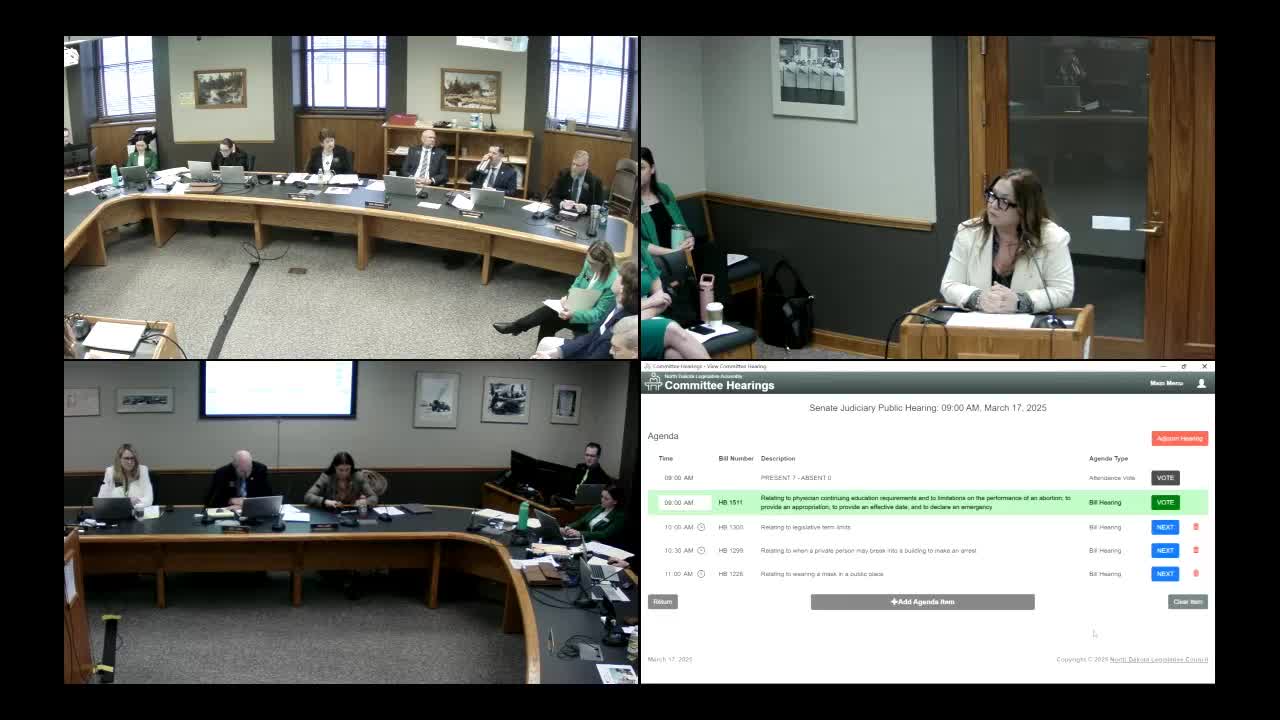
House Bill 1300, introduced March 17 by Representative Ben Koppelman, would instruct how the legislative assembly interprets the recently adopted term-limit amendment to the state constitution. Koppelman told the committee the statutory language would clarify that the limitations established by the amendment have prospective effect only and that service is counted from the time an individual is first elected or appointed after the amendment’s effective date, not retroactively.
Koppelman said the bill is intended to offer a legislative interpretation rather than to amend the constitution, noting precedent for implementing statutes following constitutional changes. He described competing readings that could leave some officeholders with shorter or longer permissible service depending on whether partial terms served before the amendment counted toward the eight-year cap. "When you read the section ... it's saying this is intended to be prospective," Koppelman said, summarizing his reading of the constitutional language.
The committee voted to recommend a "do pass" for House Bill 1300. Senator Myrtle moved the recommendation and Senator Lueck seconded; senators recorded on the transcript as voting in favor included Senator Brownberger, Senator Luke, Senator Mittel, Senator Paulson, Senator Castaneda, Senator Lueck and Chair Larson. Chair Larson announced the motion carried and said Senator Myrtle would carry the bill.
Supporters told the committee the bill will reduce uncertainty and avoid piecemeal litigation over who can run again after the amendment, while opponents were not recorded at the hearing. Koppelman noted the proposal does not change the substance of the amendment voters approved; it only resolves an ambiguity about partial terms and appointments that he said could otherwise spawn costly court challenges.
The committee’s favorable recommendation sets the bill up to move to the next stage of the legislative process; Senator Myrtle was designated to carry the bill forward.
AI generated
The text on this page is AI generated. Summaries, highlights, analysis, and video transcripts are all produced from the original source material.
AI can make mistakes, so if you spot one, and we will fix it for everyone.
Note: the source content is unaltered by us. Any content source we link to, be it a video, an audio recording, or a document, is presented exactly as its publisher released it. That publisher is usually a government body, sometimes an individual official or another organisation.