Get Full Government Meeting Transcripts, Videos, & Alerts Forever!
Get email alerts on the Physician Education Abortion topic
No spam. Unsubscribe anytime.
Committee hears bill to require physician education on North Dakota abortion laws
Summary
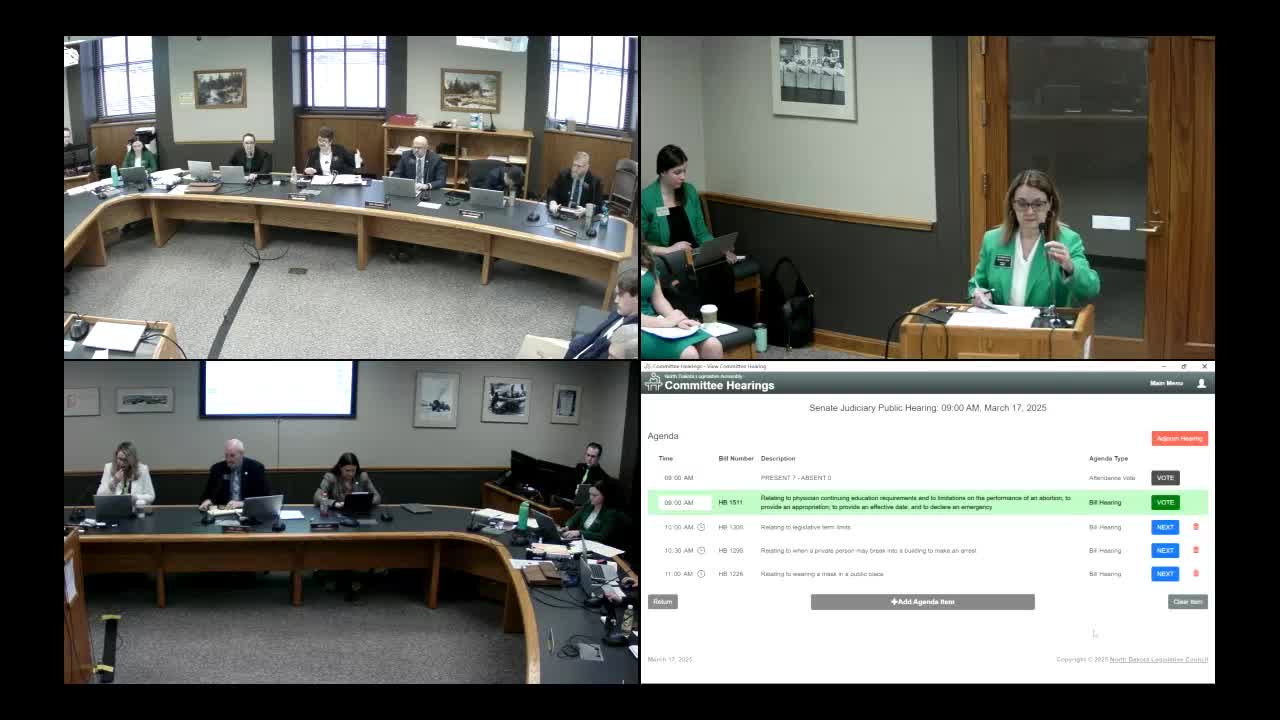
House Bill 1511, introduced March 17 before the Senate Judiciary Committee, would require physicians who engage in the practice of obstetrics in North Dakota to complete a state-developed instructional course on abortion-related statutes as part of licensure renewal, Representative Rohrer told the committee.
House Bill 1511, introduced March 17 before the Senate Judiciary Committee, would require physicians who engage in the practice of obstetrics in North Dakota to complete a state-developed instructional course on specific state statutes relating to abortion as part of licensure renewal requirements, Representative Rohrer told the committee.
The bill directs the Office of Management and Budget to contract for development of the course, with final approval by the state attorney general, and appropriates $50,000 for that purpose. Section 1 would prohibit any abortion except when performed by a licensed physician engaged in obstetrics using applicable medical standards. Section 1, subsection 4 would require that a physician “review the educational information created under section 43-17-27.1” within a set period before performing an abortion; Representative Rohrer suggested amending that period from one year to two years. Section 2 would require the Board of Medicine to require obstetrics physicians to complete an instructional course addressing North Dakota Century Code chapters cited in the bill, and section 4 would make sections 1 and 2 effective Jan. 1, 2026. Section 3 appropriates $50,000 to OMB to develop the instructional course, and section 5 declares that appropriation an emergency measure.
Supporters told the committee the bill’s purpose is educational. Dr. Jerry O'Breach, an obstetrician-gynecologist who said he has practiced in the state for more than 30 years and teaches at the University of North Dakota School of Medicine, said the course would provide clarity for physicians after the 2023 legislative changes. "This bill would afford an opportunity for OB-GYNs to obtain accurate information, alleviating undue fear and anxiety about criminal prosecution practicing within the confines of the current statute," Dr. O'Breach said. The North Dakota Right to Life, the North Dakota Catholic Conference and North Dakota Family Alliance Legislative Action also testified in support, saying education would reduce uncertainty among clinicians.
Opponents and neutral parties raised implementation and legal concerns. Sandra de Pontes, executive director of the North Dakota Board of Medicine, said the board is neutral on abortion policy but opposes mandating a course as a licensure requirement because of logistics and existing interstate licensure compacts. "The board supports having education on the topic available, but not as a condition for licensure and renewal," de Pontes said, and she offered an amendment to remove the licensure requirement while making the course available on the board's website. The board noted more than 60% of North Dakota licenses come via the Interstate Medical Licensure Compact, which limits adding state-specific requirements for compact licenses.
Physician witnesses opposing the mandate said education alone would not resolve the core legal risk clinicians reported. Dr. Anna Tobias, an OB-GYN and maternal-fetal medicine specialist, told the committee that physicians and hospital legal teams continue to fear criminal exposure because "anyone can question reasonable medical judgment" under current statutes and that mandatory training would not immunize clinicians from prosecution. Multiple practicing obstetricians said the bill’s timeline and content were not sufficiently defined in the proposed language and that a statutory provision the bill would teach is currently the subject of a pending appeal before the North Dakota Supreme Court.
Testimony also focused on practical questions: whether the course would be accredited to count as continuing medical education, how the Board would verify completion, how frequent refreshers should be, and whether the course could be updated rapidly if the law changes. Opponents noted the bill contains no explicit limit on course length (witnesses testified they envision a one-hour module), no accreditation requirement, and no mechanism guaranteeing availability for physicians licensed across many states.
The committee did not vote on HB 1511 during the hearing. The record shows multiple parties offered amendments and proposed alternative approaches, including the Board of Medicine’s amendment to keep the material available but not mandatory and Representative Rohrer’s suggested amendment to change the review period from one year to two years. The committee closed the hearing on HB 1511 and moved on to other bills without taking a final vote on the measure.
The bill centers on education about statutes enacted in the 2023 session (referred to repeatedly in testimony as Senate Bill 2150 and the corresponding North Dakota Century Code provisions), and witnesses noted the legal environment remains unsettled while parts of the law are under judicial review.