Get Full Government Meeting Transcripts, Videos, & Alerts Forever!
Get email alerts on the Dementia Care topic
No spam. Unsubscribe anytime.
Committee advances cleanup to North Dakota dementia care services law
Summary
A House Human Services Committee voted unanimously to give Senate Bill 2140 a "do pass" recommendation; the bill updates language that authorizes the state'contracted dementia care services program to reflect earlier intervention and modern diagnostic practices.
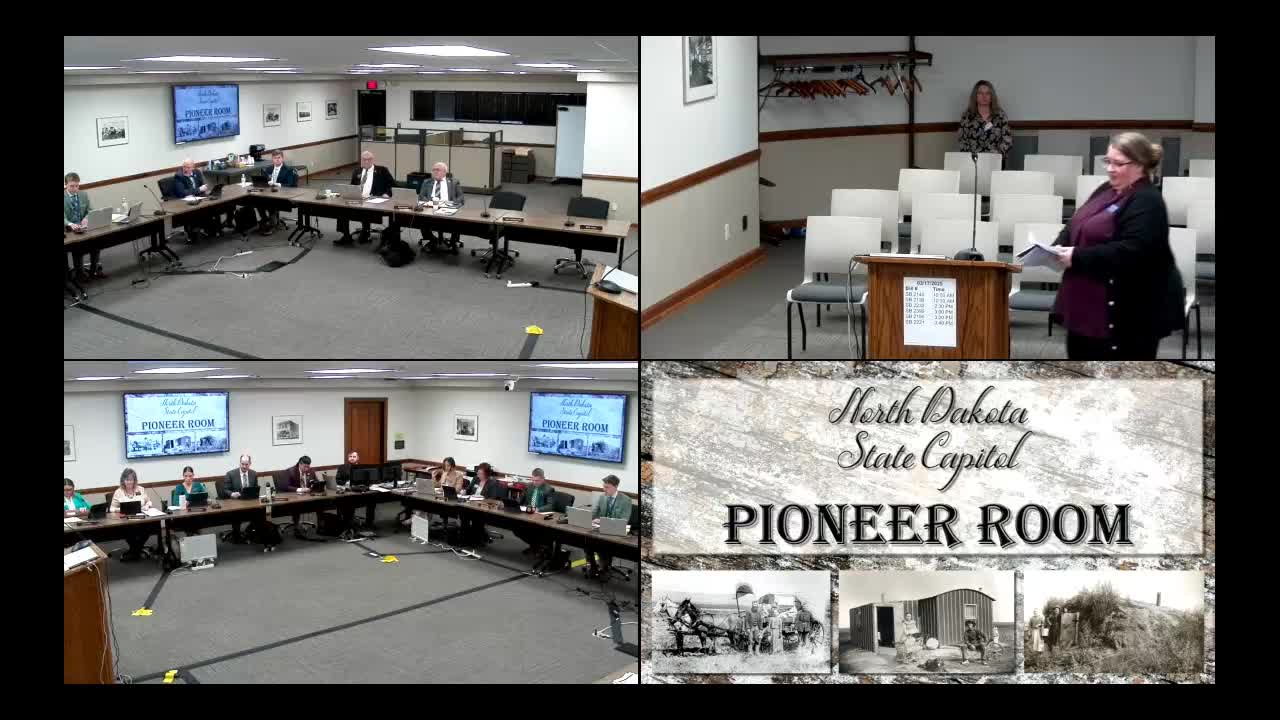
BISMARCK -- The House Human Services Committee voted to give Senate Bill 2140 a "do pass" recommendation after testimony that the measure makes technical updates to the statute authorizing North Dakota's dementia care services program.
Melanie Gaby, North Dakota public policy director for the Minnesota-North Dakota chapter of the Alzheimer's Association, told the committee the bill is a cleanup measure to align statutory language with current research and practice and does not change the program's purpose or goals. "The changes are simply to bring the authorizing language into alignment with what has changed through research and ensure we continue providing services to the North Dakotans who need to know they aren't navigating Alzheimer's disease and related dementias alone," Gaby said.
The dementia care services program is a state-managed contract administered by the Adult and Aging Services section of the Department of Health and Human Services and delivered by the Alzheimer's Association, Gaby said. She described care consultations, education and training, and referrals as core services that the program provides free of charge across North Dakota. For the current contract period beginning July 1, 2023, she said the program delivered just over 2,000 care consultations, provided information and referrals for more than 1,200 caregivers and trained hundreds of law enforcement and health-care professionals.
Gaby said the bill updates the statute's client definition so that access to services can be based on symptoms aligned with mild cognitive impairment as well as diagnosed dementia. "Many of our clients come to us through referrals from our partners and have yet to receive a formal diagnosis of dementia prior to seeing us," she said. The change would allow the program to begin providing support earlier, she said.
Morris Hardy, director at Dakota Central Human Service Zone, testified in support of the bill and described how human service zones and community partners respond when older adults exhibit concerning behaviors that can be related to dementia. "To better equip our community partners, access to credible information and support is key," Hardy said.
Committee members questioned confidentiality and operational details. Representative Fralick asked whether the program's assessments are used in court competency hearings; Gaby replied the association's consultations include confidentiality protections, disclosures can be handled by family consent or disclosure agreements, and staff are mandated reporters when required. Representative Fegley asked whether the program operates statewide; Gaby said program staff travel across the state and that they do not have offices in every town but provide services border-to-border.
The committee voted on a motion by Representative Freilich to give Senate Bill 2140 a due pass; Representative Rohrer seconded. The clerk recorded the vote as "Motion carries 11-0-2." Representative Kiefert volunteered to carry the bill.
The hearing record and testimony noted the underlying statute authorizing the program as North Dakota Century Code 50-06-33; the bill makes technical updates to bring that language into alignment with current understanding of disease progression and diagnosis.
The committee closed the hearing with unanimous support and moved the bill forward to the next stage of review.