Get Full Government Meeting Transcripts, Videos, & Alerts Forever!
Get email alerts on the Higher Education Hiring Transparency topic
No spam. Unsubscribe anytime.
Committee Hears Bill Requiring NDUS to Pre‑Plan Hires, Adds Reporting to Budget Section
Summary
Representative Eric Murphy introduced an amended version of House Bill 11 61, which would require the North Dakota University System to pre‑identify planned faculty, staff and administrators and report quarterly on use of a designated internal hiring pool to the budget section.
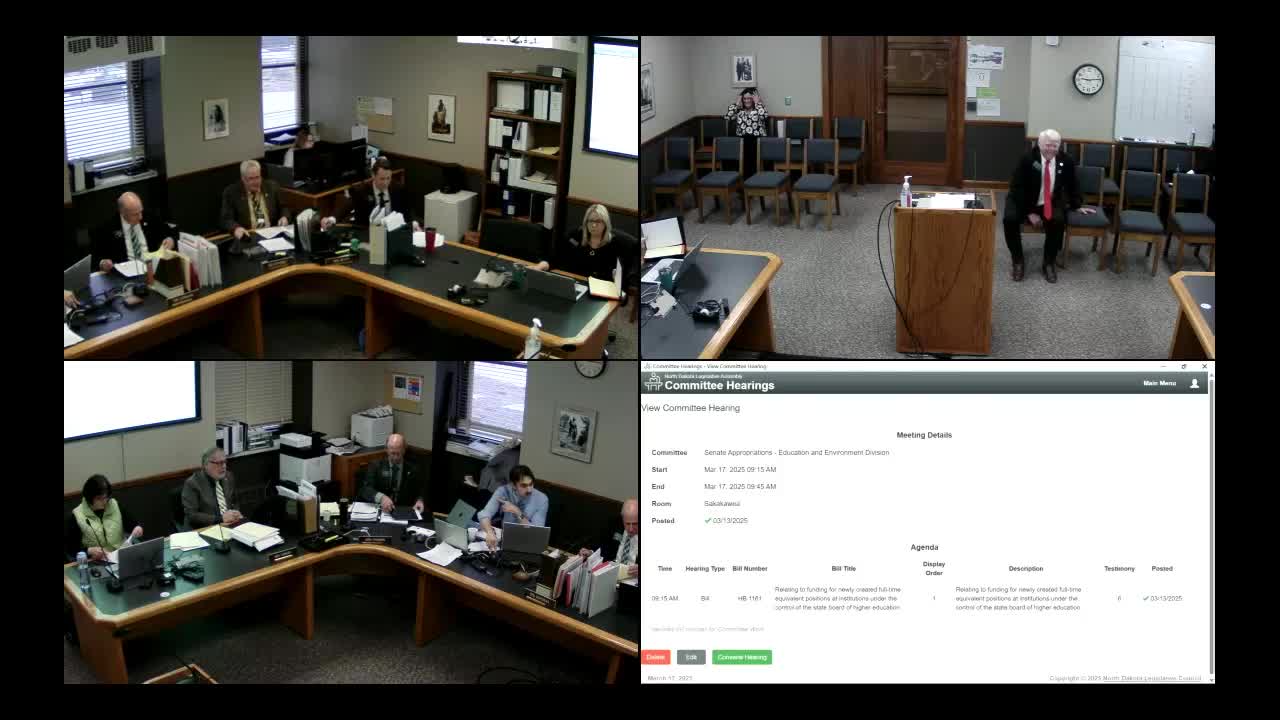
Representative Eric Murphy introduced an amended version of House Bill 11 61 on behalf of the North Dakota University System (NDUS), telling the Appropriations — Education and Environment Division that the bill would require institutions to pre‑identify hires and report use of a dedicated internal hiring pool to the budget section.
The bill would require NDUS, on even‑numbered years, to list the faculty, staff and administrators each institution plans to hire over the upcoming biennium and place funds into an internal account to support those positions; those funds, Murphy said, could be used for operations if necessary and would be reported quarterly to the budget section by the State Board of Higher Education (SBHE). "And so the idea is on even numbered years, they're going to list the faculty, staff, and administrators they plan on hiring over the biennium," Murphy said during his presentation.
Murphy said the amended version preserves the SBHE's constitutional authority as the designated reporter to the budget section, removes an original "clawback" provision, and aims to increase transparency about how higher education uses general fund and other revenues for hiring. He described the change as intended to help the legislature and the budget section track whether institutions hire the positions they planned to fill and to justify deviations (for example, hiring administrators instead of faculty).
Senator Thomas questioned whether the requirement to report at every budget section meeting would amount to micromanagement of campus staffing decisions and whether frequent reporting might desensitize committee members to the data. "I'm just wondering are we getting to micromanagement or versus oversight?" Thomas asked. Murphy replied that the statutory change was intended as a reporting mechanism rather than a restriction on hiring decisions, saying the report would give the budget section "a good idea of how that money is being used in hiring, but it doesn't micromanage other than their reporting."
Officials from the NDUS and an individual campus testified in opposition. Dave Krebsbach of the University System Office said the system views institutions as operating under a block‑grant funding model and already provides FTE and turnover metrics to the system office and to interim committees when requested. "The NDUS stands in opposition to House Bill 11 61," Krebsbach told the committee, acknowledging he understood the legislature's intent but arguing the bill would add reporting on top of existing requirements.
Crystal Lambrecht, vice president for administration and finance at Minot State, also opposed the bill and described institutional budgeting practices: NDUS institutions receive funding under a formula tied to completion of scheduled credit hours rather than on a per‑FTE basis; budgets draw on a mix of general fund appropriations, tuition and fees, grants and auxiliary revenues; and campuses regularly analyze whether to refill vacated positions or reclassify roles. "House bill 11 61 would require additional reporting on top of significant reporting requirements already in place," Lambrecht said, urging a "do not pass" recommendation.
Committee members also discussed practical details raised by witnesses: institutions already report some human‑resources metrics to the NDUS system office and to interim legislative committees; some institutions use internal funds for capital matches or auxiliary operations; and the amended bill would allow internal hiring pools to be used for either permanent or temporary positions so long as the SBHE reports use to the budget section.
No formal committee vote was taken on House Bill 11 61 at the hearing. The chair closed the public hearing after receiving testimony in opposition and said the committee will take the bill up at a later date when more members are present. The committee scheduled further work across the week's agenda and did not adopt a recommendation at this session.