Get Full Government Meeting Transcripts, Videos, & Alerts Forever!
Get email alerts on the State Budget Forecast topic
No spam. Unsubscribe anytime.
Appropriations panel adopts revised March 2025 general fund forecast
Summary
The House Appropriations Committee voted to adopt a revised March 2025 general fund revenue forecast that raises the current biennium beginning balance by a one‑time $27.6 million pickup and lowers the 2025–27 ongoing forecast by about $74.6 million; the committee approved the forecast motion 21–0 with two members absent.
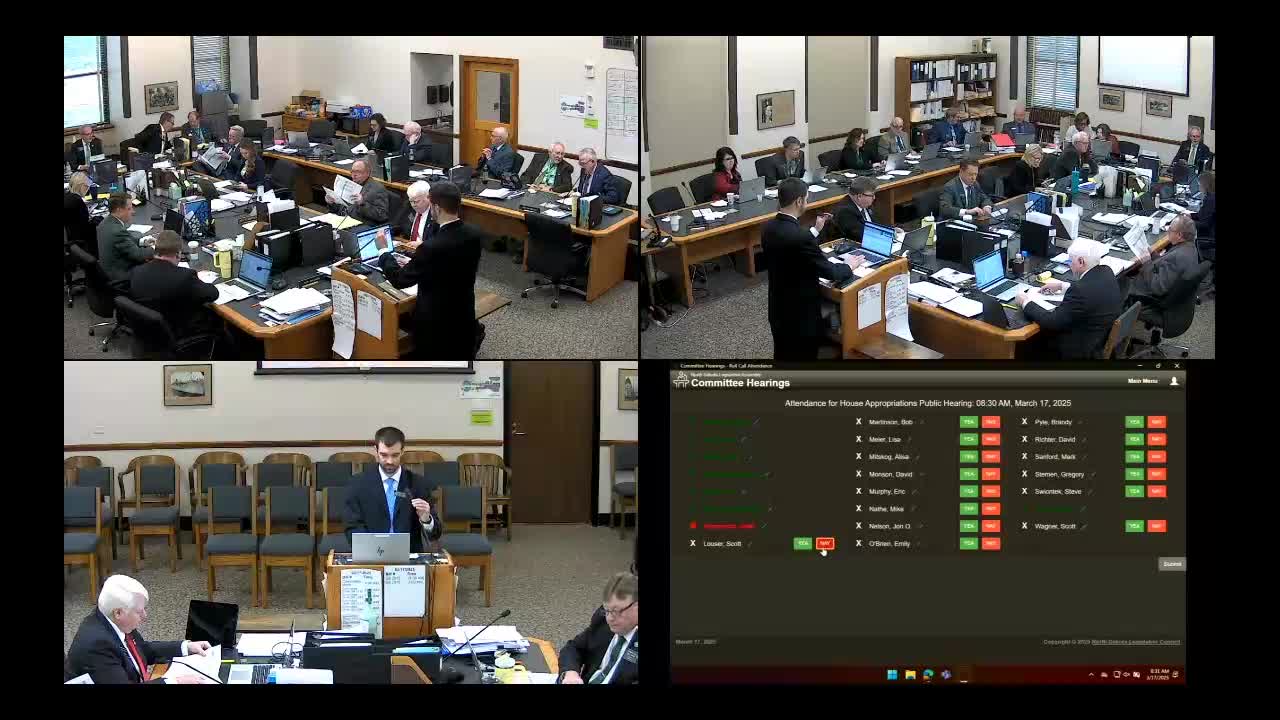
The House Appropriations Committee on March 17 adopted a revised March 2025 general fund revenue forecast and directed staff to update the committee's budget status reports to reflect the changes.
Legislative counsel Adam Mateuk, who presented the forecast material to the committee, said the package includes a one‑time positive adjustment of about $27.6 million to the remainder of the 2023–25 biennium that will be treated as beginning balance money available for the next biennium. "That additional revenue . . . is considered to be a one‑time additional pickup of revenue affecting the beginning balance," Mateuk told the panel.
Why it matters: The committee’s action sets the revenue baseline that appropriators will use as they consider bills this session. The forecast adopted on the committee floor averages private‑sector projections for major tax sources and incorporates agency carryover and updated oil price assumptions; it does not reflect the fiscal effect of any bills that the Legislature ultimately passes.
Key changes and context - 2023–25 (remainder of current biennium): The committee adopted proposal adjustments that net about a $27.6 million increase to beginning‑balance (one‑time) revenues. Mateuk told members that most of that change comes from a positive revision to sales and use tax collections and several smaller adjustments across other tax types and transfers. - 2025–27 (upcoming biennium): The committee adopted forecasts that reduce ongoing general fund receipts by roughly $74.6 million for 2025–27 versus the January estimate. The largest single downward change is about an $81 million average loss across the four major tax types (sales/use, individual income, corporate, and another large bucket), with other offsets such as higher assumed interest on the budget stabilization fund. - Oil and extraction taxes: The presentation reflected lowered oil price assumptions for 2025–27 (roughly a $3 per barrel decline in the first and second year of the next biennium in the materials Mateuk showed), and a revised effective oil extraction tax rate based on more recent collections. - Agency carryover (unspent appropriations): Agencies’ turn‑back surveys and carryover exemptions produced an estimated $71.5 million net addition to one‑time beginning balance money for 2025–27 (that figure reflects about $108.7 million in estimated turn back less roughly $37.2 million of authorized carryover).
What committee members asked Members pressed staff on several points, including how the March revisions compare to the original forecast from the previous session and what drives changes in mineral leasing fees and oil‑related buckets. Mateuk and other presenters said OMB’s lower sales/use tax view pulled down the average, and mineral leasing fees largely track oil price expectations.
Committee action Representative O’Brien moved adoption of the general fund March 2025 forecast (LC 25.942102) and Representative Steeman seconded. The committee recorded the motion as approved; the chair stated the result as 21 yes, 0 no, 2 absent and instructed staff to integrate the numbers into the committee’s budget status reports going forward.
Votes at a glance from this meeting - General fund March 2025 forecast (LC 25.942102): Motion to adopt by Rep. O’Brien; second Rep. Steeman; outcome: approved (chair reported 21 yes, 0 no, 2 absent). - Other bills — several bills later on the agenda received committee action (see separate provenance notes below). The committee recorded committee recommendations on those items on the floor; for bill‑level roll calls where the transcript does not report a conclusive, unambiguous tally in the text, the committee record should be referenced for official vote counts.
Ending note Committee staff said the forecast action is intended to be the last major revision to the biennial forecast before appropriation decisions; any legislative changes (new bills or enacted changes) will be reflected subsequently in the committee’s budget status reports.