Get Full Government Meeting Transcripts, Videos, & Alerts Forever!
Get email alerts on the Sb 5343 Wolf Livestock Management topic
No spam. Unsubscribe anytime.
Northeast Washington wolf-livestock management bill draws sharply divided testimony on nonlethal versus lethal tools
Summary
Senate Bill 5343 would make permanent budget provisos that expanded allowable uses of the Northeast Washington wolf livestock management account to include broader wolf-livestock management and grants to local sheriff’s offices, prompting sharply divided testimony over nonlethal and lethal responses.
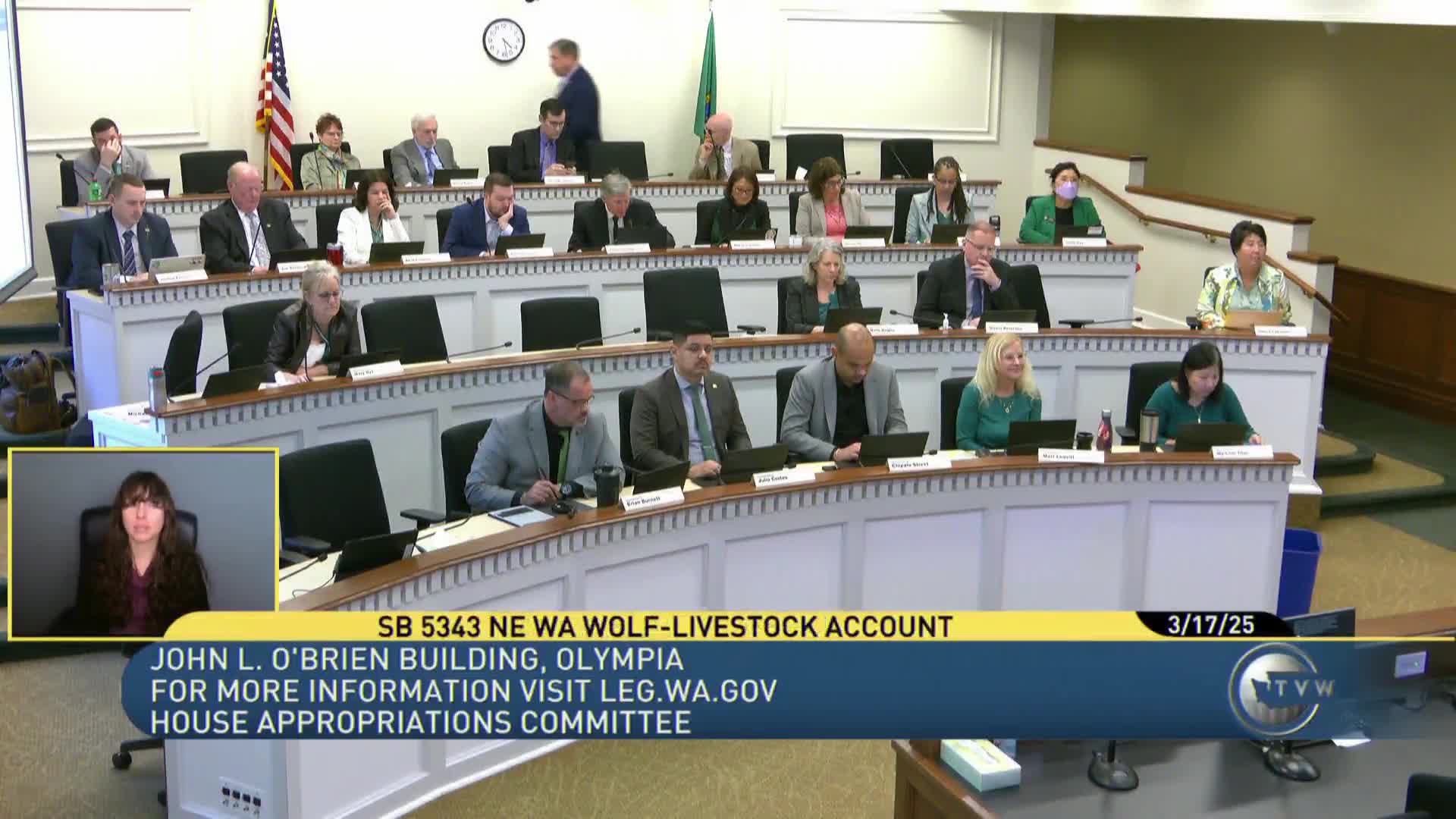
Senate Bill 5343, concerning allowable uses of the Northeast Washington wolf livestock management account, generated sharply divided public testimony at the Appropriations Committee.
Dan Jones, committee staff, said the account is a nonappropriated Department of Agriculture fund created in 2017 for grants and nonlethal wolf deterrents in counties east of the Cascades that border Canada. He told the committee the account has no independent revenue source and has been funded through appropriations in the operating budget; recent budget provisos expanded allowable uses to include wolf-livestock management generally and grants to the sheriff’s offices of Stevens and Ferry counties. “Senate Bill 53 43 does 1 thing, which is to make those expanded uses of the account ... a permanent part of the statute,” Jones said.
Supporters of the bill at the hearing — including Ferry County Commissioner Theresa Jenkins and a Washington rancher — said the change would streamline access to local wildlife specialists and make funding steadier so local responders can manage wolves and reduce livestock losses. Jenkins said the wildlife specialist is an important nonlethal tool, is trusted by local communities, and often responds faster than state agencies.
Opponents, including Washington Wildlife First and several conservation-minded witnesses, urged that statute continue to limit the account to nonlethal deterrence. Francisco Santiago Avila, science and advocacy director for Washington Wildlife First, told the committee he opposed the bill because allowing the account to be used for lethal methods would contradict the scientific evidence that nonlethal methods are effective and that killing wolves can exacerbate conflicts. Jonathan Gruden and Ronald Reid expressed similar concerns that removing language limiting expenditures to nonlethal deterrents could allow lethal control or fund activities lacking scientific backing; Gruden noted the bill drops the word “only” from existing language restricting expenditures to nonlethal deterrents and said that change “could nullify the original intent.”
Sheriffs’ office grants and local wildlife specialists are funded in current budget provisos; Jones said the proviso describes amounts (for example, $100,000 per fiscal year to some sheriffs’ offices) and an ongoing base funding figure used in budget deliberations. No vote was recorded during the hearing.
Testimony divided on whether statutory change would help local management and reduce livestock losses or would permit lethal removals and shift management away from science-based, nonlethal conflict prevention. The committee took the testimony and moved to other items on the agenda.