Get Full Government Meeting Transcripts, Videos, & Alerts Forever!
Get email alerts on the Utility Relocation topic
No spam. Unsubscribe anytime.
Bill would require WSDOT to share project plans with utilities, prompt report on federal funding for fish‑barrier relocations
Summary
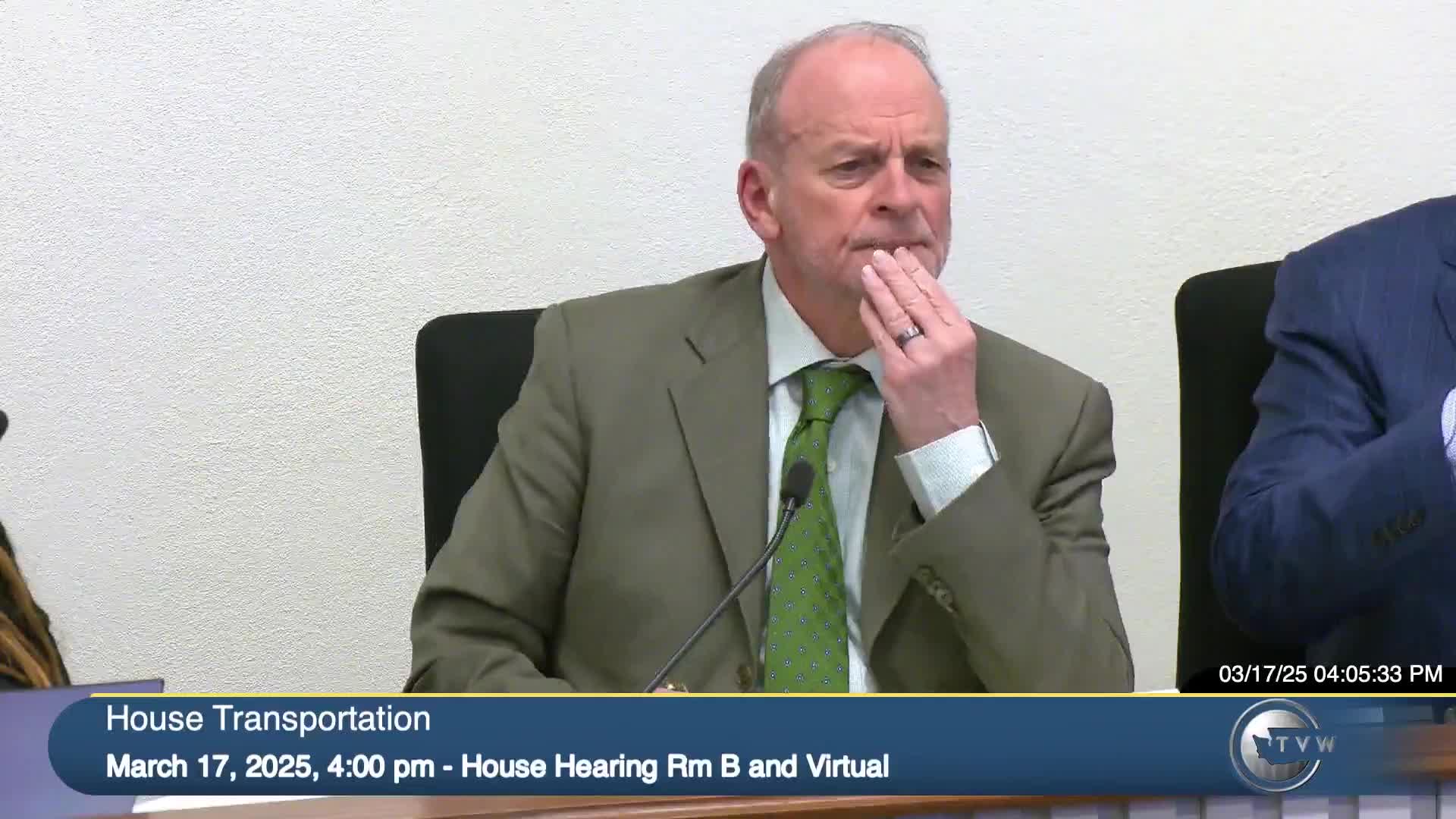
The House Transportation Committee heard public testimony on Substitute Senate Bill 5690, a measure that would require the Washington State Department of Transportation (WSDOT) to adopt policies proactively sharing planned highway-project information with utility owners so they can coordinate installation or relocation work.
The House Transportation Committee heard public testimony on Substitute Senate Bill 5690, a measure that would require the Washington State Department of Transportation (WSDOT) to adopt policies proactively sharing planned highway-project information with utility owners so they can coordinate installation or relocation work.
The bill’s sponsor and staff told the committee the change is meant to reduce duplicated work and ratepayer costs by encouraging utilities to take advantage of “open ditch” opportunities during state projects. “This is just a good government efficiency bill…when one agency is doing work on something, we let other agencies know what’s going on so that we can collaborate,” said Senator Drew McEwen, sponsor of the measure.
Supporters from utilities and public utility districts said better notice and coordinated planning would reduce costs borne by small utility ratepayers. Kristen Masteller, general manager of Mason County PUD No. 1, said three current WSDOT-related relocations cost her utility about $4,300,000 and that her system serves roughly 5,600 meters, which she said equates to “about a $767 impact per household per customer” and would require roughly a $64 monthly surcharge for a year to cover the relocation costs.
WSDOT officials said they support the goal of coordination but urged the committee to narrow the bill. “Section 1 of this bill broadens the statute to include all utilities, which WSDOT estimates would require approximately 10 new full time staff to assist with the additional coordination efforts,” said Greg Gahowski, state utilities manager at WSDOT. He also told the committee that longstanding legal limits on motor vehicle fund expenditures may constrain WSDOT’s ability to use state or some federal funds to pay utility relocation costs.
Multiple utility and PUD representatives urged the committee to require at least one year’s advance notice of fish‑barrier and related highway projects, and to have WSDOT pursue available federal funding for utility relocations tied to fish‑passage work. Bill Clark of the Washington PUD Association told the committee there is a federal program that could provide about $200 million per year for utility relocations associated with fish‑barrier projects but said local utilities cannot apply directly; only the state or tribes may be applicants.
WSDOT reported a fiscal estimate tied to the bill (as amended on the Senate floor) of about $2,500,000 per biennium to support the preplanning and design collaboration, and said an additional one‑time consultant cost would likely be needed to prepare the report the bill would require. WSDOT asked the committee to remove the broader coordination duties in section 1 and to preserve statutory language on the required December 15, 2026 report, citing attorney‑general guidance and state constitutional limits on motor vehicle fund use.
The committee took testimony from multiple utilities and WSDOT representatives and did not take a committee vote during the hearing. The public hearing on SB 5690 concluded after the testimony.
Why this matters: utilities say relocation costs for small providers can be disproportionately high, and coordination could prevent redundant work and heavy one‑time cost shifts to ratepayers. WSDOT said the policy goal is shared but the agency needs clarity on funding authority and staff capacity before taking on new proactive duties.