Get Full Government Meeting Transcripts, Videos, & Alerts Forever!
Get email alerts on the Tenant Rights topic
No spam. Unsubscribe anytime.
Committee hears bill to bar certain lease clauses, including class-action waivers and forced "valet garbage" charges
Summary
Senate Bill 5,313 would add several tenant-protection provisions to the Residential Landlord Tenant Act, banning lease clauses that waive rights to participate in causes of action, block disclosure of lease terms, or force tenants into third-party "nonessential" services without an opt-out.
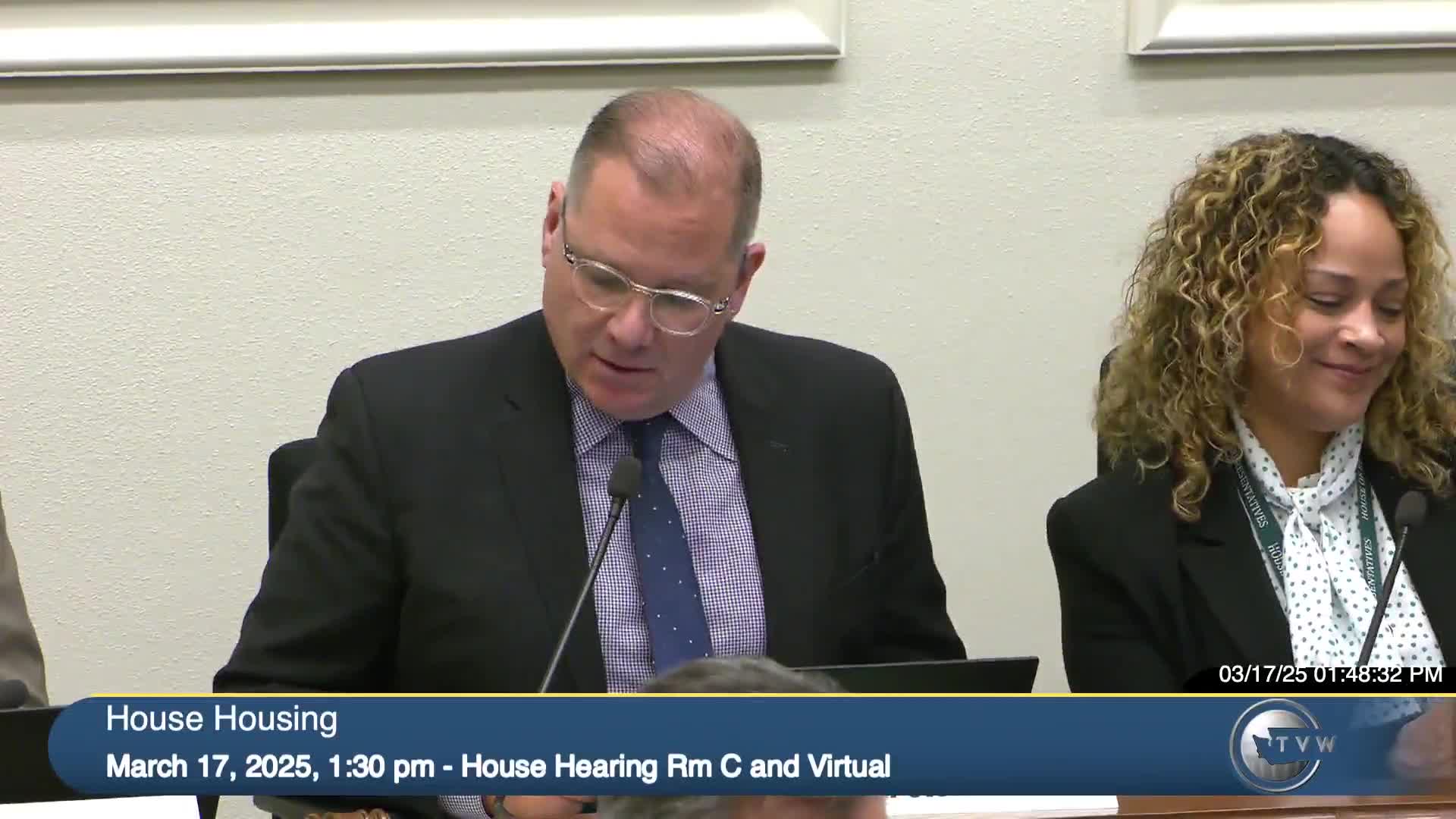
Committee staff briefed the House Housing Committee on Senate Bill 5,313 on March 17. The bill would expand provisions currently prohibited under the Residential Landlord Tenant Act (RLTA).
Audrey Vasek, committee staff, described the existing RLTA limits and the proposed additions. Current law already bars clauses that waive tenant rights, require confession of judgment, or broadly limit landlord liability. The bill under consideration would add several new prohibited provisions: waivers of any right to participate in causes of action against a landlord (including class actions); nondisclosure agreements related to the lease or its terms; arbitration clauses that require tenants to arbitrate disputes unless the landlord pays the entire arbitration cost and the agreement is notarized; and clauses that force tenants to buy or subscribe to "nonessential services". Vasek explained that nonessential services are third‑party services offered by the landlord at the tenant's cost, excluding utilities and insurance.
Senator Jamie Peterson, sponsor, framed the bill as a response to lease provisions that can take away tenants' bargaining power or access to the courts. Peterson said she was motivated by news reports and constituent stories of tenants who unwittingly waived class-action rights and of renters charged for valet garbage. "I read a story ... about a woman who ... had, in the fine print of her lease, waived away her right forever to be able to join a class action lawsuit," Peterson said. She and stakeholders negotiated changes that would discourage mandatory arbitration by requiring landlord payment of arbitration costs and notarization for arbitration clauses.
Committee members asked detailed implementation questions. Representative Connors asked whether the bill defines nonessential services; Peterson said the bill specifies some essential services (such as utilities) and uses a general definition for nonessential services, and she said she was open to clarifying language. Representative Reed asked about the "timely fashion" standard tied to automatic enrollment in services; Peterson said the provision targets health-and-safety uses by landlords and is not intended to impose precise hour-by-hour timing requirements.
Tenant advocates supported the bill but raised concerns about a floor amendment that they say may expand the legal definition of rent and thereby affect eviction standards. Michelle Thomas of the Washington Low Income Housing Alliance said tenants almost never can negotiate lease terms and that nondisclosure and forced-service clauses are appearing in some leases. She urged cleanup of the floor amendment language. Emily Rosenzweig, who runs a national campaign opposing valet-garbage practices, testified the amendment may create a loophole that landlords could exploit to force tenants into paid services and asked that the committee prohibit overcharging and limit automatic enrollment practices.
The committee closed the hearing on SB 5,313 after testimony and questions; no vote was taken during the session.