Get Full Government Meeting Transcripts, Videos, & Alerts Forever!
Get email alerts on the Middle Housing topic
No spam. Unsubscribe anytime.
Committee hears bill to allow limited "middle housing" on rural parcels in growth areas
Summary
A House housing committee heard Senate Bill 5,471, which would let counties authorize up to four-unit "middle housing" on parcels zoned for single-family homes within designated urban growth areas and limited areas of more intensive rural development, subject to sewer and other infrastructure requirements.
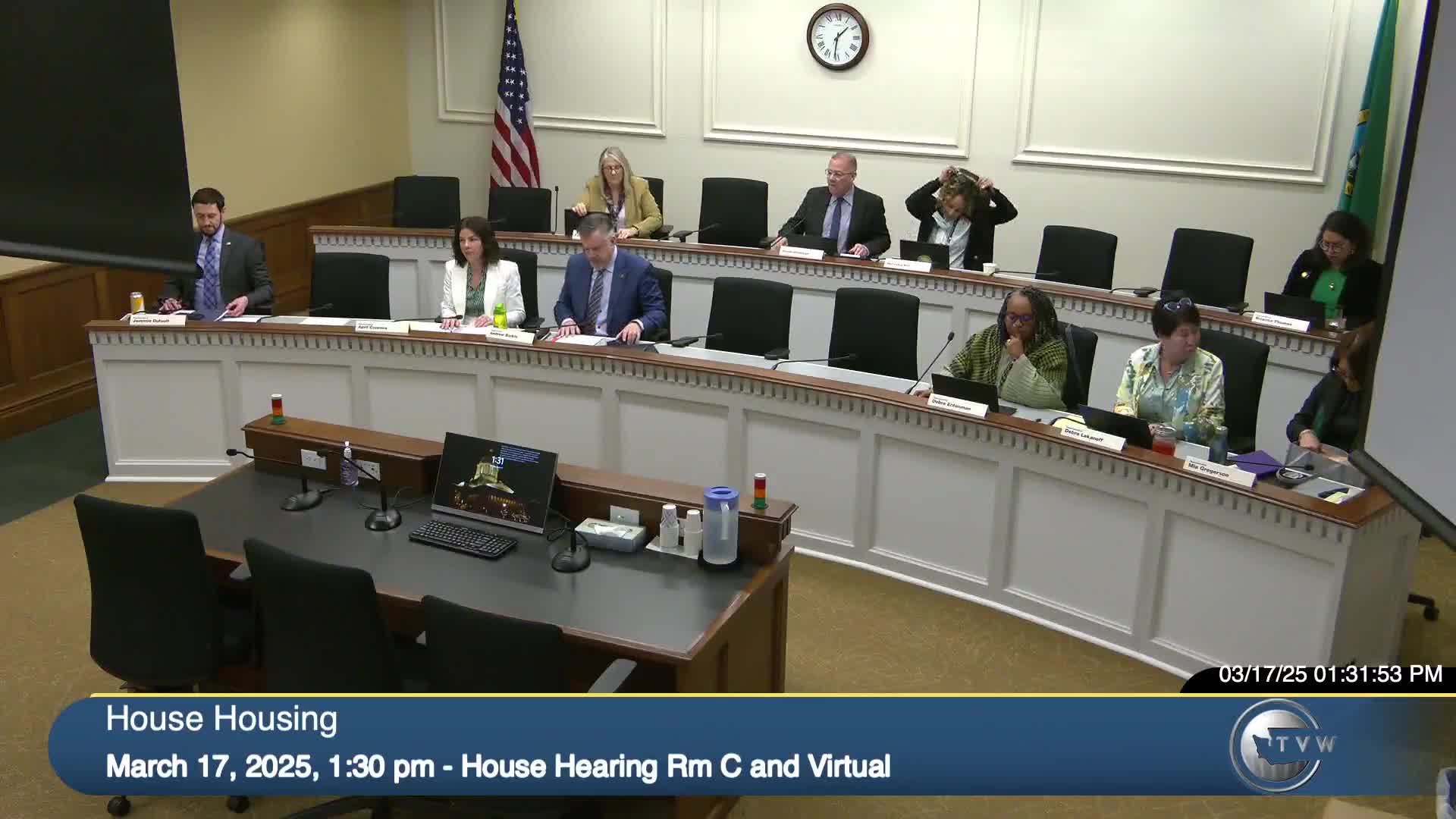
Senate Bill 5,471, a measure to allow "middle housing" in some rural and growth-area settings, received a public briefing during the March 17 meeting of the Washington State House Housing Committee.
The bill briefing was delivered by Serena Dolly, staff to the committee. Dolly said the bill ties to the Growth Management Act's existing framework for Limited Areas of More Intensive Rural Development (LAMRs) and designated urban growth areas (UGAs). "Senate Bill 5,471 relates to middle housing in rural areas," she said, and explained that middle housing includes duplexes, multiplexes and townhouses that are compatible with single-family homes.
The bill would allow a county to authorize middle housing on any parcel that permits detached single-family residences within UGAs and LAMRs, but limits development to no more than four residential units per parcel. Counties that adopt the authorization could not impose standards for that middle housing that are more restrictive than those required for detached single-family homes, and applicants must follow the same permit and environmental review processes unless state law requires otherwise. Dolly also said that middle housing in a LAMR must be served by sewer service; middle housing in a designated UGA would need water and sewer. The bill text, as explained by staff, would also make actions taken by a county under this authorization not subject to appeal under the State Environmental Policy Act (SEPA) or the Growth Management Act (GMA).
Senator Keith Gaynor, one of the bill's prime sponsors, said the measure "just creates a housing option" and is intended to extend housing types commonly allowed inside city limits into nearby growth areas. Gaynor cautioned, however, that the sewer and water requirements will likely limit where the policy can be applied. "I only bring that to light because I'm concerned that the application of this opportunity is going to be very limited," he said, adding that improving access to housing options in rural areas is the bill's aim.
Representatives of housing and county groups who testified expressed general support. Brian Enslow of the Washington State Association said the measure "strikes a balance" by requiring public sewer and water while avoiding unnecessary barriers. Bryce Aden of FutureWise said counties have worked through many details and raised only a remaining technical point about stormwater and the definition of existing sewer in LAMRs. Committee staff and proponents said they would work on language to ensure consistency with existing LAMR law.
The committee took the testimony and did not take a vote during the hearing. The chair suspended the public hearing on SB 5,471 to allow further consideration and to reconcile technical language raised by witnesses and sponsors.
The bill briefing and testimony stressed that the measure is narrowly targeted and infrastructure-dependent. No formal action or vote was recorded during the March 17 hearing.