Get Full Government Meeting Transcripts, Videos, & Alerts Forever!
Get email alerts on the Earned Income Tax Credit Eitc topic
No spam. Unsubscribe anytime.
Committee hears testimony supporting 6-year extension of Oregon Earned Income Tax Credit
Summary
Legislative Revenue staff and multiple advocates testified in favor of extending Oregon's state Earned Income Tax Credit for six years; proponents urged consideration of further expansions to increase benefit levels and broaden eligibility, while the committee carried the item as a public hearing with no vote.
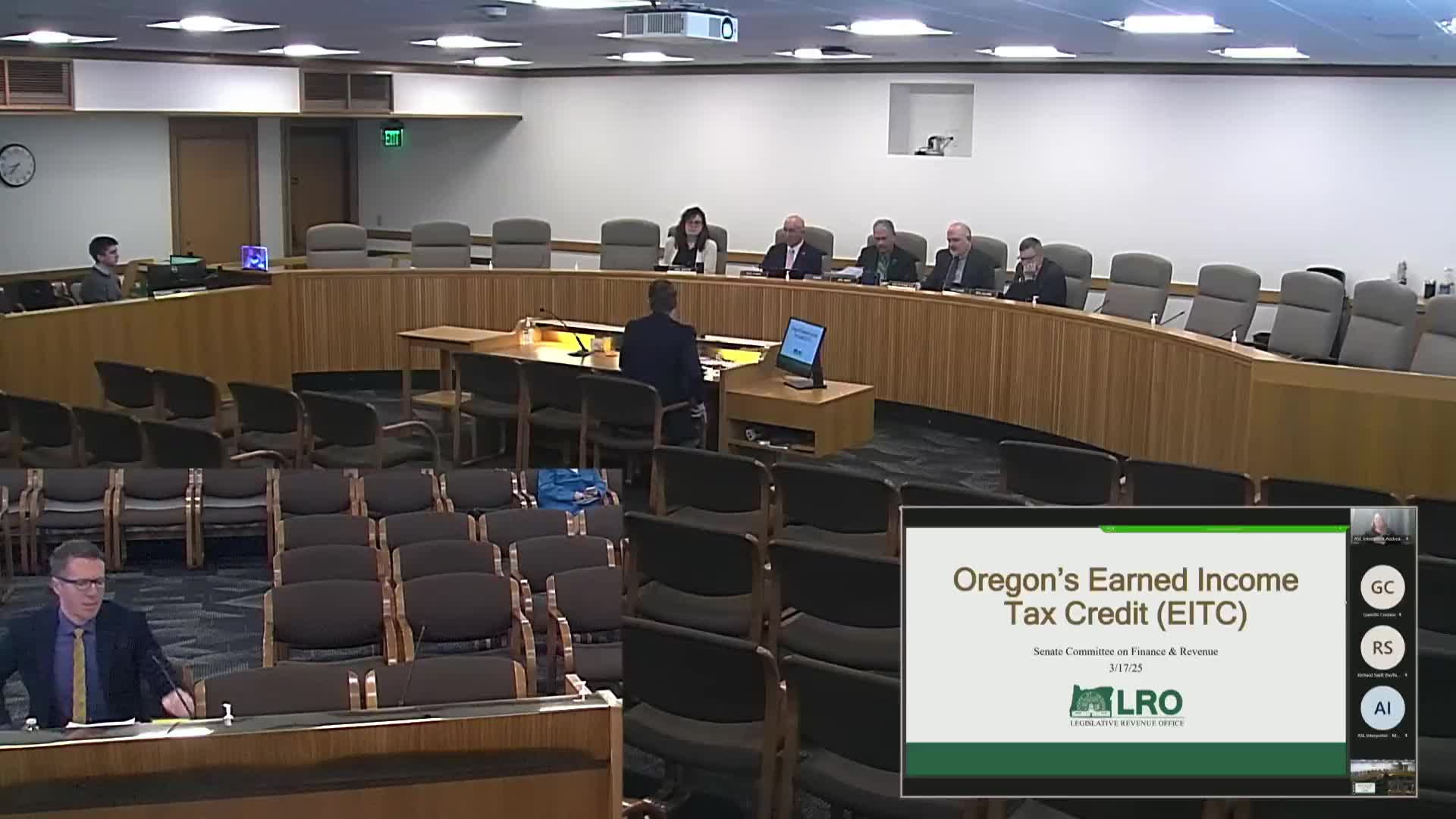
The Senate Committee on Finance and Revenue held a public hearing on March 17, 2025, on Senate Bill 121, a bill that would extend Oregon's state Earned Income Tax Credit (EITC) for six years with no policy changes.
Why it matters: The EITC is a refundable tax credit designed to increase the after‑tax income of low‑ and moderate‑income working families. Committee materials and witnesses emphasized both the credit's anti‑poverty effects and its fiscal cost; Legislative Revenue staff provided utilization and cost history and advocates described options to strengthen the credit.
Legislative summary and fiscal context: Kyle Easton of the Legislative Revenue Office summarized the bill as "the fourth and final of those credits that are up for their policy review" and said the committee was being asked to consider a six‑year extension "with no policy change" to allow continued review. Easton presented historical cost figures for the credit (reporting a recent 2022 cost cited in materials, and noting year‑to‑year variation) and said a one‑year extension would cost on the order of tens of millions of dollars based on current projections.
Supporters and recommended changes: Daniel Hauser, deputy director of the Oregon Center for Public Policy, testified in support of SB 121 and urged the committee to consider strengthening the credit in a follow‑up process. He said the state EITC "helps more than 200,000 working families" and noted the federal EITC lifts an estimated 68,000 Oregonians, including 34,000 children, out of poverty. Hauser recommended policy changes discussed in a recent House bill (HB 2958) including raising Oregon's match to the federal credit (he suggested raising the state match to roughly 20% baseline and 25% for taxpayers with a child under 3), expanding age eligibility to start at 18, and aligning the state credit's garnishment protections with the federal EITC and the Oregon Kids Credit.
Administration and participation: Easton reviewed participation and administration issues, noting that national literature finds some eligible taxpayers do not claim the credit—often because they do not file a tax return—and that participation tends to rise when the state match or credit value increases. Easton also described IRS outreach efforts that have identified eligible filers and prompted amended returns in some cases. He summarized administrative and improper‑payment tradeoffs in existing research and said the combined administrative and improper‑payment costs for EITC are meaningful but comparable to other means‑tested programs.
Additional supporters: John Calhoun, speaking for Tax Fairness Oregon, urged the committee to extend the refundable state credit, saying it "helps Oregon's lowest paid workers live with some dignity and reduces homelessness." Several witnesses urged that any future expansions be prioritized to provide the largest benefit to lowest‑income households.
Process and next steps: The committee closed the public hearing without taking a vote. Witnesses asked that the EITC not be allowed to sunset and urged the committee either to pass the six‑year extension or to advance the bill to the Joint Committee on Tax Expenditures with an instruction to consider strengthening changes. Any fiscal estimates, amending language or votes will be reflected in subsequent committee filings.
Votes at this hearing: none (public hearing only).