Get Full Government Meeting Transcripts, Videos, & Alerts Forever!
Get email alerts on the Education Nondiscrimination topic
No spam. Unsubscribe anytime.
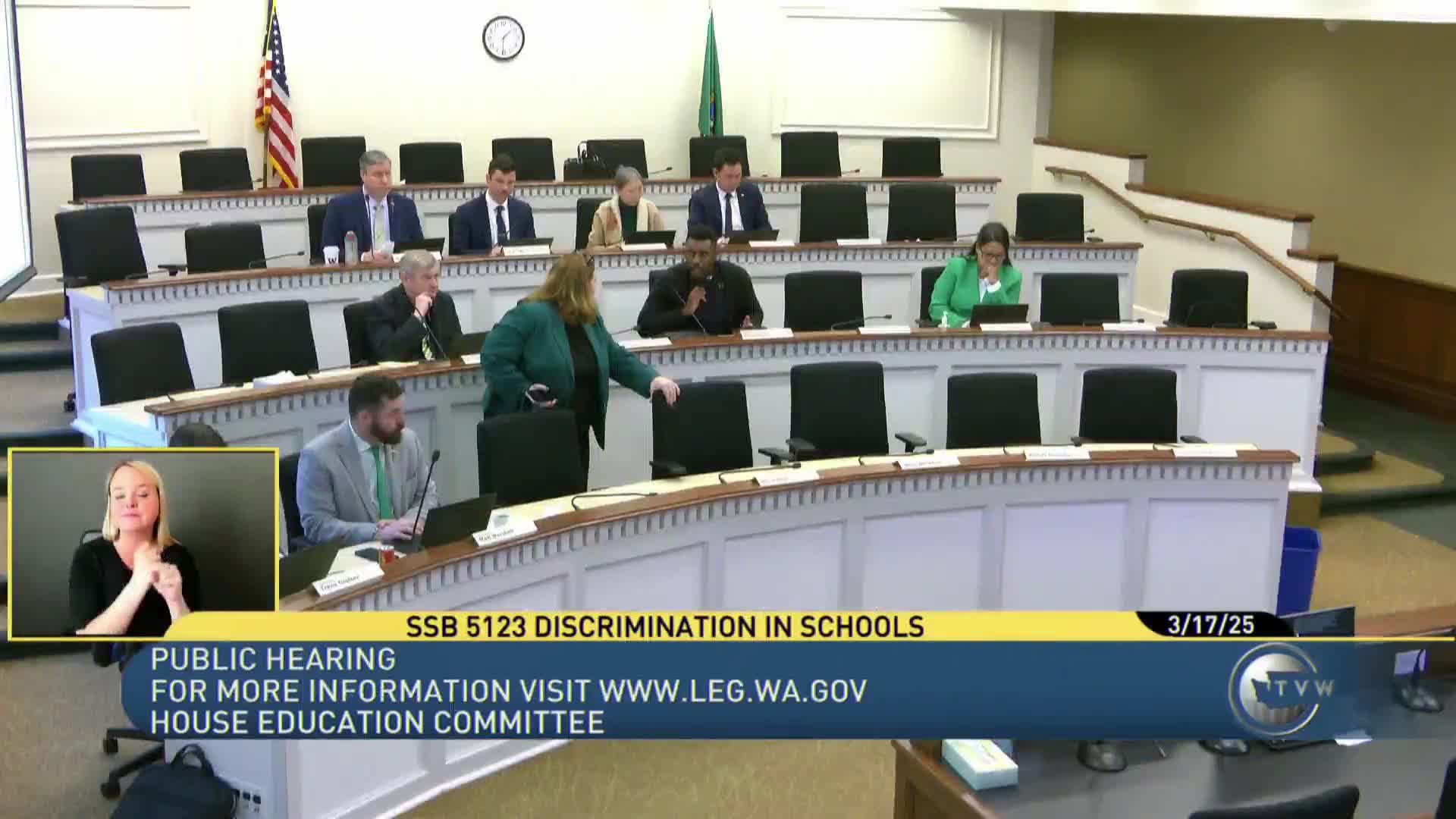
House Education Committee hears hours of testimony on bill to expand enumerated student protections
Summary
The House Education Committee on March 17 took public testimony on Substitute Senate Bill 5123, a proposal to add several enumerated protected classes to Washington’s public-school nondiscrimination code and to separate existing combined categories for sexual orientation, gender expression and gender identity.
The House Education Committee on March 17 took public testimony on Substitute Senate Bill 5123, a proposal to add several enumerated protected classes to Washington’s public-school nondiscrimination code and to separate existing combined categories for sexual orientation, gender expression and gender identity.
Ethan Moreno, nonpartisan committee staff, told the panel SB 5,123 would add ethnicity, homelessness, immigration or citizenship status, and neurodivergence to the list of protected classes that apply in Washington public schools and would split the current combined phrase “sexual orientation, including gender expression or gender identity” into three separate categories with definitions. Moreno said the Office of the Superintendent of Public Instruction (OSPI) currently enforces nondiscrimination rules and may take corrective action, place a district on probation or withhold state funds when violations are found.
The bill matters because enumerated protections can affect how school policies are written, how complaints are investigated, and who may pursue a right of action in superior court. Supporters told the committee enumeration makes anti-bullying and nondiscrimination protections concrete; opponents argued the bill’s definitions are inaccurate, could conflict with federal guidance and raise privacy and fairness concerns for girls in sports and single-sex spaces.
Nonpartisan staff summary: Moreno said the bill’s additions are “additive, not subtractive,” meaning the legislation adds categories rather than removing existing protected classes. He described the OSPI’s current authority to monitor compliance and pursue corrective action, and noted the bill provides definitions for the new and divided categories.
Supporters’ testimony: Dan Novogratzky, who identified himself as the father of a transgender son, urged passage so “my kid would be a little safer the day after it’s passed than the day before.” Amy Kannava, a nationally certified school psychologist, told the committee that enumeration matters for enforcement and cited legal precedent: “Enumeration is the essential device used to make the duty to not discriminate concrete and to provide guidance for those who must comply,” citing Romer v. Evans. Grace Niblade, a licensed clinical social worker who said she has worked with LGBTQ youth for 25 years, said one supportive adult can reduce suicide risk among gender-diverse youth and that state-level protections can save lives. Lyndon Jordan, representing PFLAG, called Washington “a beacon of hope” and urged passage. Student testifier Pree Bridal (recorded as “Pree Bridal”) said the bill “extends protections to the groups most vulnerable to discrimination” and described immigration-status harassment she’d seen in her district.
Opposition testimony: Several speakers urged rejection or amendment. Dawn Land said some definitions in the bill are inaccurate and asserted that “sexual orientation is based entirely on biological sex” and warned passage would jeopardize federal funding (she referenced “federal regulations as of 01/20/2025” without specifying which regulation). Anthony Mixer and Sharon Gamoff said gender identity definitions do not line up with federal definitions and expressed that there are only two genders; Gamoff warned the state could lose federal education dollars and asserted girls’ privacy and fair competition in sports could be harmed. Tanya Hickman, a school board legislative representative, said school staff are not licensed to diagnose and that controversial bills may be driving families away from public schools. Jennifer Heiney Withy said current law protects students and raised questions about conflicts between protected classes. Matthew Jackson (testimony recorded under that name) urged a “no” vote and characterized the bill as advancing a “radical gender ideology.” Jan Smith, a former chemical-dependency counselor and family-rights activist, said she feared some professional evaluations can be “shoddily prepared” and raised free-speech concerns.
Committee exchange and process notes: Representatives asked staff to clarify whether the bill removes existing protections; Moreno replied it does not. Representative Marshall asked whether the bill is creating subgroups within the existing combined statutory phrase; staff confirmed the bill separates and defines those categories. The chair noted the committee had allotted 35 minutes for in-person testimony from the first panel and that the bill drew heavy interest—initially 90 people signed in for testimony during the first timed block; as the hearing continued the committee recorded a total of 3,087 people signed in as pro, con or other (1,028 pro; 2,058 con; 1 other). The chair said the committee kept the public hearing open, moved to two other bills to allow additional testimony to be accommodated later, and later returned to close the public record.
What the bill does not do (as presented to the committee): Moreno reiterated the text adds enumerated categories and definitions; it does not, in the staff briefing, change the OSPI’s existing enforcement powers or explicitly alter funding formulas.
Next steps: The committee did not vote on SB 5,123 during the hearing. The chair kept the public hearing open for additional testimony and scheduled caucus time after concluding the day’s business.
Ending: The committee adjourned after completing the scheduled public hearings; no formal committee action on SB 5,123 was taken during the March 17 session.