Get Full Government Meeting Transcripts, Videos, & Alerts Forever!
Get email alerts on the Transportation.passenger Only Ferries topic
No spam. Unsubscribe anytime.
‘Mosquito Fleet’ bill wins broad local support in committee hearing for passenger‑only ferries
Summary
Lawmakers heard more than 50 in‑person and remote supporters of ESHB 1923, the Mosquito Fleet Act, which would expand which local entities can form passenger‑only ferry taxing districts; witnesses said passenger‑only services can be launched faster and more cheaply than vehicle ferries and can relieve pressure on WSF.
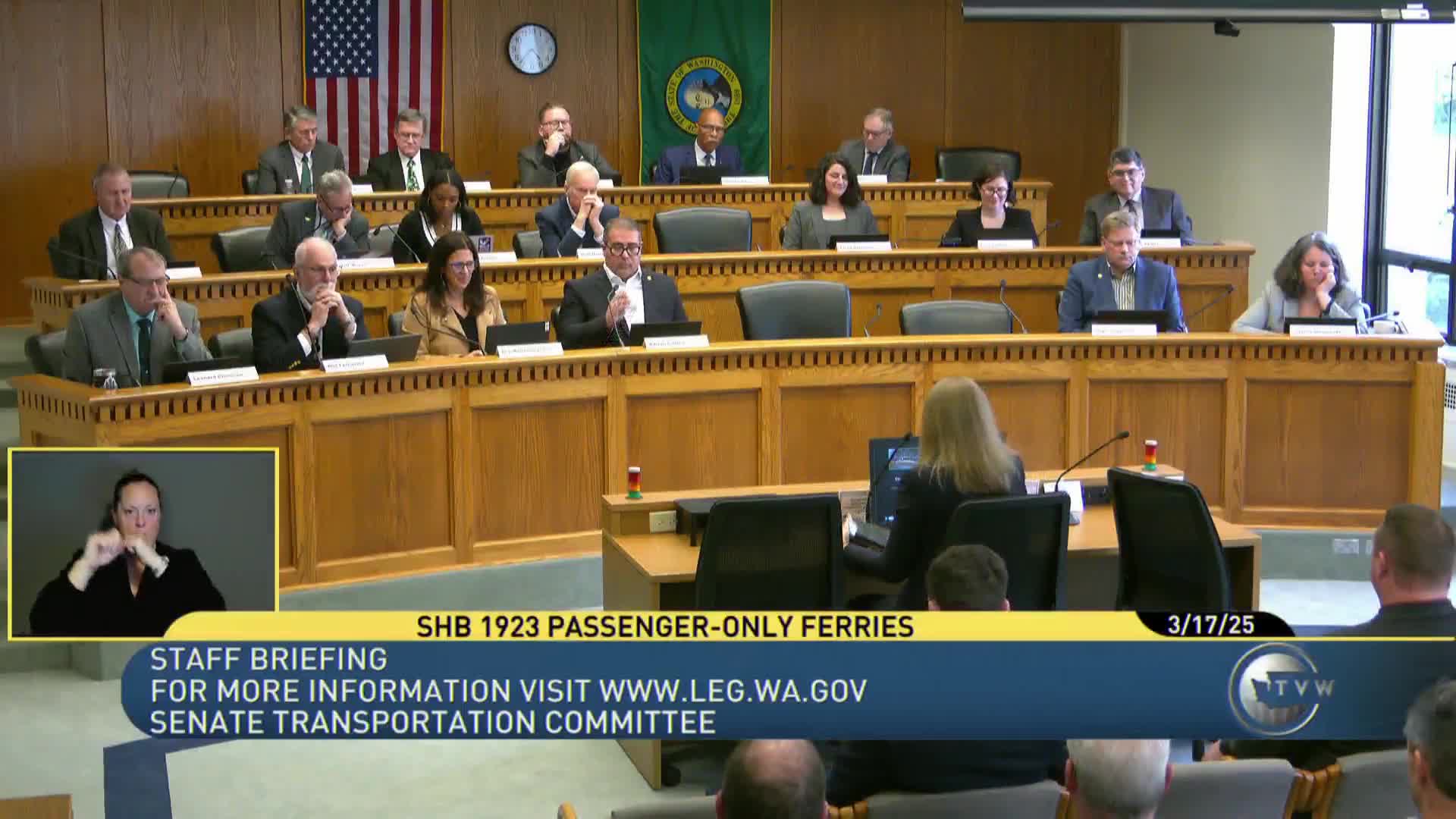
OLYMPIA — The Senate Transportation Committee heard testimony March 17 on Engrossed Substitute House Bill 1923, the Mosquito Fleet Act, which would broaden which local governments and transit entities may form passenger‑only ferry (PO) taxing districts on Puget Sound and Grays Harbor.
Committee staff Jenna Forti said the current law limits passenger‑only taxing districts to public transportation benefit areas (PTBAs) on the west side of Puget Sound and noted Kitsap Transit is the only existing qualifying PTBA. The bill would add counties, ports, city transit systems, county transportation authorities, metropolitan municipal corporation transits, unincorporated transportation benefit areas and regional transit authorities that border Puget Sound or Grays Harbor. Forti also provided a fiscal note: an estimated one‑time cost to the Department of Revenue of $1.3 million and an ongoing $1.0 million biennial cost to the general fund.
Representative Craig Nance, prime sponsor and Kitsap delegation member, said the bill is “about local empowerment” and argued that passenger‑only service can be started quickly, cheaply and nimbly to restore connectivity while the state’s large auto‑carrying ferry fleet is rebuilt. “Every community across Puget Sound deserves reliable ferry access,” Nance told the committee.
Kitsap Transit’s director Dylan Doty described the Kitsap model: a 0.3‑cent sales tax plus farebox revenue has funded a roughly $25 million annual passenger‑only budget that operates 10 vessels on five routes, he said. Doty testified that the Kitsap system is “fully self‑sufficient in terms of the operational dollars.” He also provided sample fares: “$2 from Kitsap to Seattle, $12 from Seattle back to Kitsap; or a monthly pass for $196,” as a rough pricing example used by his agency.
Local elected officials, port and transit leaders, business groups, emergency‑preparedness volunteers and maritime workforce advocates gave broad support during several hours of testimony. Proponents said passenger‑only ferries help underserved communities, improve access to medical care and work commutes, can be run from existing recreational marinas (reducing terminal capital costs), and may relieve car and truck congestion on auto ferry routes.
Peter Phillips, who consults on passenger ferry policy, said the Mosquito Fleet Act would enable “several communities to come together to organize themselves to most efficiently establish service that serves a mutual need” and projected new vessels would be built in Washington shipyards.
Several county officials and San Juan County leaders said reliable passenger‑only service has been essential during recent WSF reductions. San Juan County Council Vice Chair Jane Fuller said emergency funding last year helped stand up temporary passenger‑only service for the route and that the bill would give rural communities a statutory framework to pursue longer‑term options.
Supporters also said passenger‑only ferries could provide workforce entry points to maritime careers, a benefit highlighted by Jake Beatty of Northwest Maritime, who described the smaller vessels as “a farm team” that lets mariners gain sea time toward larger credentials.
Public safety and emergency preparedness advocates urged passage as resilience planning: Vashon Island emergency volunteers said small, nimble vessels could be critical after a regional disaster when larger terminals might be damaged.
Opposition and concerns were limited in the hearing record that day. Senators asked about environmental protections for whales and quiet‑hull technology; Rep. Nance said the bill’s intent language had been amended to reflect environmental safeguards and that the sponsor had consulted whale‑protection advocates.
What’s next: The committee received extensive public testimony and did not vote on the bill that day. Supporters urged the committee to advance the bill so local communities could move more quickly to stand up passenger‑only service.