Get Full Government Meeting Transcripts, Videos, & Alerts Forever!
Get email alerts on the Background Checks Fingerprint Compact topic
No spam. Unsubscribe anytime.
Bill would let Washington join interstate compact to speed fingerprint background checks
Summary
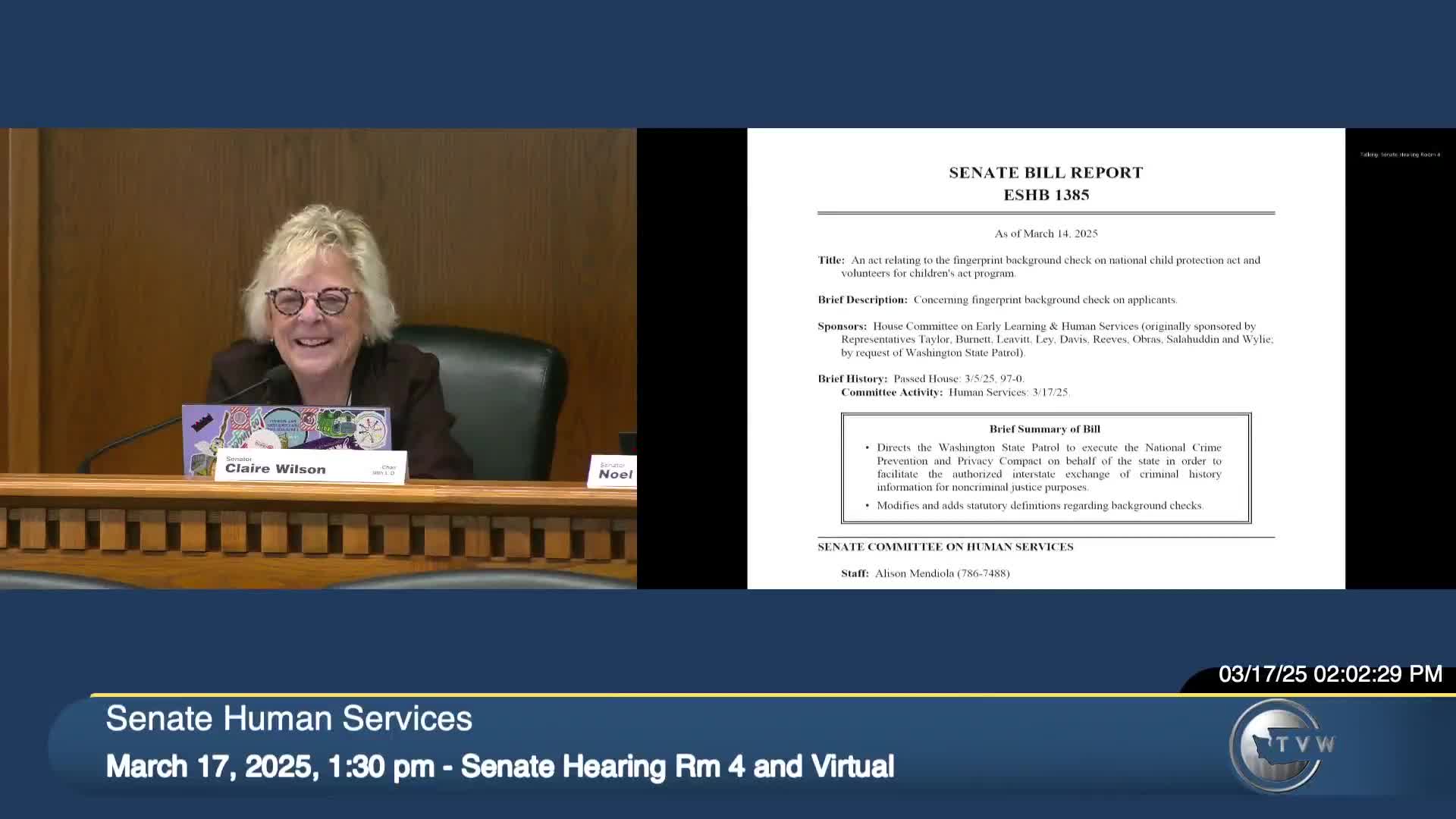
Engrossed substitute House Bill 1385 would authorize the Washington State Patrol to enter the federal compact that enables interstate exchange of fingerprint‑supported criminal history records for non‑criminal‑justice background checks, committee staff and the sponsor told lawmakers March 17.
Allison Mendiola, committee staff, briefed the Senate Human Services Committee March 17 on engrossed substitute House Bill 1385, a Washington State Patrol agency request to participate in the National Crime Prevention and Privacy Compact and to facilitate fingerprint‑supported criminal history exchanges for non‑criminal‑justice background checks.
Staff said the bill was passed off the House floor unanimously. Mendiola and sponsor Representative Taylor described federal authorities that permit exchange of criminal history records for authorized entities under the National Child Protection Act and the Compact, and explained that the State Patrol would set fees to cover processing costs, including the FBI fee. The briefing noted that 35 states have ratified the compact to date.
Representative Taylor, sponsor, said the change is about “government efficiency” and reducing delays that slow hiring for positions that require fingerprint‑based checks, including direct‑care roles. “These background checks can take a lot less time to complete,” Taylor said, and she urged exploring portability that would allow a background check to follow an individual between employers doing similar work.
Dion Glover, captain with the Washington State Patrol, testified in support and said the bill would align state agencies and federally‑recognized tribes with FBI standards and allow interstate reciprocal exchange of records for noncriminal purposes. Glover told the committee that the agency’s process would charge a fee to cover costs and that an agency would pay $33 for a copy of the federal record for an applicant — the applicant need not pay directly if the agency shares the record. He said the compact would reduce duplicative state requests and speed checks across DSHS, DCYF, Department of Health and tribes.
Committee members asked whether checks would be portable; witnesses said portability is an implementation detail the bill would allow states and agencies to address, and staff offered to follow up on specifics. No committee vote on the bill is recorded in the transcript; staff reported the House floor action and provided a staff fiscal note indicating no fiscal impact.