Get Full Government Meeting Transcripts, Videos, & Alerts Forever!
Get email alerts on the Transportation.labor.maritime Compensation topic
No spam. Unsubscribe anytime.
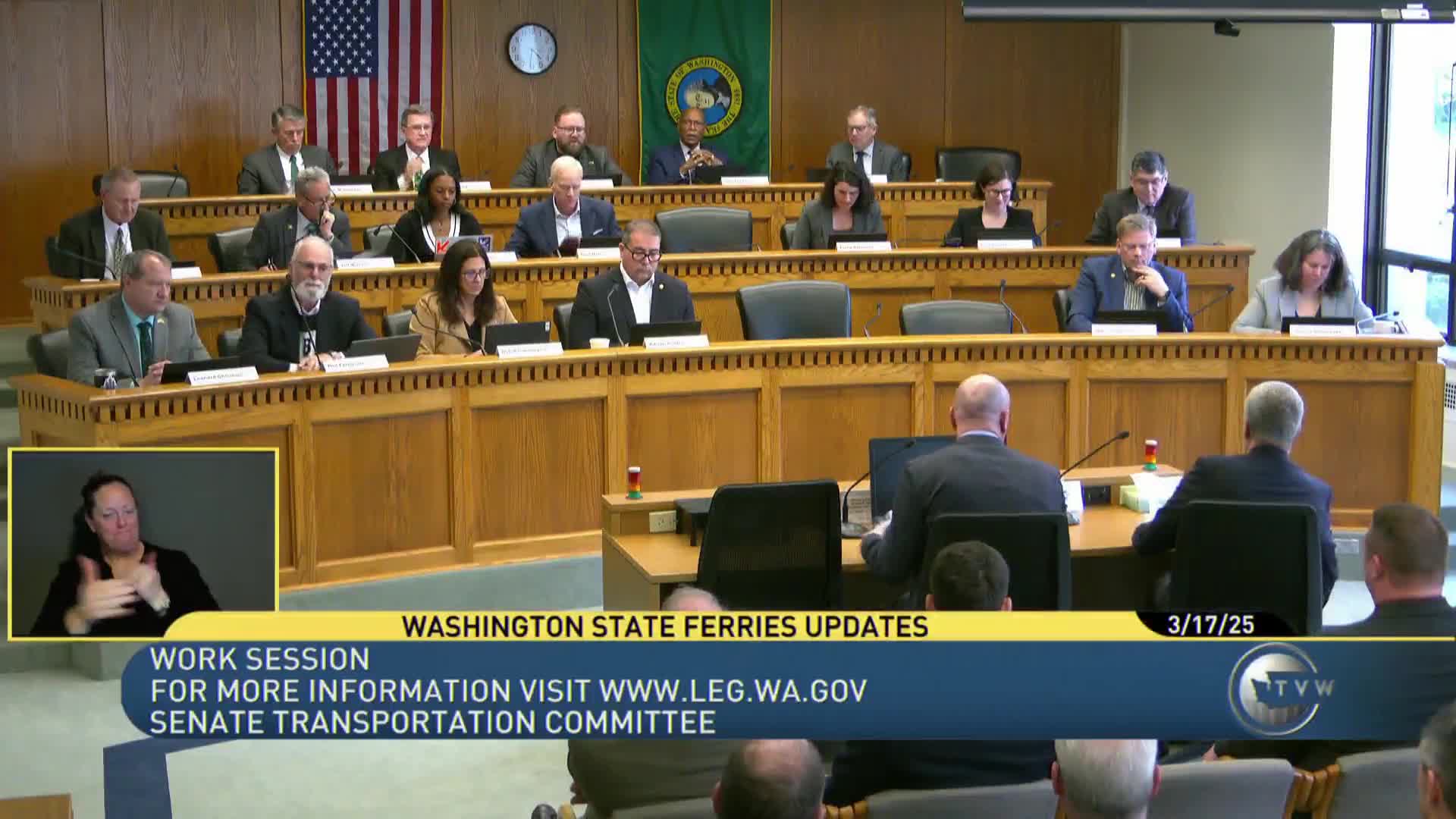
Senate committee hears testimony for bill to expand salary comparators for Washington State Ferries contracts
Summary
Staff and union representatives urged the Senate Transportation Committee to approve House Bill 1264, which would require OFM to use a national compensation firm and expanded comparators when producing the salary survey used in ferry collective bargaining.
OLYMPIA — The Senate Transportation Committee held a public hearing March 17 on substitute House Bill 1264, a bill that would require the Office of Financial Management to contract with a nationally recognized human resources firm to produce a biannual salary survey covering public and private sector comparators for Washington State Ferries (WSF) bargaining units.
Jenna Forti, committee staff, told the panel the bill would require OFM to produce an unredacted survey by April 1 of every even‑numbered year, to seek input from employee organizations and to specify comparator groups for masters, mates, pilots, engine room employees and trades at Eagle Harbor. The bill includes a fiscal note: a one‑time interagency transfer estimated at $375,000 from motor‑vehicle funds to OFM to conduct the survey, Forti said.
Representative Laurie Jinkins Fye (presenting as prime sponsor at the hearing) framed the bill as an effort to make compensation comparisons more accurate and transparent to help recruitment and retention in a stressed maritime workforce.
Labor and front‑line WSF employees offered multiple statements in favor of the bill during the public hearing.
Robert Hodge, assistant business manager/organizer for Boilermakers Local 104, told the committee, “The current collective bargaining process at Washington State for this group of workers is fundamentally broken,” and said OFM’s existing process had dismissed submitted contracts and produced what he described as a narrow set of comparators.
Chief Engineer Chris Schneider, elected chair of the License Negotiating Committee, said the bill would let the state “allow more accurate and fair assessment of our compensation and the job market that our licensure qualifies us to work,” and warned that the 400 engineers at WSF worked “a combined total of over 100,000 hours of overtime” last year.
Representatives of unions and licensed engineers emphasized a global shortage of marine engineers, competition from private shipping and other public systems, and the wage gap that has driven experienced mariners away. Eric Wing of the Marine Engineers Beneficial Association said the bill would “close that wide gap and bring Washington State Ferries in line with what the market is paying to professional marine engineers.”
Multiple engine‑room and deck officers recounted that WSF has struggled to attract credentialed mariners and that current comparators exclude private‑sector jobs requiring the same Coast Guard credentials. Felix Tapley, a marine engineer with 18 years’ industry experience, said wages are a primary factor causing departures and described temporary work on a container ship that paid several dollars an hour more than a WSF chief engineer’s rate.
WSF employees and union representatives asked senators to move the bill forward so arbitration panels have a fuller view of comparable wages, hours and benefits when resolving collective bargaining disputes.
What’s next: The committee closed the public hearing on HB 1264 after receiving testimony. No formal committee vote on the measure was recorded that day.