Get Full Government Meeting Transcripts, Videos, & Alerts Forever!
Get email alerts on the Criminal Justice Training topic
No spam. Unsubscribe anytime.
Committee reviews bill to expand trauma‑informed training for peace officers and Title IX investigators
Summary
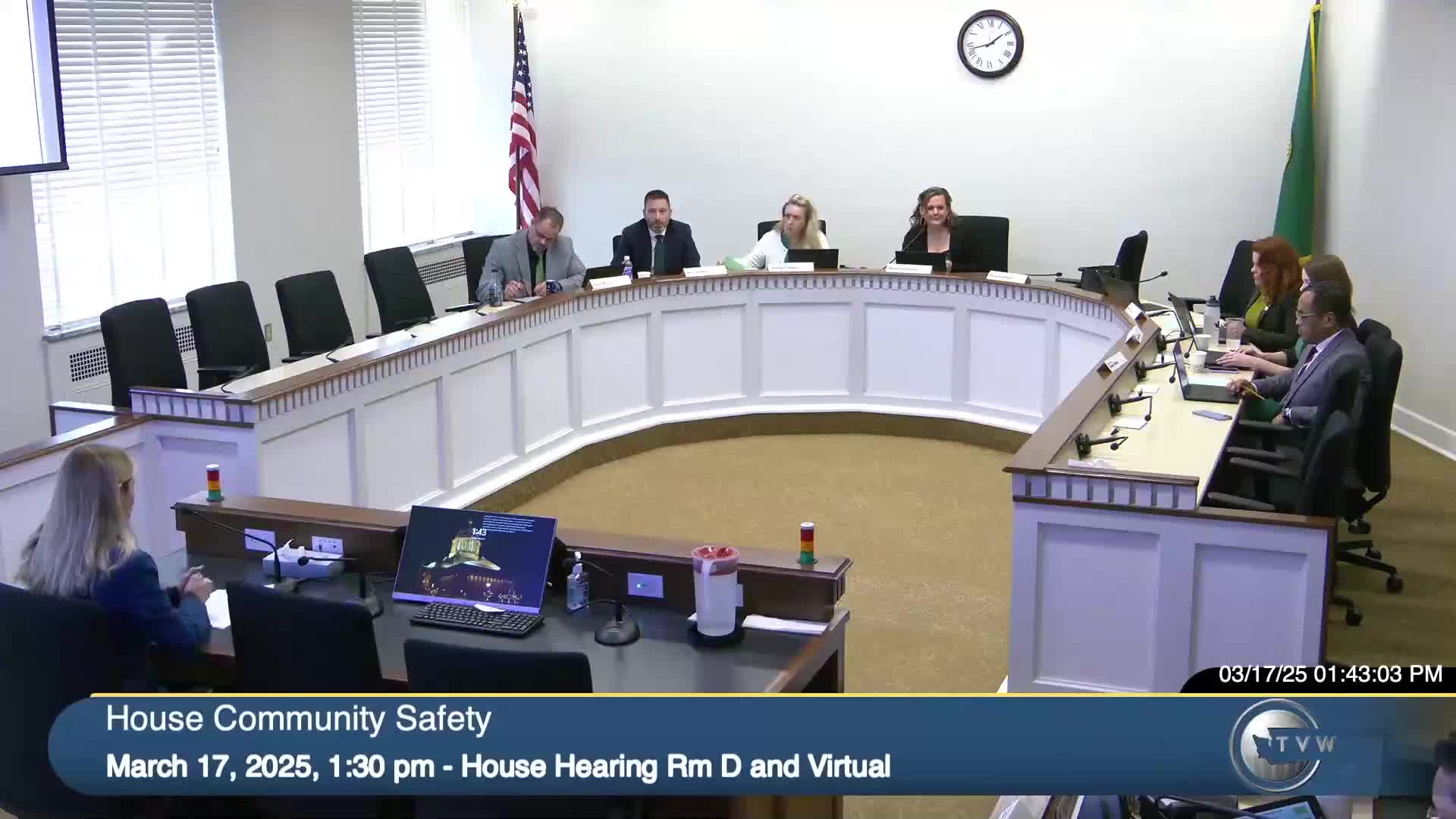
The House Community Safety Committee held a public hearing March 17 on Substitute Senate Bill 5356, which would require the Criminal Justice Training Commission to develop trauma‑informed, victim‑centered curricula for patrol officers and campus Title IX investigators.
Olympia, March 17 — Lawmakers and advocates on Monday debated a bill to expand trauma‑informed training for peace officers and Title IX investigators.
Substitute Senate Bill 5356 would require the Washington State Criminal Justice Training Commission (CJTC) to develop two curricula: one focused on a victim‑centered, trauma‑informed approach for patrol officers and one for peace officers generally on gender‑based violence. The bill also directs CJTC to provide integrated training on investigating and prosecuting sexual assault cases that benefits prosecutors, defenders and victim advocates and to consult with stakeholders, including the Washington Association of Prosecuting Attorneys (WAPA), Washington Defender Association (WDA), Washington Association of Sheriffs and Police Chiefs (WASPC), Washington Coalition of Sexual Assault Programs (WCSAP) and the Washington Student Achievement Council (WSAC).
Lena Langer, committee staff, summarized the bill's training requirements and timelines: officers assigned to patrol would have to complete the patrol training within one year of assignment and all peace officers would be required to complete the training at least once every three years. The bill also directs that investigators handling campus Title IX cases be included in integrated investigator/prosecutor trainings.
Sponsor Senator Tina Orwell and other supporters framed the measure as a restoration and extension of prior CJTC requirements. "We've learned so much about the neurobiology of trauma and how that impacts people and their ability to report," Orwell said, describing training that the commission already offers and telling members the courses are largely online and in place.
Andrea Piper Wintland, sexual assault program manager at CJTC, told the committee the commission has online trainings already developed and can manage additional volume. She asked only for logistical flexibility to create campus‑specific practical scenarios for Title IX investigators rather than dilute patrol training materials.
Several witnesses supported the bill as a way to standardize best practices and reduce inconsistent campus responses. Heather Kelly of the League of Women Voters said the measure was a necessary tool to reconcile public safety with civil liberties and improve outcomes for survivors. Riddhi Mokhopadhyay of the Sexual Violence Law Center said aligning campus investigators with CJTC training would reduce liability and improve victim‑centered responses.
A cluster of public witnesses raised concerns about the bill's use of the term "gender‑based violence." Several male survivors and public commenters asked lawmakers to remove or clarify the phrase, arguing it can exclude male victims and that the statute lacks a definition. Representative K. A. Davis asked committee members to consider the disproportionate impact of domestic violence and coercive control on women; proponents and some victims'service advocates countered that "gender‑based violence" is inclusive of all genders and helps highlight structural disparities in harm.
CJTC staff said trainings would be available online and that timelines in the bill (effective date July 1, 2026 was discussed) would be workable, though scheduling and volume considerations mean the commission would coordinate delivery and may produce a separate campus‑specific module. No amendments were adopted during the hearing; members said they would consider technical adjustments to timing and scope before executive action.
The committee did not take a formal vote Monday and left the hearing open for further stakeholder meetings and technical edits.