Get Full Government Meeting Transcripts, Videos, & Alerts Forever!
Get email alerts on the Workers Compensation Reform topic
No spam. Unsubscribe anytime.
Senate committee hears debate on HB 1788 to change workers’ comp wage‑replacement formula
Summary
Lawmakers and witnesses debated a bill to equalize workers’ compensation wage‑replacement percentages for single parents and married workers, with proponents calling it an equity fix and opponents warning of higher time‑loss costs and urging a broader systemic review.
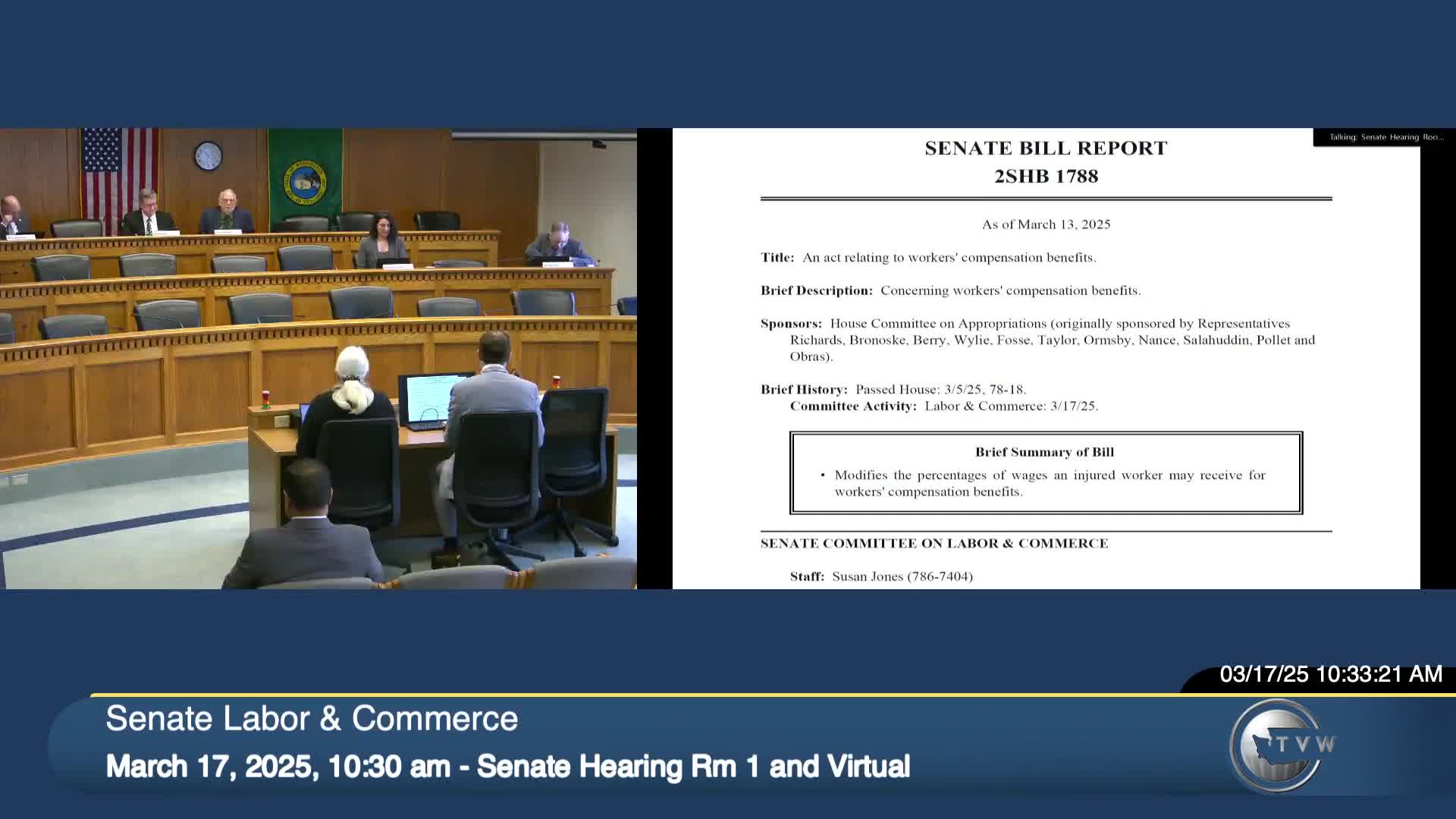
Olympia — The Senate Labor & Commerce Committee heard testimony on second substitute House Bill 1788 on Monday, a bill that would change the formula used to calculate workers’ compensation time‑loss payments and equalize benefits for single parents and married workers.
Committee staff told members the bill, sponsored in the House by Representative Addison Richards, would alter time‑loss percentages and add a 2% payment to a child's legal custodian, reducing payments to the worker or surviving spouse by that amount. Susan Jones, committee staff, said the bill passed the House 78‑18 and that a fiscal estimate on the proposed second substitute shows $509,000 to the accident and medical aid accounts.
Supporters said the measure fixes an inequity in the decades‑old formula. "This bill simply fixes an inequity in the time loss formula for different family compositions," said Ray Dumas of Operative Plasters and Cement Masons Local 528, urging the committee to move the bill. Representative Addison Richards, the House sponsor, told the committee the change is about "fairness and parity" and described single parents’ financial risk while recovering from an on‑the‑job injury.
Labor groups framed the change as a limited, targeted correction. Joe Kendo of the Washington State Labor Council, who also sits on the workers’ compensation advisory committee, described prior multi‑stakeholder work on time‑loss accuracy and said HB 1788 removes a penalty for single parents without reopening broader wage‑definition debates.
Opponents urged caution and systemic fixes. Patrick Connor of the NFIB said the bill "has become little more than a benefit increase" and recommended the department convene stakeholders to address underlying calculation problems. Carolyn Logue of Associated Builders and Contractors said the bill adds significant time‑loss costs, telling the committee, "if you look at page 7 of the fiscal note, you'll see that it still does add $36,000,000 in time loss costs over five years." Rose Gunderson of the Washington Retail Association echoed concerns that increasing benefits without addressing drivers of long‑term disability could worsen system costs.
Committee staff described the bill’s mechanics: for injuries or disease manifestation on or after July 1, 2026, the base replacement percentage would remain 60% for an unmarried worker with no children; married workers with no children and unmarried workers with one child would receive a higher starting percentage, and the benefit would increase by 2% for each additional child up to a 75% maximum. The bill also changes the date used to classify prior claims (before July 1, 2026, rather than on or before June 30, 2026) and adds a 2% payment to a legal custodian of a worker’s child.
Several witnesses urged the committee to use a workers’ compensation advisory group or a stakeholder work group to examine the broader issues behind rising time‑loss and permanent disability rates before adopting benefit increases. Proponents said the bill’s narrowly targeted equity fix is necessary now to prevent single parents from receiving smaller wage replacement.
No formal action or vote on HB 1788 was recorded during the hearing. Committee members asked staff and witnesses for additional materials and referenced prior work groups and bills that examined time‑loss calculations.
The committee moved on to other bills after the HB 1788 panel concluded.