Get Full Government Meeting Transcripts, Videos, & Alerts Forever!
Get email alerts on the Hb 1587 Wsos Promise topic
No spam. Unsubscribe anytime.
Bill would let cities, counties create local 'promise' scholarships inside WSOS; hearing held
Summary
Kelly Gunn, nonpartisan staff to the Senate committee, briefed lawmakers on Second Substitute House Bill 1587 during a public hearing and said the measure would allow local governments to establish local promise scholarship programs within the Washington State Opportunity Scholarship framework and receive a state match.
Kelly Gunn, nonpartisan staff to the Senate committee, briefed lawmakers on Second Substitute House Bill 1587 during a public hearing and said the measure would allow local governments to establish local promise scholarship programs within the Washington State Opportunity Scholarship (WSOS) framework and receive a state match.
"WSOS is a private nonprofit which administers a private‑public match program in which the state matches any private contribution to fund the scholarships," Gunn said. Under the bill as presented, the statewide match to WSOS is capped at $50,000,000 annually, and state matching funds for each local government partner's program would be limited to $250,000 per fiscal year.
Gunn said eligibility in the bill requires that students have received a Washington high school diploma or high school equivalency and be attending a public two‑year institution, a professional‑technical certificate or degree program as defined by the local government partner; local programs may not provide eligibility for more than three years. For a local program to be eligible for a state match in the 2025‑27 biennium, the local government must submit a pledge by Feb. 1, 2025, Gunn said. The bill also creates reporting requirements: the Education Research and Data Center must provide outcomes data on WSOS recipients and graduates, and WSOS must include certain information in its annual report.
Representative Steve Bergquist, the bill sponsor, framed the measure as a way to scale municipal pilot efforts such as the Renton Promise. Bergquist said the bill would reduce administrative fees charged against matched funds (from roughly 50% under some arrangements to 10% in the sponsor's framework), allowing more donor and match dollars to go directly to students. "This would allow students to sign up later—into the fall quarter—so they have time to choose programs without committing months before graduation," Bergquist said, describing Renton's pilot and retention gains.
Ben Mitchell, director of policy and advocacy at Foundation for Tacoma Students, testified in support and said the bill could help local partners meet unmet student need without fully relying on municipal budgets. Jessica Monger, external affairs director for WSOS, said WSOS staff "see real value and opportunity" in the proposal and that WSOS would administer local government scholarships if the bill passes, but she added that WSOS is neutral on the bill because local programs would be able to set eligibility beyond WSOS's current focus on high‑demand fields and income limits.
One remote testifier, John Axtel, urged additional eligibility screening, asking that diploma/equivalency requirements be supplemented with placement cut scores to ensure students are prepared for college‑level work.
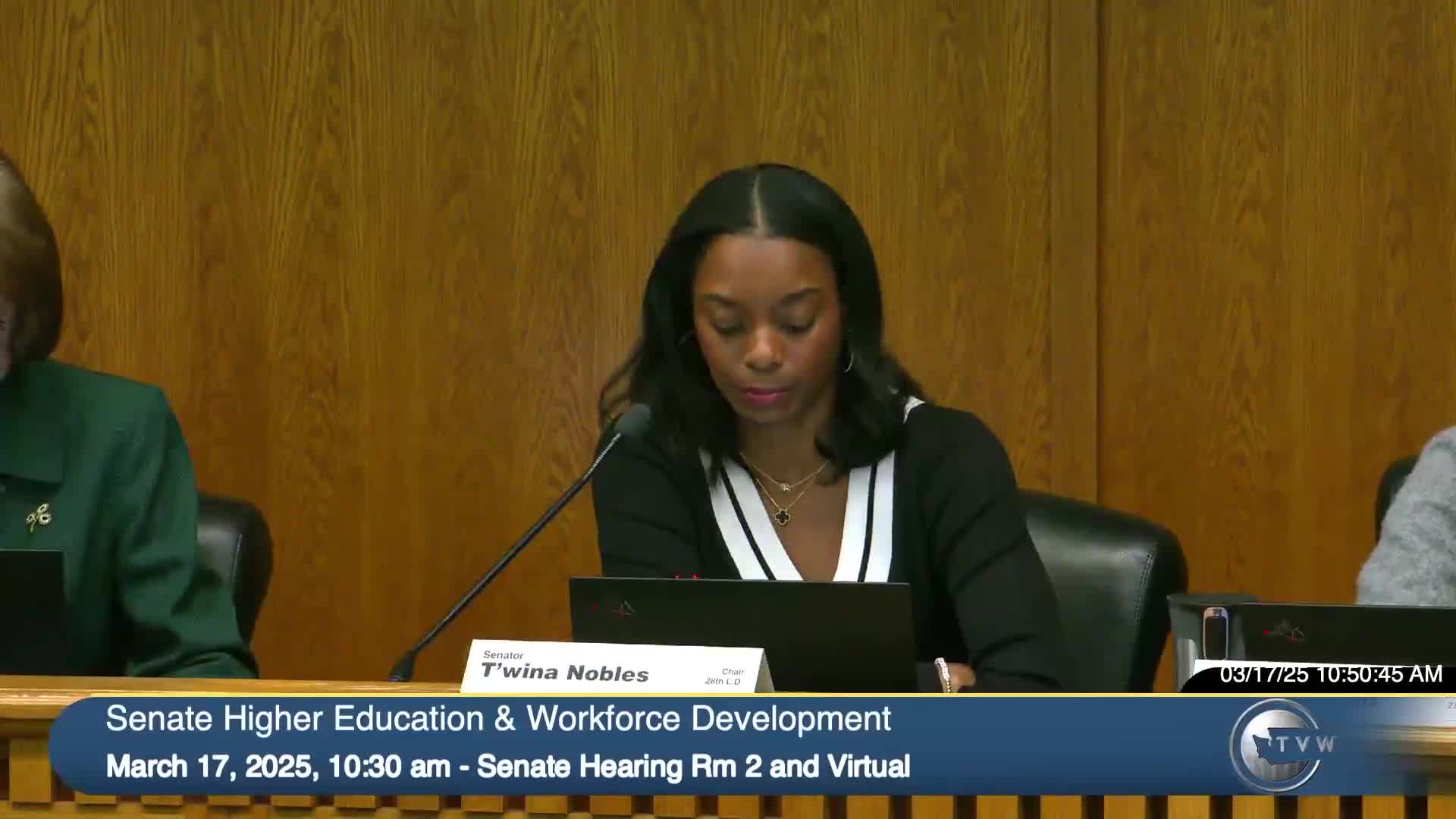
Kelly Gunn told the committee that a fiscal note is available and that staff are available for questions. Chair Nobles opened and closed the public hearing and set the bill aside to return to the work session; the committee did not take a committee vote at the hearing. Gunn also noted the bill passed the House 58‑38 earlier in the session.