Get Full Government Meeting Transcripts, Videos, & Alerts Forever!
Get email alerts on the Digital Deception topic
No spam. Unsubscribe anytime.
Substitute bill criminalizes knowing distribution of forged digital likenesses with intent to harass, intimidate or defraud
Summary
Substitute House Bill 1205 would expand criminal impersonation in the second degree to cover the knowing distribution of forged digital visual or audio likenesses when done with intent to harass, intimidate, threaten or defraud. Sponsors said the change targets malicious fabricated media while preserving exemptions for satire, newsworthy uses and
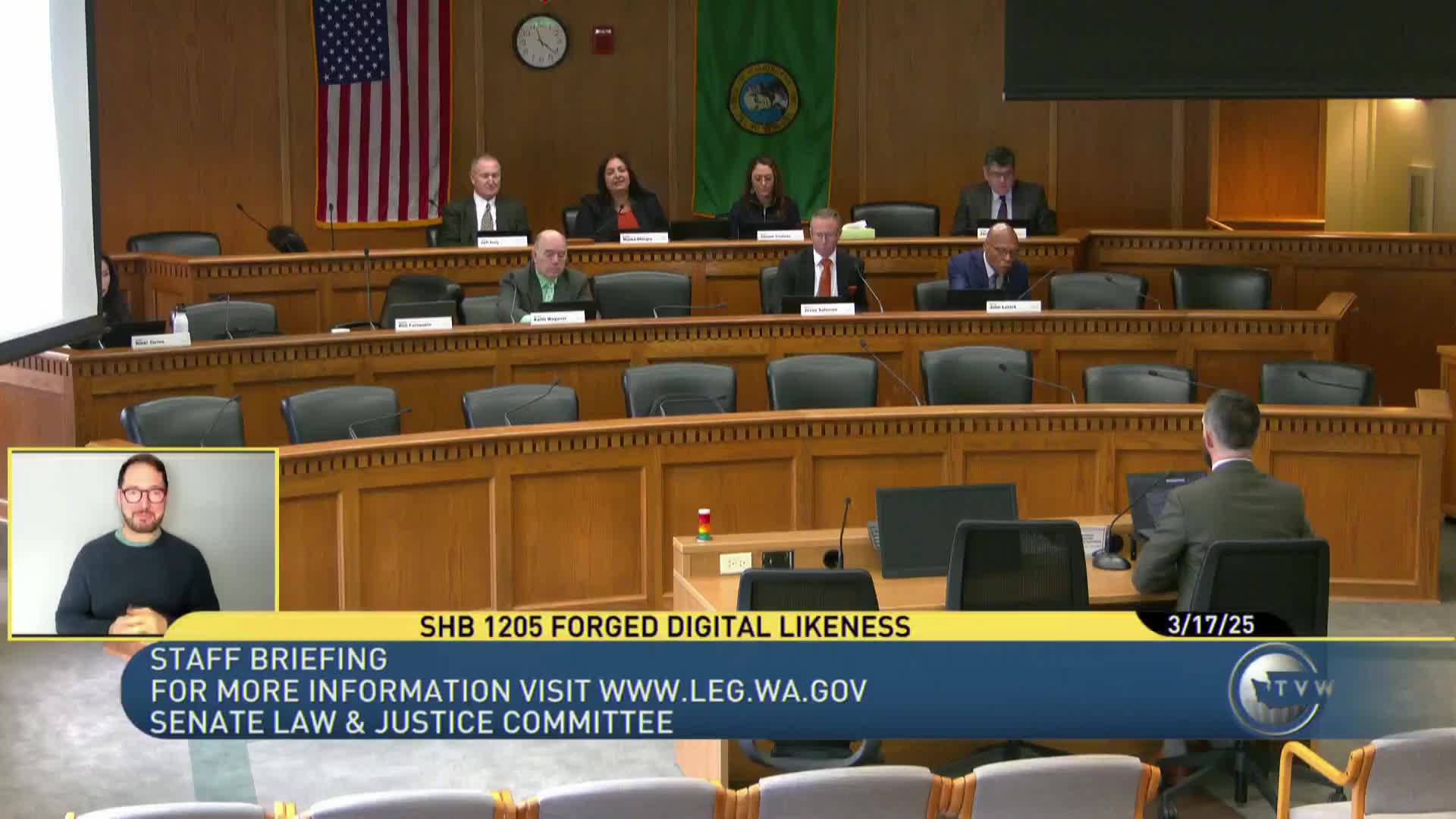
Substitute House Bill 1205 was heard March 17 by the Law & Justice Committee. The bill would expand the existing crime of criminal impersonation in the second degree to include knowingly distributing a forged digital likeness — a fabricated visual representation or audio recording — of another person when done with the intent to defraud, harass, threaten or intimidate or for other unlawful purposes and when the distributor knows or reasonably should know the likeness is not genuine.
Joe McKittrick, staff counsel, reviewed existing laws: Washington already has civil and criminal prohibitions for various uses of synthetic or fabricated media (for example, disclosure of fabricated intimate images can be criminal), and criminal impersonation in the first and second degrees exist for assuming a false identity or impersonating public servants or veterans for unlawful purposes. HB 1205 expands the second-degree definition to cover knowing distribution of forged digital likenesses while also stating that the bill should not be construed to prohibit constitutionally protected works such as satire, parody, newsworthy reporting, or other public-interest uses.
Representative Cindy Ryu, sponsor, described national incidents where fabricated media damaged a principal's reputation and said the bill adapts existing impersonation law to address increasingly realistic AI-created content. Committee members discussed constitutional limits and McKittrick responded that the bill focuses on the distributor's unlawful intent (to defraud, harass, threaten or intimidate), which narrows conduct to unprotected categories such as true threats and fraud.
No public testimony was offered in person or remotely; one pro and one con submission were recorded in the hearing record. The public hearing closed with no committee action taken.