Get Full Government Meeting Transcripts, Videos, & Alerts Forever!
Get email alerts on the Shellfish Burrowing Shrimp Ipm topic
No spam. Unsubscribe anytime.
Bill would create shellfish pest research board after Ecology denied pesticide request; critics warn of industry influence
Summary
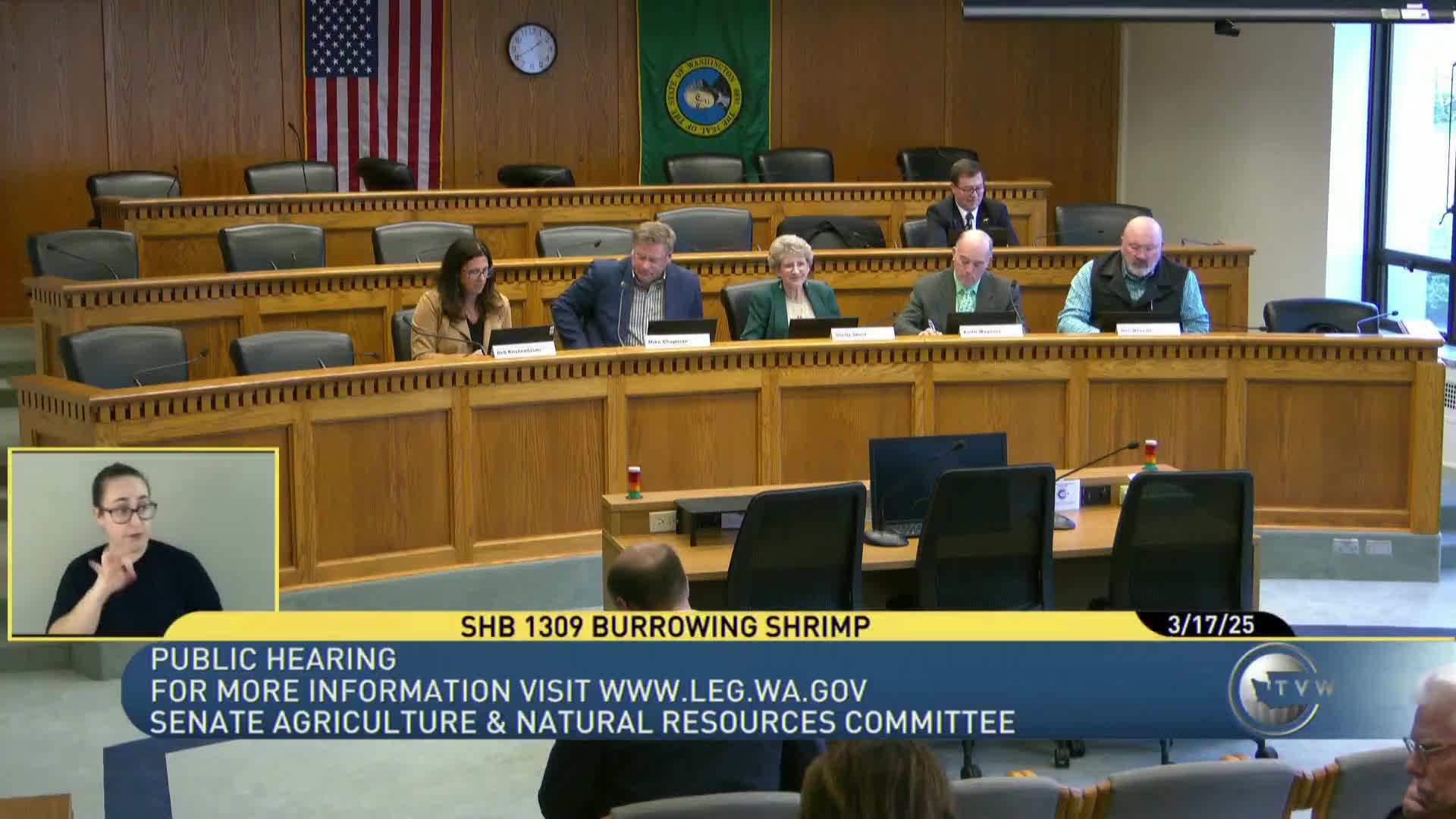
The Senate Agriculture Committee heard substitute House Bill 1309 on March 17, which would create an integrated pest management research program at the Washington Department of Agriculture to address burrowing shrimp impacts on bottom culture shellfish.
The Senate Agriculture, Water, Natural Resources & Parks Committee heard Substitute House Bill 13 09 on March 17. The bill would direct the Washington Department of Agriculture to administer an integrated pest management (IPM) research program focused on burrowing (ghost) shrimp and establish a governing board to oversee program grants and research priorities.
Committee staff, Jeff Olson, said the bill mirrors language passed in the House (94–1) and is a companion to a Senate measure. Olson recounted that in 2018 the Department of Ecology denied a request by growers to use a pesticide on shellfish beds in Willapa Bay and Grays Harbor, and that Ecology and shellfish growers subsequently entered a settlement agreement to pursue other management options. The bill would create an IPM research program, and a governing board with representatives from six state agencies, shellfish growers and processors, the Shoalwater Bay Tribe, an ecosystem‑based nonprofit and a nonprofit shellfish organization. Olson said the governing board is directed to meet at least quarterly. A partial fiscal note put initial implementation costs at about $193,000 and did not include research funding.
Rep. Joel McIntyre, the bill’s prime sponsor, said the coastal shellfish industry has suffered production losses attributable to burrowing shrimp and that research into a suite of tools — mechanical, biological and other delivery mechanisms — is needed. “This is just the start to a solution,” McIntyre said, calling the bill a step toward environmentally acceptable management techniques.
Several shellfish growers and the Willapa Grays Harbor Oyster Growers Association testified in favor. Laura Butler, legislative liaison for the Washington State Department of Agriculture, described nearly $4 million in state research grants awarded since 2019 under a prior grant program tied to the Ecology settlement and said the IPM work has been collaborative among growers, agencies and tribes.
A number of environmental and community witnesses testified in opposition or urged caution. John Garner of the Environmental Coalition of Pierce County and other speakers raised concerns that the bill’s governing‑board membership requirement — which the bill text frames as members who “must have a clear stake or vested interest in the preservation and sustainability of the shellfish industry” — would bias decisions toward industry priorities and could reopen the door to chemical controls. Several opposition witnesses said Ecology’s past denial of aerial pesticide spraying reflected science‑based concerns about impacts to estuarine ecosystems and food webs. Advocates for the bill responded that the program’s statutory language is intended to support integrated pest management research and collaboration across agencies, tribes and scientists and that research to identify non‑toxic management tools is ongoing.
Committee staff and multiple witnesses cited the bill’s House passage with strong support and described an active IPM working group that has carried out micro‑scale research trials since 2019. The committee did not take action at the hearing.