Get Full Government Meeting Transcripts, Videos, & Alerts Forever!
Get email alerts on the Higher Education Funding topic
No spam. Unsubscribe anytime.
Senate committee hears that Washington 'fund split' shifts costs to students, straining campuses
Summary
Presenters told the Senate Higher Education & Workforce Development Committee that a budgeting practice known as the fund split—created after the Great Recession—now leaves public institutions reliant on tuition amid falling enrollment and a statutory tuition cap, producing deficits, staff cuts and reduced student services across the sector.
Melissa Beard, director of legislative affairs for the Council of Presidents, told the Senate Higher Education & Workforce Development Committee that a long‑standing budgeting practice known as the "fund split" has shifted recurring compensation and central‑services costs from the state to tuition, producing budget shortfalls and service cuts across Washington's public higher education sector.
Beard briefed the committee during a March 17 work session on how the fund split emerged after the Great Recession and how it affects each public institution differently. "Historically, the state assumed 100% of operating and central services costs for institutions and tuition was used to meet emerging academic and support needs of students," Beard said. "This fund split practice is not in law or written down, it is a budgeting practice."
The fund split divides the cost of compensation and central services between state appropriations and tuition revenue. Beard said the split varies across the sector—from roughly 60% state funding at the University of Washington to about 85% state funding for some smaller institutions. She told senators that lower enrollment, a statutory tuition cap enacted in February 2015 and rising inflation have combined to reduce tuition revenue available to fill those gaps.
Beard described how the policy has translated into concrete impacts at individual campuses. She said Central has reduced staff by about 14% since 2019, a reduction that she tied to lost course offerings and services. Eastern, she said, faces an ongoing $12 million deficit and recently identified 55 programs for consolidation or elimination as part of a plan intended to save about 12% of its base budget over three to five years. Evergreen still carries a roughly $4.4 million structural deficit, Beard said. "When institutions have to cut their base budgets, they reduce flexibility to serve emerging student needs," she said.
Beard also described a set of impacts at research universities. She said the University of Washington's fund split is about 60% state funding and 40% tuition revenue and that, "per‑student state funding at the U is now substantially lower than in earlier decades," attributing the analysis to LEAP. She said UW has a hiring pause and has felt pressure on its ability to provide cost‑of‑living adjustments in a high‑cost region. At Washington State University, Beard said tuition revenues have fallen short of state projections for five straight years and that WSU has cut about $34.7 million over the last three years to balance operations; she also said the share of tenure‑track faculty across the sector has declined over the past decade.
Choi Holliday, deputy executive director for business operations at the State Board for Community and Technical Colleges, provided sector context for the community and technical colleges. "We serve around 290,000 students last year," Holliday said, and noted the sector’s in‑state tuition for a full‑time student was about $4,700 for the year she described. Holliday explained how the board allocates the system appropriation to colleges and emphasized that the colleges also rely on grants, contracts and enterprise operations. She highlighted a mismatch between large cost drivers—for example, collective bargaining increases covered by Initiative 732 formulas—and modest tuition increases constrained by the statutory cap.
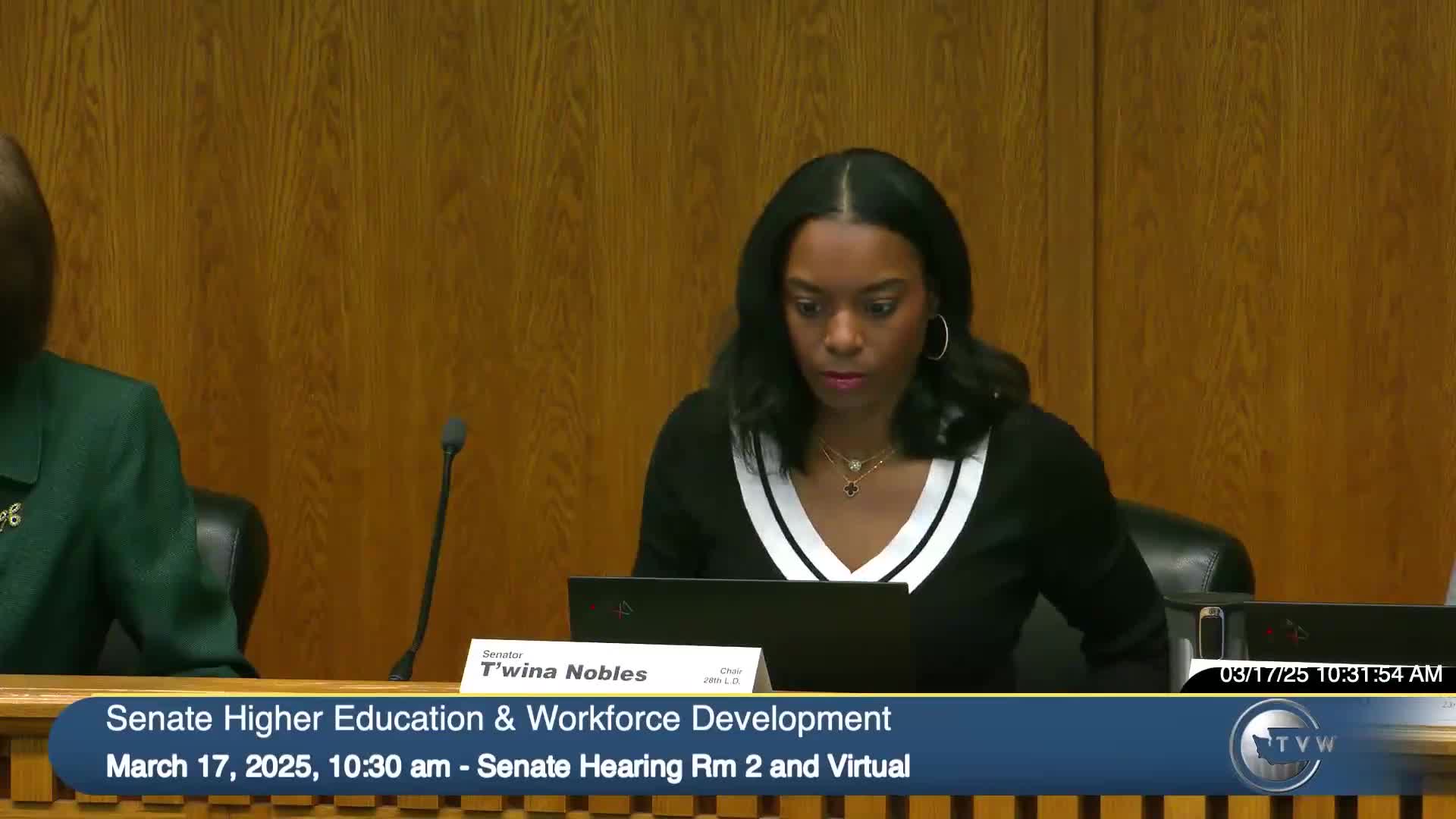
Committee members asked presenters for further data. Senator Slatter praised the clarity of the presentation and asked about transparency in campus budgeting; a follow‑up question requested a breakout showing how federal research dollars interact with state funding. Chair Lisa Nobles (referred to in the transcript as Chair Nobles) said the fund split and preservation of the Washington College Grant are priorities for the committee and noted pending legislation to revisit tuition policy.
No committee vote was taken at the work session. Presenters and staff agreed to provide additional data to senators on enrollment trends, federal funding breakout and the allocation model used by the community and technical college system.