Get Full Government Meeting Transcripts, Videos, & Alerts Forever!
Get email alerts on the Traffic Safety Policy topic
No spam. Unsubscribe anytime.
Substitute bill would let repeat-moving-violation drivers avoid suspension once by taking safety training
Summary
Substitute House Bill 1244 would let drivers eligible for a 60-day suspension avoid that suspension once every five years by completing an approved safe driving course, showing insurance and paying the reissuance fee.
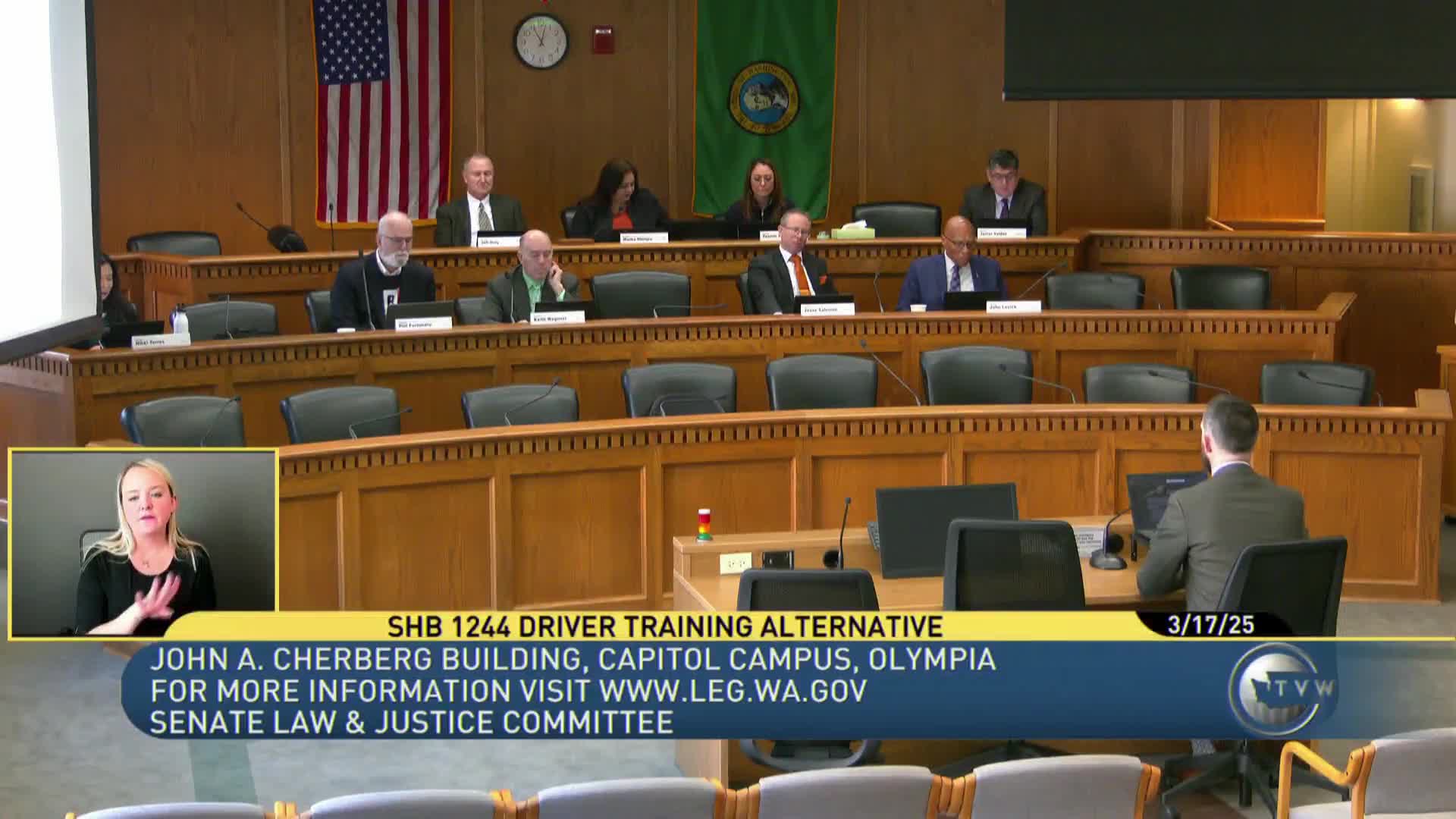
Substitute House Bill 1244 was heard March 17 by the Law & Justice Committee. The bill would allow the Department of Licensing (DOL) to reinstate the license of a driver who otherwise would have a 60-day suspension for repeated moving violations after the driver presents proof of completing a DOL-approved safe driving course, proof of insurance and payment of the $20 reissuance fee. The option would be available one time per five years and would not apply to serious offenses such as DUI, reckless driving, or street racing.
Joe McKittrick, staff counsel, summarized the existing statutory framework: a driver's license is suspended for 60 days when a person commits three or more moving violations in one year or four or more in two years; reinstatement now requires completion of a safe driving course after the suspension period and proof of insurance. HB 1244 would permit DOL to reinstate the license once the person submits proof of course completion, insurance and fee without waiting for the full suspension to run.
Alejandro Sanchez, Deputy Director for DOL, testified in support as agency-request legislation and described the policy as a modest one-time "off-ramp" intended to reduce the hardship caused by 60‑day suspensions while preserving safety: the course is targeted at lesser moving violations and is not available for serious offenses. Sanchez cited Massachusetts' program as a model and said recidivism among participants fell in comparative data; DOL staff reported that under the current framework about 55% of suspended drivers take the safe driver course and about 18% of participants had another offense in the following year.
Representative Sharon Wiley, prime sponsor, described the policy rationale as reducing disproportionate life impacts of suspensions and encouraging timely training. The National Safety Council submitted supporting testimony citing studies that retraining can reduce violations and crashes; witnesses noted the course already exists in multiple modalities (online and in person) and DOL maintains a list of certified providers.
Committee members asked for additional data on the numbers of suspensions and outcomes, accessibility in rural areas, course cost, and length of any probationary period if the course is taken to avoid suspension. DOL staff said the alternative would put the driver on a one-year probationary period after course completion and that an additional infraction on probation would trigger at least a 30-day suspension (agency staff said the precise suspension could be longer depending on circumstances). The public hearing closed with no committee vote; a fiscal note is available and the bill would take effect April 1, 2026 if enacted.