Get Full Government Meeting Transcripts, Videos, & Alerts Forever!
Get email alerts on the Building Codes topic
No spam. Unsubscribe anytime.
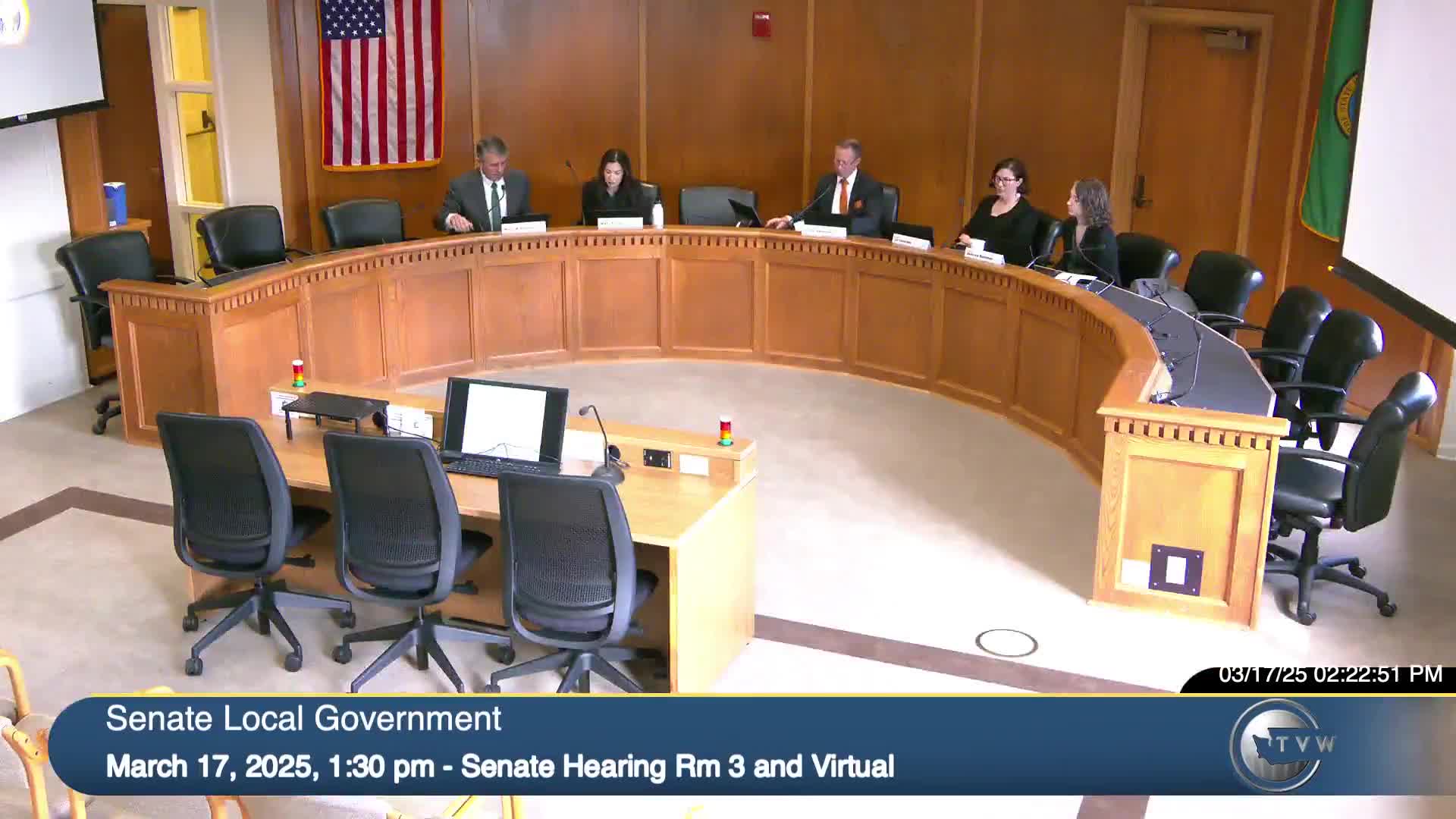
Senate committee hears bill to ease rules for passive-house retrofits, solar and affordable housing
Summary
A Senate Local Government Committee hearing reviewed House Bill 1183, which would allow limited exterior insulation into setbacks, increase roof height allowances for rooftop solar, and prohibit certain local requirements for affordable, modular, mass-timber and passive-house projects.
House Bill 1183 would change several local land-use and building-code practices to facilitate energy-efficient retrofits and certain types of housing, committee staff and the bill sponsor told the Senate Local Government Committee.
Committee staff said the bill applies to cities and counties planning under the Growth Management Act and would allow exterior wall insulation for qualifying retrofits and new construction meeting passive-house standards to project up to 8 inches into required setbacks and to allow roof height to exceed municipal maximums by up to 48 inches to accommodate rooftop solar panels.
“Passive house is a very, very energy efficient way of building,” Representative Devina Duerer, the bill’s sponsor, said. She told the committee exterior insulation and thick passive-house walls can otherwise reduce interior living area and that the bill is “a very targeted bill” aimed at encouraging affordable and energy-efficient housing.
The bill also measures gross floor area from the interior face of exterior walls, allows existing nonconforming buildings used as housing to extend exterior insulation up to an additional 8 inches into setbacks, and states jurisdictions may not require façade modulation or upper-level setbacks for qualifying residential projects.
HB 1183 would prohibit local governments from requiring off-street parking as a condition for permitting affordable housing, new construction, passive-house retrofits, modular construction or mass-timber construction, unless the jurisdiction submits an empirical study to the Department of Commerce and Commerce certifies that parking limitations would be significantly less safe. Counties may require parking where roads do not meet urban standards adopted within the county.
The bill sets other limits, including minimum measured setbacks of 36 inches between dwelling units and measurement of setbacks to the outside face of the foundation for qualifying projects. It requires cities and counties to implement the provisions within six months after either their next periodic comprehensive plan update or their next implementation progress report, whichever comes first.
Supporters who spoke at the hearing said the measures would reduce barriers to energy upgrades, increase the feasibility of low‑carbon materials like mass timber, and reduce the upfront cost of building energy-efficient housing. Local government representatives said they had worked with the sponsor on many provisions but raised remaining concerns about some parking exemptions and the prescriptive nature of façade and setback preemptions.
The committee did not vote on the bill today; staff said a fiscal note is available and that the bill passed the House 56–39.