Get Full Government Meeting Transcripts, Videos, & Alerts Forever!
Get email alerts on the Sex Offender Policy topic
No spam. Unsubscribe anytime.
Bill would require electronic monitoring when sexually violent predators placed on less-restrictive release
Summary
Substitute House Bill 1457 would require real-time electronic monitoring with programmable geofencing when courts release persons civilly committed as sexually violent predators on less-restrictive alternatives.
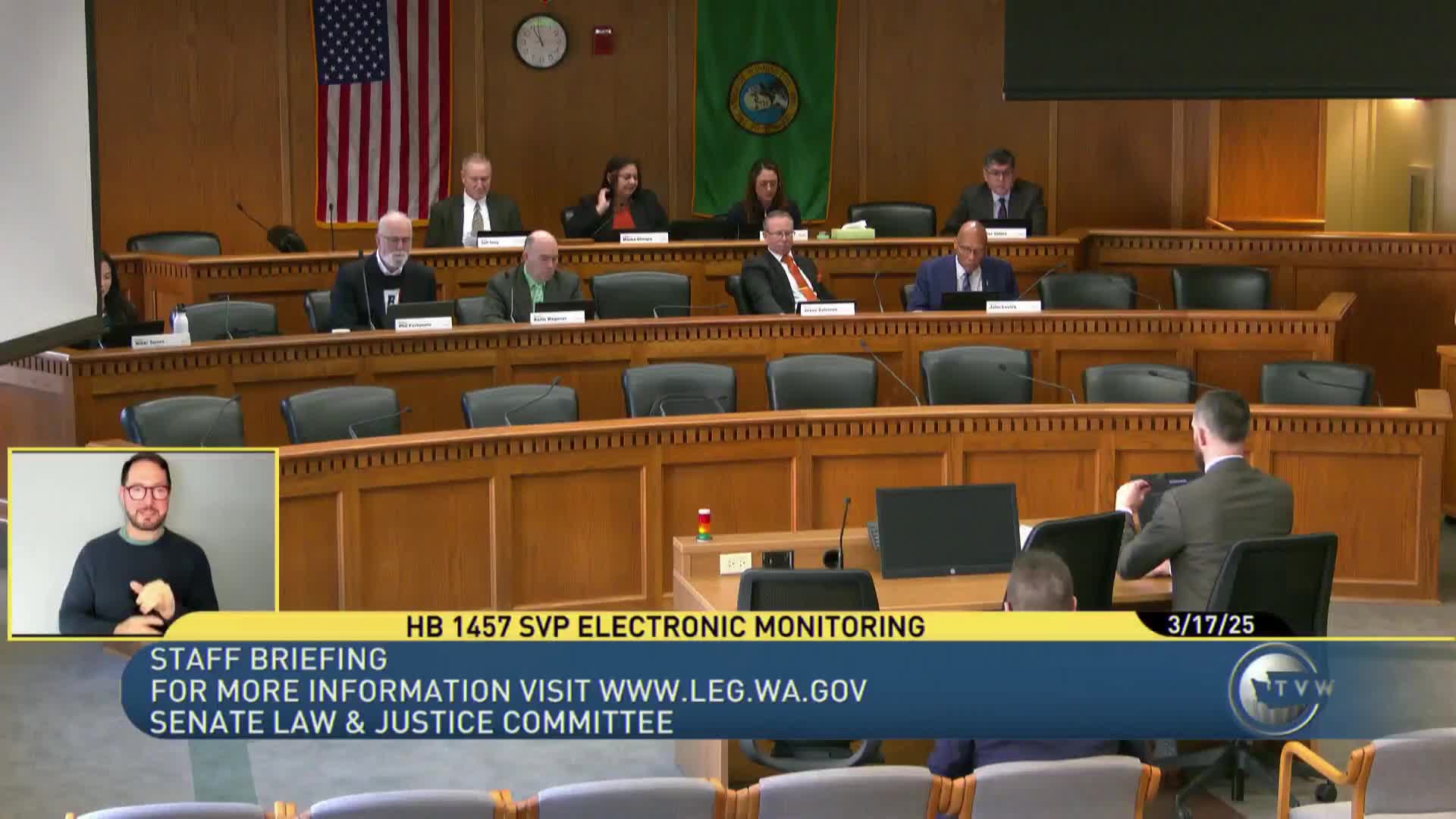
Substitute House Bill 1457 was the subject of a March 17 public hearing before the Law & Justice Committee. The bill would require courts to impose electronic monitoring when releasing someone classified and civilly committed as a sexually violent predator (SVP) on a less-restrictive alternative (LRA).
Joe McKittrick, staff counsel, summarized the statutory framework: a sexually violent predator is a legal classification that permits civil commitment at the Special Commitment Center (McNeil Island) when a court finds the person was convicted of a crime of sexual violence and suffers from a mental abnormality or personality disorder that makes them likely to reoffend. DSHS must perform annual reviews and may petition for conditional or unconditional release if the person's condition has changed.
Under HB 1457, courts would be required to impose electronic monitoring capable, to the extent feasible, of providing real-time tracking, programmable geofencing (inclusion and exclusion zones), tamper notifications, and survivor-notification features. Representative Dan Griffey, sponsor, said the proposal had bipartisan input and that defenders agreed to the monitoring requirement because the technology could both protect communities and demonstrate compliance with court-ordered conditions.
Testimony in support included the Department of Licensing's earlier testimony about monitoring programs (noting the bill addresses civil commitment reentrants rather than driver licensing) and witnesses who emphasized survivor notification as a significant public-safety benefit. No one signed in to testify in opposition; the committee closed the public hearing with only committee discussion. Committee staff recorded written submissions (147 pro, 2 con, 1 other) in the hearing record. No committee vote occurred during the hearing.
Questions from members focused on technological feasibility, survivor notification procedures, and how monitoring would integrate with existing release conditions. The bill would take effect 90 days after signature if enacted, and a fiscal note is available on the committee's bill page.