Get Full Government Meeting Transcripts, Videos, & Alerts Forever!
Get email alerts on the Sentencing Reform topic
No spam. Unsubscribe anytime.
Bill would let courts treat pregnancy resulting from sexual assault as aggravator regardless of victim age
Summary
House Bill 1484 would expand the Sentencing Reform Act's listed aggravating circumstances so a pregnancy resulting from sexual assault may support an exceptional sentence regardless of the victim's age. Proponents said the change closes an age-based gap in sentencing; witnesses included prosecutors and victim advocates.
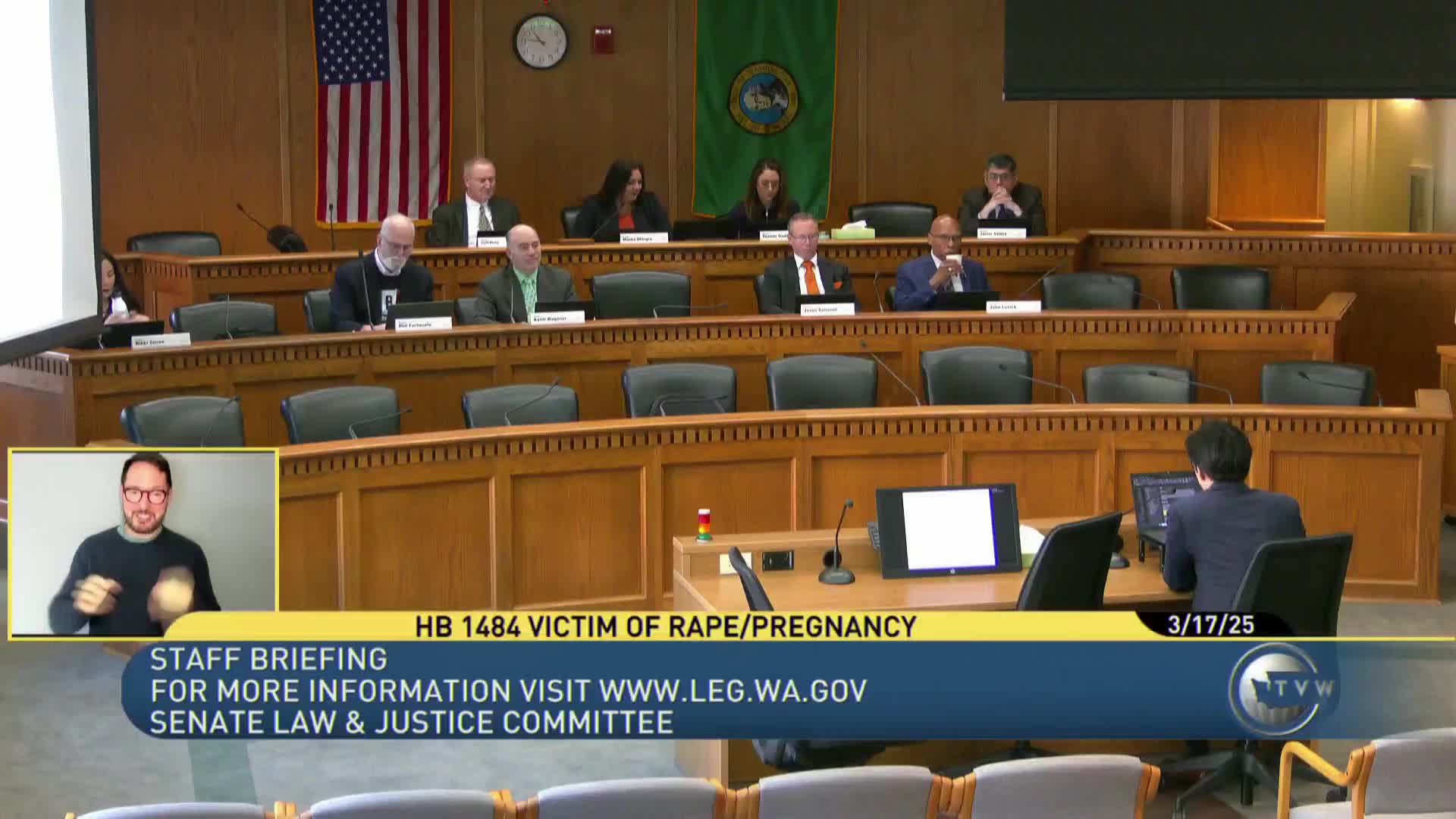
House Bill 1484 received a public hearing March 17 before the Law & Justice Committee. The bill would amend the Sentencing Reform Act's list of aggravating circumstances to allow a trial court to impose an exceptional sentence when an offense results in the pregnancy of a victim of sexual assault regardless of the victim's age.
Ryan Giannini, staff counsel, summarized the mechanics: under current law the Sentencing Reform Act (SRA) provides a standard sentence range and a court may impose an exceptional sentence only after written findings that a substantial and compelling reason justifies departure. The SRA currently includes an aggravator when an offense results in the pregnancy of a child victim of sexual assault; HB 1484 would extend that aggravator to pregnancies resulting from sexual assault of victims of any age.
Representative Osman Salahuddin, sponsor, said the bill "ensures that justice is not just determined by age but by the magnitude of the crime itself," and described national data on pregnancies resulting from sexual violence. Laurel Smith, a senior deputy prosecutor in Clark County, gave factual examples of cases in which adult victims became pregnant after sexual assault and noted that current law gives a sentencing aggravator only for pregnancies involving minors. She asked the committee to close that gap so judges can account for the added harms of a resulting pregnancy.
Carrie Anne Yetzner, coordinator for the Washington State Sentencing Guidelines Commission, testified as "other" and recommended that, if the committee adds this aggravating factor, it also consider whether the statutory language should be added to subsections of RCW 9.94A.537 that govern separate proceedings for evidence supporting aggravators (to preserve admissibility procedures and avoid unfair prejudice to juries).
Raquel Rodriguez, a King County sexual assault victim advocate, said a pregnancy resulting from sexual assault increases survivors' legal, medical and caregiving burdens and urged the committee to pass the bill. Committee staff closed the public hearing; no committee vote occurred during the session.
Committee members asked technical and evidentiary questions; staff noted a fiscal note was available. The hearing record contains written submissions.