Get Full Government Meeting Transcripts, Videos, & Alerts Forever!
Get email alerts on the Parks Encroachment topic
No spam. Unsubscribe anytime.
Oregon City reviews McLaughlin Promenade encroachments; staff to arrange site visits, cost estimates and assessor consultation
Summary
The commission directed staff to schedule site visits, obtain cost estimates and consult the county assessor after reviewing private encroachments on the McLaughlin Promenade at the March 11 work session.
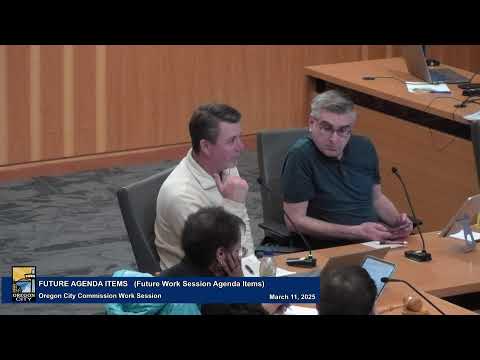
The Oregon City Commission on March 11 reviewed a city staff report on private encroachments along the McLaughlin Promenade and provided direction on next steps, including focused site visits, legal review and cost sharing discussions with affected property owners.
City staff outlined four options for dealing with private improvements on the promenade: pursue vacating small strips of dedicated promenade to adjoining owners (a formal vacation), record an acknowledgment of encroachment, use revocable encroachment licenses, or require removal of unlawful encroachments. City Attorney Bill explained that easements and lot‑line adjustments do not eliminate the original dedication; only a vacation removes the dedication and clears the title interest from the promenade.
Staff reported a mix of responses from property owners: some have signed encroachment license agreements, some have offered to pay vacation costs, some have not responded and others opposed indemnity language in the draft license. Commissioners asked staff to pursue the options case‑by‑case.
Key directions given by the commission:
- Staff was asked to schedule on‑site inspections (a "walkthrough") for a priority set of parcels, specifically those listed in the staff packet including properties near 302, 306 and 311 Bluff Street and adjacent parcels identified as 406 and 408 Bluff. The commission asked staff to return with photos and recommendations after the site visits. - Staff was directed to obtain preliminary cost estimates for vacation processing (survey work, legal description, recording and other fees) and to explore cost‑sharing arrangements with owners who have offered to pay. Commissioners asked staff to report approximate per‑parcel costs before committing to formal vacations. - Staff was directed to consult the county assessor about the tax implications of vacating promenade parcels and whether those changes could trigger reassessment or other tax adjustments for property owners. - For specific parcels where owners are willing to pay to correct title (for example the VFW parcel discussed in the meeting), staff should prepare a proposed scope and cost split for commission approval. A VFW representative said their proposal would give up roughly 5,000 square feet and request back about 600 square feet for an internal parcel; staff estimated that would increase park area by about 4,200 square feet if finalized.
Commissioners also made parcel‑level decisions by consensus during the meeting: small movable sheds or temporary items should be moved or obtain right‑of‑way permits; decks and structural encroachments were treated as higher‑priority items for either vacation or license agreements; rock walls or landscaping that clearly demarcate private property from parkland were to be removed unless they qualified as historic retaining walls or were otherwise approved through an agreement. Several commissioners emphasized a preference for clear, recorded resolution (vacation where appropriate) over leaving ambiguous, unrecorded acknowledgments.
Why it matters: The promenade is dedicated public land; unresolved encroachments create legal uncertainty, potential liability and ongoing maintenance questions for the city. Vacations and recorded agreements change property titles and can carry survey and recording costs and potential tax implications for owners.
Next steps: Staff will schedule the walkthroughs, request assessor guidance, return with parcel‑level cost estimates and proposed agreements, and prepare any necessary public‑process items for vacations or codified encroachment agreements.