Get Full Government Meeting Transcripts, Videos, & Alerts Forever!
Get email alerts on the Parking And Transportation topic
No spam. Unsubscribe anytime.
Oregon City planners review state—limate-friendly parking rules; approve minutes, set public hearing for April
Summary
City planning commissioners heard a consultant—riefing on Oregon dministrative Rule implementation for parking, EV infrastructure, tree canopy and bike parking. Staff will present recommendations to the City Commission March 11 and hold a public hearing April 14. The commission also approved the Feb. 24 minutes.
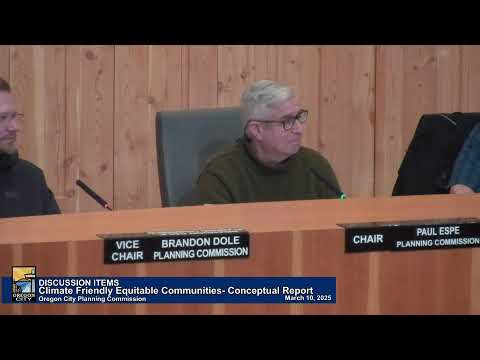
The Oregon City Planning Commission on March 10 heard a consultant presentation on the Climate Friendly and Equitable Communities (CFEC) rules the city must adopt, discussed specific code options for parking, electric-vehicle infrastructure, tree canopy and bicycle parking, and set next steps for hearings and council review. The commission also voted to approve the Feb. 24 meeting minutes.
Consultant Brian Davis of Studio Davis told commissioners the state rules aim to "reduce the construction of underutilized overabundant parking" and to make required parking more climate friendly through landscaping and EV-ready infrastructure. He summarized public outreach and said the project team will return to the commission for a public hearing on April 14 and to the City Commission work session on March 11 before a final code package aimed at meeting the state's June 30 compliance deadline.
Why it matters: the new Oregon Administrative Rules change when cities may require parking, set maximums near frequent transit, require landscaping or solar on lots, and impose EV-ready conduit and bike-parking standards. Those requirements influence development costs, tree canopy in parking lots and where on-street and off-street parking can be reduced or repurposed.
Major points of discussion
- Exempt areas and minimums: Davis said the OAR language removes local authority to require minimum parking inside the city areas defined by the rule (the consultant and staff used a map that includes a half-mile buffer around Line 33 and the downtown regional center). He said a parking study could not be used to circumvent the exemption. Commissioners discussed how the map and buffer would apply in practice and whether existing approvals are affected.
- EV infrastructure: Davis said the state requires that when parking is built for certain residential developments (more than five units), 40% of the parking spaces must be "EV ready" (conduit/electrical capacity). He read the ORS language describing "provisions for electrical service capacity," and noted the recommended code will add a definition of "electric service capacity" consistent with state guidance. Commissioners debated how prescriptive the land use code should be on amperage and whether the building division and electrical code should set technical load requirements. One commissioner suggested consulting the building division and aligning any local definition with state/electrical-code definitions rather than setting a specific ampere requirement in the land-use code.
- Tree canopy and landscaping vs. fee-in-lieu: Davis reported strong public support for meeting the CFEC option via tree canopy (a proposed requirement to reach 40% canopy cover of a lot at tree maturity for qualifying parking lots). He said the fee-in-lieu option would route funds to a state fund outside local control and that public feedback favored canopy or solar over the fee. Commissioners asked for guidance on approved tree species and urged prioritizing native and long-lived species where appropriate.
- Bike and micromobility parking: Staff and the consultant said Oregon City's existing bike-parking standards largely comply; the recommended changes are mostly clarifying language and implementation in the Transportation System Plan for on-street facilities and key destinations (libraries, schools, grocery stores). Commissioners emphasized including space for family and cargo bikes rather than only small hook-mounted racks.
- Parking maximums: Davis said cities in the Metro area must adopt parking maximums in certain zones. Oregon City already complies in many areas but will need to reduce some multifamily maximums in the half-mile transit buffer. The consultant recommended adopting a single citywide maximum for simplicity, per outreach feedback.
Procedure, votes and next steps
- Approval of minutes: Commissioner LaSalle moved to approve the Feb. 24 minutes; Commissioner Laws seconded. Commissioners present voted to approve (recorded affirmative responses by Commissioner Schagenhofer, Commissioner Stoll, Commissioner Meining, Commissioner Laws, Vice Chair Dole and Chair Espie). The minutes motion passed.
- No formal code adoption occurred at this meeting. Staff will present the recommended draft to the City Commission at its March 11 work session and return to the Planning Commission for a public hearing and potential action on April 14.
What was not decided or remains unresolved
Commissioners asked for clarifications to bring back before any adoption: whether repaving or substantial maintenance of existing lots would trigger the new requirements (staff indicated this interacts with the city's nonconforming-structures rules and will seek DLCD clarification), the technical definition and amperage expectations for "level 2" EV readiness and how to align that with building/electrical code, and whether the city should offer incentives (for example, density bonuses) to encourage developers to reserve space or infrastructure for future EV charging rather than require land set-asides that could be treated as parking.
Quotes
"The new rules exist to reduce the construction of underutilized overabundant parking," Brian Davis said, summarizing the state's aims and the kinds of design and EV/landscaping requirements the rules add.
"If there's no minimum requirement, you can't require the number of charging spaces, but if they do build parking, 40% must be EV ready," Davis said when explaining how the 40% EV-ready requirement applies to developments with more than five units.
Ending
Staff and the consultant will refine draft code language (definitions, tree-list guidance, EV-service capacity language) and return to the commission in April; the project team also will seek DLCD/building-division input on nonconforming situations and electrical-capacity details. The March 11 City Commission work session and the April 14 Planning Commission public hearing are the next scheduled steps.