Get Full Government Meeting Transcripts, Videos, & Alerts Forever!
Get email alerts on the Legal Training topic
No spam. Unsubscribe anytime.
Deputy city attorney briefs Oregon City Planning Commission on land‑use procedures, ex parte rules and housing law changes
Summary
Deputy City Attorney Carrie Richter gave the commission an annual legal briefing Feb. 24 covering Oregon’s land‑use framework, hearing procedures, ex parte rules, public‑records obligations and recent housing law changes.
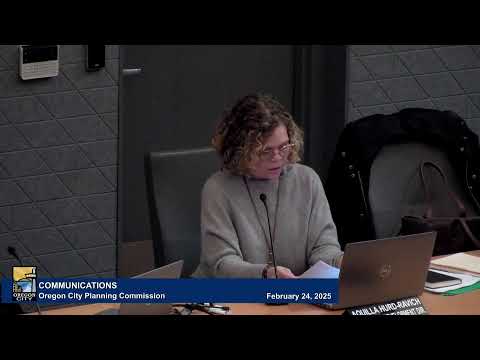
Carrie Richter, deputy city attorney, gave the Planning Commission an annual legal training at the Feb. 24, 2025 meeting, reviewing Oregon’s statewide land‑use framework, types of land‑use decisions, public‑hearing procedures, rules on ex parte contacts and conflicts of interest, public‑records obligations, and recent housing‑law developments.
Richter told the commission that Oregon has a statewide land‑use program created in large part by Senate Bill 100 in 1973 and implemented through the Oregon Revised Statutes and the Department of Land Conservation and Development’s acknowledgement process. She said local comprehensive plans implement statewide goals and must include a 20‑year projection of growth and infrastructure needs.
Richter explained the difference between legislative (long‑range planning) decisions — where the City Commission adopts policies or code amendments that apply broadly — and quasi‑judicial (development review) decisions, where the commission applies existing criteria to a specific application. She summarized Oregon City’s types 1–4 procedures, noting that type 3 discretionary reviews typically involve public notice, a Planning Commission hearing and appeal rights to the City Commission.
On procedure, Richter reviewed the completeness check (30 days for a local completeness determination) and the 120‑day “decision” deadline that begins when an application is deemed complete; she noted applicants may extend that timeline but the city must act within the statutory period unless the applicant agrees otherwise. Richter described the evidence sequence at hearings — applicant presentation, testimony in favor, testimony in opposition, applicant rebuttal — and explained that parties have a right to request a continuance at the initial evidentiary hearing.
She emphasized that the applicant bears the burden of proof to show approval criteria are met and that decisionmakers must base decisions on evidence in the record, not personal knowledge or outside information. Richter explained ex parte contacts (communications or information outside the public record) must be disclosed at the hearing and encouraged commissioners to forward any media or outside materials to staff so staff can place them in the record. She noted decisionmakers must be free of actual bias and must step aside when a pecuniary conflict of interest exists.
Richter also covered public‑records and public‑meetings rules, warning that a quorum discussing city business outside a noticed meeting (including “serial” emails or reply‑all chains) can create an unlawful public meeting and that notes and other writings relating to city business may be public records. She noted the city has procedures to copy and maintain commissioners’ notes when they are part of the record.
On housing law, Richter summarized recent state requirements intended to encourage housing: standards, conditions and procedures for housing must be “clear and objective” (for example, numeric setbacks and height limits), and local standards may not have the effect, alone or cumulatively, of discouraging needed housing through unreasonable cost or delay. She described the “fixed goalpost” rule: standards in place when an application is deemed complete generally control the review even if the city later amends the code, subject to specific statutory provisions.
Commissioners asked questions throughout the presentation on topics including how to handle ex parte contacts, when a commissioner should step down for bias or conflicts, the completeness review timeline, and whether land‑use approvals transfer to new owners. Richter answered that approvals are generally transferable within the permit’s time limits and clarified that Oregon City code currently provides a three‑year expiration for approvals unless building permits are submitted and issued per code timeframes.
Richter closed by encouraging commissioners to ask questions, disclose contacts early in hearings and forward any outside materials to staff for inclusion in the record.